Segment 3 of 4Word Count 46,422, 160-minute Reading Time with ~400+ Images
Note that I am continually updating this entry with new information and corrections as I discover them during my on-going research into Jekyll Island’s History.
Sidebar 5: The Unintended Consequences of Dredging Waterways Around Jekyll Island
The On-Going Movement to Upscale
The Georgia State Ownership Era, Part I: 1947 to 1980Main Body of Segment 3, Part I
Main Body Index
The Jekyll Island Club’s Closure & State Acquisition[Link]
The Jekyll Island Club Hotel and Events in the Early State Era[Link]
A Deeper Dive Into The State-Owned Era: 1947 to 1980[Link]
Viewing Suggestions & Recommendations
Scaling: Given the WordPress typefaces, type size and formatting — never mind the length and all of the images — my compilations are best viewed on a larger desktop computer flat screen monitor, with perhaps a zoom setting of 110% or 125%, as it will make it much easier to read, especially for the current year values in superscript that follow then-year dollar amounts.
Hyperlinks:You’ll find hyperlinked text in the various tables of contents for the main headings and sidebars that can be used to ‘jump to them’ vs. trying to scroll to them. You’ll also note the major section headings in each table and sub-table of contents that appear in blue text are also hyperlinked. And, throughout the ‘document’ you’ll find typically blue hyperlinks that can be used to jump-back to the tables of contents and indexes to speed-up navigating forward and backward in the document.
Like all hyperlinks, you just merely need to move your cursor and ‘hover’ over the blue colored text, and if the cursor changes to a hand with the index finger extended, you can click on it you will be taken to that section of the document.
Links to Other Internet Sites: You will also sometimes find Blue Bolded and Underscoredarticle names or other outside sources that I have mentioned inside the body of a paragraph or in “Notes” that indicates they are links to that article or source. Once again, like other hyperlinked text, you just merely need to move your cursor and ‘hover‘ over the blue colored text and if the cursor changes to a hand with the index finger extended, you can click on it you will be taken to a new window with that source.
Images: In many cases, unless it’s obvious from the accompanying text what an image is related to, I have usually used bolded text in the body of the document next to the image that helps explain it. And, to make the images easier to see, I’ve done my best to ensure a larger and scalable image of every embedded image in my compilations can be opened with a click in a new window to provide far-greater detail, from which you can further increase its size using the scaling features on your computer or digital device. As it is for hyperlinked text, you just merely need to move your cursor and ‘hover‘ over the image and if the cursor changes to a hand with the index finger extended, you can click on it and the image will open in a new window.
Sources
I will note, given other demands on my time and the overwhelming details I learned about the State Owned Era — especially from Nick Doms exceptional and highly-detailed book, From Millionaires to Commoners, The History of Jekyll Island State Park— I struggled with this segment on the State Era and took an 8-month break beginning in the Fall of 2023. It was not until August 2024 that I resumed work, only to find once again there was just so much that has occurred —much of it requiring checking and back checking, with quite a bit of discovery in the process — that it once again began to consume far more time that I had envisioned. I began a second break between the winter of 2024 and summer 2025 that has further delayed completion of the State Owned Era segment(s).
However, I would be remiss if I did not clearly state I borrowed heavily from the following invaluable sources to create this personal blog entry, to which I have referred over and over again..
My compilation of historic information and images is something I enjoy doing as purely a hobby, if only because like most well-documented research papers — as we were as students required to produce in high school and college — that committing what I learn to a written and illustrated product, I find it far easier to recall that information.
I especially enjoy having done so when we visit the island and have reason to apply what I’ve learned to things we see or during conversations we have with other folks whom we meet on the island during our visits. The latter often times sends me back to my blog entries to either add additional information, or make corrections based on new information that comes to my attention. And, that is something I deeply appreciate as I’d like to “get it right” instead of merely passing along urban legends and ‘approved‘ history versus the real history of things that interest me.
A Note on Inflation Adjusted Values
I gain a far better appreciation for the cited costs of things in the past when I adjust them to current-year values to help add context to the expense or value of things based on the current, equivalent cost.
However, given the time lag between my Jekyll Island Segments 1 and 2 written in 2023 and Segment 3 written in 2025, and Segment 4 that will be finished in 2026, the State Era Parts I and II use 2025 $’ values. Therefore things such as the $675,000 paid for Jekyll Island by the State of Georgia that was shown as $9,223,047 in 2023 $’s is now reflected as $9,717,919 in 2025 $’s. Of course, the same is true for the ups and downs in inflation and adjusted dollar values between some ‘then years’ driven by economic factors over time, especially when deflation was more common between the 1800’s and 1950’s.
Sidebar 1: How to Eat An Elephant
Yes, there’s a lot of material in my Part I of the Jekyll Island State Era, as you can see just with the table of contents for the Overview that follows. Never mind, my attempts to look at the evolution of the island at a high-level with both illustrated graphics and photographs to add context and color to what is admittedly a fairly long overview.
But, given we’re looking back over the 78-year history of Georgia’s state ownership of Jekyll Island — noting the Jekyll Island Club Era history was only 56-years before closing on 5 April 1942 — there’s a lot of material to cover.
Moreover, in addition to the island’s development under the auspices of the Jekyll Island Authority on behalf of the State of Georgia since 1950, there have been several issues that warrant a closer-look, if only to ensure the same poor decisions– or at least in hindsight, what appear to have been poor decisions — are looked-at and learned-from as “Lessons of History” so they are not repeated in the future.
The Overview & Issues: For some casual readers, perhaps only the Overview is all that may be of interest, as it hopefully provides a high-level view of how Jekyll Island’s landscape has changed during the State Era — literally and figuratively — as the State Park developed the roads, altered the dunes, developed businesses, guest lodging, recreational and convention amenities as well as residential neighborhoods.
Note that the Overview also reaches into the still in-work ‘Part II of the State Era: 1980 to Present’ to touch on the restoration of the Jekyll Island Club Hotel, San Souci Apartments and other Historic District structures as well as to some development proposals in the 2008-2009 timeframe that thankfully never came to pass.
The Main Body of Segment 3: If you use the hyperlinks to ‘jump’ to the Table of Contents you’ll find there are actually three sections, each with its own Table of Contents.
The Jekyll Island Club’s Closure & State Acquisition – This may be of value to those who may be interested in my take as to why the Jekyll Island Club closed by 1942 — which can be skipped those who remember it from the Club Era History in Segment 2 — as well as a look at how and why the state used the condemnation process to acquire the island and the political implications for Governor M.E. Thompson’s actions and those of Governor Herman Talmage who followed Thompson and put in place the Jekyll Island Authority Act that created the JIA who — at least as recently as 2009 — was still wresting with the development on the island.
The Jekyll Island Club Hotel and Events in the Early State Era – For those who may want to know more about the early years of the JIA and some of the aforementioned mistakes covered in the Overview & Issues section, as well as other early changes made to the island and it’s initial operation from 5 March 1948 through 10 September 1951, this may be of interest albeit with some repetition from the Overview at State Acquisition section included for context and continuity.
There’s also a little about the funding and construction of the Jekyll Island / Downing E. Musgrove Causeway and the Jekyll Creek lift-bridge, as well as the early building boom on the island, subsequent issues with Senator Jimmy Dykes and why the term “Dykes Island” came about.
Finally, it looks at how the Georgia Historic Sites Survey office in Atlanta was instrumental in putting Jekyll Island’s historic sites and structures on the National Register of Historic Places and National Historic Landmark District in the 1970’s as the Jekyll Island Club Hotel and San Souci Apartments fell into disrepair and were closed in 1971, and a look forward at how attorney Vance Hughes and architect Larry Evans essentially ‘saved’ the Jekyll Island Hotel and San Souci from likely demolition, with the help of Leon N. Weiner & Dave Curtis of Leon N. Weiner and Associates, as well as many others.
A Deeper Dive Into The State-Owned Era: 1947 to 1980 – This is for those with a lot of time on their hands who may have enjoyed or learned new things from the previous sections described above that delves deep into the first 33-years of the State Era.
All told, there are 77-sections listed in just this section’s Table of Contents. Therefore, readers can expect to find both new information, as well as seeing information, images and graphics from the previous sections, once again included for context and continuity.
As to the full proverb / metaphor “How do you eat an elephant?” One bite at a time.
As mentioned in my introduction to this series, my wife and I honeymooned at Jekyll Island in July 1993, and spent most of our time in the Historic District. Access to the island was still made by crossing the 1954-era Jekyll Creek lift-bridge, as the current M.E. Thompson memorial bridge wouldn’t be built until three years later in 1996. The beach area at that time consisted of a combination of closed or ‘tired’ hotels & motels built during the 1960’s and 1970’s, as well as an early version of a beach village.
Reference the below image1, for readers who are not familiar with the overall ‘layout’ of Jekyll Island, I decided to start off with this satellite image of the Island. It is one I have used several times with different annotations throughout my State Era Segments to orient readers as to where the places I make mention of are located in relation to each other on seven-mile long and 1.5-mile wide island.
Note 1: As with almost all of the images you’ll find in my compilations, they are hyperlinked such that they can be clicked-on and larger versions of the images will open in a new window that can usually be further enlarged as needed.
Moreover, I use many other closer-up satellite images to accompany my comments, but often times shown with different compass-based orientations, e.g., the above, overall satellite image of the island is shown using a ‘West-Northwest Up’ orientation, if only because it was the ‘best fit’ for the graphics.
In doing-so, as with this overview image, I try to make the point that the “center of the world” on Jekyll Island was quite different than it is today. In the Club Era, “Stable Road” crossed what is now Beachview Drive 450 feet to the North of the current “Stable Road”, and a half-mile North of the round-about at the entrance to the current Beach Village. In fact, during the Club Era what is now Beach Village would have been where the 11th, 12th and 16th holes of the 1928 Oceanside / Great Dunesgolf course ‘back-nine’ were located.
Beach Village, circa 1993
January 1993 Satellite Image, looking East
The center piece in the State Era was the 1961 Aquarama heated, in-door pool with its iconic, triangle-shaped enclosure that was removed in 1988, and by the end of 1993 the pools had also been removed and backfilled.
It is by no coincidence that the Summer Waves Water Park on the southwestern side of the island and first opened in 1987 had quickly become Jekyll Island State Park’s very successful summer season water attraction.
Nearby was the 1970’s era conference center and on the opposite side of Beachview Drive was a pair of 1960’s era shopping centers, all surrounded by a sea of asphalt parking lots, where several landscaped islands were added to soften the look at some point.
A Flashback to the 1970’s when the Aquarama was still an indoor, heated “almost” Olympic size pool.
The Evolution of Sub-developments on Jekyll Island State Park
The Six Initial Sub-developments on Jekyll Island
Several of the 1960’s and even 1970’s State Era beachside structures that were still standing and in use to some extent by the time of our first visit in 1993 were in need of renovation. To that end, the three hotels / motels located south of the current Days Inn & Suites by Wyndham Jekyll Island — the 1961 Georgia Coast Inn 2, 1971 Holiday Inn and 1961 Buccaneer — would eventually close and be razed between 2005 and 2007, and two of the three would become the new communities of the Ocean Oaks in 2018 and Seaside Retreat currently being developed in 2025.
Note 2: The Georgia Coast Inn was originally the first Holiday Inn on Jekyll Island, then acquired by and renamed the Stuckey Inn in 1963, then became the Atlantic Carriage Inn in 1970. It was next acquired by Ramada Inn Corporation in 1980, but continued to operate under the Georgia Coast Inn brand. It encountered financial issues after the Ramada Inn Corporation dropped the brand and it eventually closed in 2002 and went into bankruptcy in 2004.
However, before I get ahead of myself, I’d be remiss if I didn’t mention Jekyll Island State Park’s six residential sub-developments, laid-out and with development beginning in the 1950’s: Beach, Oak Grove, Palmetto, St. Andrews, Pinegrove and Old Plantation.
As the JIA moved closer to re-opening the island while work on the Jekyll Creek lift-bridge was on-going, residential lot lease applications fell well short of expectation.
When the JIA’s Master Plan was developed, it called for leasing 750 lots per year with a goal of achieving a grand total of 2,000 leased lots for both commercial and residential purposes.
Initially, residential lots inland and without beach views were assed fair-market lot values that yielded an annual rent fee of $100 per year $1,204 in 2025 $’s, while those with beach views, corner lots and those that could be used for multi-unit dwellings were accessed a $400 per year $4,817 in 2025 $’s lease rent fee.
However, by 1960 the Island had just over 21 adults as permanent residents, with between fifteen and twenty school-age children. As of 1961, only a total of 97 homes had been built on lots leased from the JIA, but by 1964 that number had increased to 326, and as of 1989 there were 733 permanent homes built on lots leased from the JIA on the island.
More Recent Re-Development
It was also in 1989 when the Villas By The Sea became a community and added a few additional permanent residences, but it was in 2015 when the JIA began to approve new, additional ‘communities’ with permanent residents in earnest:
As noted, the first ‘new community’ since the 1950’s came when a portion of the 1973 By the Sea Hotel was converted to a condominium / hotel Villas by the Sea arrangement in 1989.
Jekyll Island State Park gained it’s next, new residential community in 2015 when the 1971 Sand Dollar Hotel was demolished and replaced by the 123-unit “The Cottages” townhouse and single family home development.
Next was the demolition of the 1972 Holiday Inn, where the southern-most portion was replaced by the Hampton Inn& Suites in 2010, but with the northern two-thirds replaced by the 36 single-family home Ocean Oaksdevelopment in 2018.
In 2023, the all new Moorings was built, a 39-condominium and 9-townhouse re-development of land originally cleared for a second dry boat storage building near the Jekyll Island Marina that was never built.
Now under construction is the 25 single-family home Seaside Retreat re-development of the former 1961 Buccaneer Motor Lodge property.
The Growth of Leased Home Sites and Population
Per the 2020 U.S. Censusand other reports based on the 2020 Census, Jekyll Island had a population of 1,078, with 659 households living in 1,434 housing units, of which 752 and single detached homes, with another 682 multi-unit structures.
I’ll delve into some of the home and resident count numbers well-down in the main body of this State Era, Part I Segment as a sidebar, noting that at times — even with the U.S. decennial census legally mandated by the Constitution data published by the U.S. Secretary of Commerce’s U.S. Census Bureau every ten years — the numbers get a bit ‘fuzzy’. The latter is driven by the somewhat fluid nature of Jekyll Island’s permanent, semi-permanent and seasonal residents, coupled with the total number of homes used as rental properties as well as multi-dwelling unit structures, e.g., duplexes, apartments and condominiums.
The Cost of Homes on Jekyll Island
On Jekyll Island, residential lot lease rents are calculated at 0.4% of the land’s fair market value annually, meaning the exact amount varies depending on the specific lot’s value. For example, a lot with a fair market value of $215,000 would have an annual lease rent of $860. In addition to the annual lease rent, owners are also responsible for property taxes —which in Glynn County are fairly high — as well as maintenance and utilities and in the newer communities monthly HOA fees, etc. Like many homes in recent years, asking prices for homes on Jekyll Island have sky-rocketed, but dropped quite a bit during 2025.
While there is still a sea of asphalt parking lots, at least to us they seem to have been‘better integrated‘ with green space in the current ‘Beach Village’. Moreover, they’ve used landscaping that will continue to grow and provide natural shade to the parking, shopping, dining and conference center area. The Beach Village is also now home to three of the five newer hotels on the island that share the southern end of the beachfront with the sole-surviving, renovated 1960 era, now Days Inn & Suites by Wyndham Jekyll Island.
The Evolution of the Hotels and Motels Built Before the 1980’s
Lodging on the North End of the Island’s Beachside
The three motels built on the“north end” of the beach in the late 1950’s — Jekyll Estates, closely followed by the curiously-named Wanderer Motel4, and the Seafarer – Apartments / Motel — have gone through several different owners, renovations and rebranding. The Jekyll Island Estates now branded as the Beachview Club Resort, was recently acquired by Hilton Corporation and is now undergoing a renovation and addition of a third wing. The Wanderer is now owned and operated as the Holiday Inn Resort Jekyll Island by IHG, and the Seafarer – Apartments / Motel is now the Best Western Plus – Seafarer Inn & Suites. They remain motor-inn / motels with outdoor access to each room / apartments.
Note 4: As noted in a sidebar regarding the The Wanderer Incidentin Segment 1 of this anthology, during a storm on 29 November 1858 a ship named the Wanderer owned by Savannah businessman Charles Lamar, was diverted to and unloaded its contraband cargo of 409 enslaved people on Jekyll Island. This was one of the last cargoes of African slaves brought to the United States. The incident is noteworthy because the Federal Slave Importation Act, passed in 1807 and effective on 1 January 1808, had banned the foreign importation of enslaved people to the United States. News of the Wanderer’ landing off the coast of Jekyll Island and its cargo quickly spread across the country and contributed to the sectional tensions between the North and the South that would soon lead to secession and the Civil War.
They were joined in 1971 by the “Sand Dollar Motel” that was razed in 2015 and redeveloped into “The Cottages” at Jekyll Island, a $500K $683,444 in 2025 $’s plus townhome and single family home development. More recently, current listings for re-sales reflect homeowners asking prices in the high six-figure to mid-million dollar range.
In 1973, the “Villas by the Sea” Motor Lodge was opened, and after making several annual requests to do-so, in 1989 the JIA approved their conversion to a semi-condominium / hotel complex where condominium asking prices are currently in the $250k to $500k range.
Lodging on the South End of the Island’s Beachside
Four new hotels were added to the southern end of the beachfront since 2010, after the 1972 Holiday Inn Beach Resort was razed. About one-third of southern-most end the former 1972 Holiday Inn’ footprint was replaced by the Hampton Inn & Suites in 2010, and in 2018 the other two-thirds were replaced by the 36-single family home Ocean Oaks sub-development.
The Marriott dual-branded Courtyard & Residence Inn opened in 2021 was a direct replacement for the 1961 Holiday Inn’s footprint after it was razed in 2005, and two of the other five motel sites were converted to the previously mentioned Ocean Oaks and Seaside Resort single family home communities.
The former 1959 Dolphin Inn site located at the southern, St. Andrews Beach end of Jekyll Island was repurposed as part of the Georgia 4-H at Camp Jekyll on Jekyll Islandin 1966.
The 1959 Dolphin Inn properties were subsequently razed and replaced in 2015 by a new 4-H staff dormitory, guest cabins, a dining hall and learning center complex anchored by the historic 1955 St. Andrews Beach Pavilion on Jekyll Island as part of the redeveloped 4-H compound operated as a University of Georgia Extension program as is the 4-H Tidelands Nature Center.
The following graphic provides a summary of the initial development of each motel and hotel through the 1970’s, as well as their subsequent evolution and the current state of the land on which they were built.
Some who are far-more familiar with and lived through the Georgia State Owned Era have drawn parallels between the the sometimes erratic-seeming actions and decisions by the JIA made in the development and business arrangements over the years to the the split personality captured in the 1886 novella, The Strange Case of Dr. Jekyll and Mr. Hyde. The latter is sometimes invoked as a colorful metaphor for some of the directions in which the Jekyll Island State Park has been taken over the years.
Sidebar 2: The JIA and Jekyll & Hyde Metaphor
For those who don’t know much about Robert Louis Stevenson’s novella beyond movies made based on the story, Stevenson first came into fame in 1883 with his publication of Treasure Island.
For Dr. Henry Jekyll, Stevenson named the benevolent and respected doctor whose surname he borrowed from his good friend and clergyman Walter Jekyll — and is correctly spelled with two ‘Ls —was pure coincidence with that of Jekyl Island.
Stevenson’s character Mr. Edward Hyde was based on an acquaintance named Eugène Marie Chantrelle, whom he first thought was a normal, civilized, well-educated man. It was only later Stevenson learned Chantrelle was a sexual predator capable of killing without the slightest moral qualm, hence he became Mr. Hyde.
In addition to the name and ‘good and evil’ split-personality, yet another coincidence was that the novella was published in 1886, the same year the Jekyl Island Club was founded.
The Good…
While there were arguably several poor decisions made by the State and Jekyll Island Authority (JIA) over the 78-years since it acquired and took on the management and development of Jekyll Island as a State Park, my wife and I have found the island to be a very enjoyable place to visit. We enjoy it so much that we visit several times a year, despite the 350-mile / five-and-a-half hour drive that takes us on Interstate 75 through the sometimes frustrating if not gridlocked Marietta, Atlanta and McDonough traffic.
Being only a visitor and not a resident, the current-state of the island ‘seems to have’ achieved a balance of accommodations, amenities, and thankfully not fully-exceeded the 35% threshold for development of the island, aka, the now obsolete 35/65 rule mandated in the 1950 JIA Authority Act.
The latter held true even after the 35/65 rule was lifted to a 50/50 rule in 1953 through 1971, when it was prudently restored to the 35/65 rule. For those who may not know, it is now set at a fixed number of 1,675 acres that can be developed, of which less than 78 acres that could still be developed remained as of 2014 when the fixed number was adopted into Georgia State Law.
Sidebar 3: The 2014 Change of the 35/65 Rule to a Fixed Cap of 1,675 Acres
If it were not for an intervention in 2008 by a University of Georgia (UGA) PhD student working on an environmental study, irreparable harm could have been done to the island vis-à-vis over-development.
To conduct his study, he used overhead, Laser-based Light Detection and Ranging (LiDAR) technology to map the island and established the actual remaining undeveloped land was only ~55-acres, whereas it was the JIA’s belief they had 108 undeveloped acres remaining to support their plans. The JIA’s fundamental miscalculation was tied to the use of the previous and incorrect 1996 JIA Master Plan that used outdated Georgia Department of Transportation maps and also erroneously including 65 and 1/3 acres of man-made water hazards on the golf courses as ‘undeveloped’ land.
The question of the total number of remaining undeveloped acres of land available to use was raised again in May 2013 when, after a task force established to update the Jekyll Island Master Plan came to the conclusion that most of the previous estimates of how much undeveloped land remained were inconsistent: the issue was the previous use of “dry land at high tide” that allowed for the inconsistent inclusion of marshlands in the total landmass of Jekyll Island.
On the basis of those findings, it was decided to do-away with the subjective 35/65 rule in place since 1971, with a compromise measure that established a fixed cap on 1,675 total acres of land that could be developed on Jekyll Island. The latter is codified in both Georgia Senate Bill 296 passed in February 2014, with the same language in House Bill 715 passed in April 2014, and then adopted into the 2014 Jekyll Island Master Plan.
Of that 1,675 acres, all but 78 of those acres had already been developed by 2014, and both Bills and the updated 2014 Jekyll Island Master Plan sets out specific rules for how the remaining land could be improved: (A) twelve acres were set aside for expansion of the original Jekyll Island Campground that is underway; (B) 20 acres were available for “unrestricted uses”; and (C) the remaining 46 acres were designated to be used for “public health, public safety or public recreation.”
Once land is developed on Jekyll Island, it will always be considered developed, but may be re-developed which is what the more recent new hotel and residential projects have involved, as did the development of Beach Village, the Summer Waves Water Park and the 4-H Tidelands Nature Center’s Tidelands Pond, as expanded upon below.
In regard to the development and evolution of Jekyll Island State Park over the past 78-years, it can be argued as to whether or not the State still provides accessibility that meets the original guidelines included in the 1950 Jekyll Island State Park Authority Act.
Per the non-legally binding language in the Act, the stated goal was to ensure average Georgian’s across nearly all working and working-derived income levels were to be provided with the ability to access and enjoy the State Park and beach.
However, beyond being able to afford the current $10 per vehicle [or $15 for vehicles exceeding eight feet] ‘parking fee’ that enables all of its occupants to enter the State Park and enjoy access to the Historic District, beaches, parks, trails, fishing piers, and nature areas in the park, it is clear not every Georgian may be able to afford and enjoy equal levels of all the same overnight accommodations, hospitality and amenities provided by some of the upscale hotels and newer communities. Therein lies some level of disagreement as to whether or not the operation of Jekyll Island State Park is meeting it’s purported goals.
Sidebar 4: The Cost of Staying Overnight on Jekyll Island State Park
With regard to meeting it goal to provide access by average Georgians, concerns and tensions still exist in that the JIA appears to place a priority on the island’s high-end tourism trade and mostly taxpayer-funded, State-agency convention business to meet it’s mandate of being self-sustainable. In doing-so, fewer reasonably priced accommodations are less accessible to the average working and working-derived income level Georgia residents and families.
I say that as the U.S. national average daily rate (ADR) for hotels was $162.72 as of May 2025, while Jekyll Island’s $351.00 ADR is significantly higher than even nearby St. Simon’s Island with its ADR of $274.00. For comparison, this would be nearly three-times as high as a non-resort city like our own home town of Kennesaw, Georgia which has an ADR of $132.00-$138.00.
However, there are family-size residential property rentals available on Jekyll Island that on a per-person basis are a bit more reasonable, but carry hefty cleaning fees that almost warrant longer stays to amortize those fees. However, those extra nights carry significant resort-fees from the JIA and a 14% room tax, payable by all motels, hotels and private residence rentals.
For those interested, below is the August 2025 Jekyll Island Occupancy Report from the JIA’s monthly board meeting on 30 September 2025. It provides a count of the total rooms, occupation rate, ADR, Rev/PAR and revenue trends for the motels and hotels on the Island. Note that, to my knowledge, while they collect taxes and fees from Airbnb and other private residential rentals, they don’t appear to report on the associated rates, likely given the variability of full-time rentals, vs. part-time rentals, never-mind the ‘wink-wink, nudge-nudge’ below-the-radar part-time “accommodations” made to friends and families.
… the Bad and the Ugly
While there is a lot of goodness, I still have lingering concerns about the future of Jekyll Island State Park based on what I learned as I researched the history of the Georgia State Ownership Era and some of the decisions that were made during the development of the Jekyll Island State Park over the years.
Moreover, there appears to be quite a bit of ‘revisionist history’ in many of the articles, videos, and both published and oral histories provided to visitors about the State Park’s development.
One example I find quite often is where background is provided for the restoration of the dunes or loss of the 1928 Oceanside / Great Dunes golf course’s back-nine, routinely cited as being due to coastal erosion instead of having been excavated by the JIA to enhance the view of the ocean from Beachview Drive. It has been in turn, that island erosion has been greatly accelerated by the removal of the centuries-old, naturally formed dunes. All told, perhaps around five-miles of the Jekyll Island’s dunes that were present when the state of Georgia acquired the island were removed, such that there less than a mile of natural dunes left ‘mostly’ undisturbed between the South Beach Picnic Area and the Soccer Fields immediately to the north of the Georgia 4-H at Camp Jekyll.
Another is that the 4-H Tidewaters Pond was originally created for the 1980’s Ski Rixen / Rixen Pond, when in fact it was part of a failed-effort in the 1970’s to create a massive, 450-yacht luxury marina, which is true of the land where the 1987 Summer Waves Water Park is located.
To that end, the following are ‘summary-level’ overviews of a few of these and other development issues that I’ll expand on in the main body of this State Era, Part I Segment.
1950’s and Excavation of the Dunes: Early-on, the State made some dreadful, irreversible changes to the island’s ecosystem in the name of “making it more attractive as a resort” in an effort to generate more interest in the island and greater revenue from visitors, business owners, and residents via fees and lease rates.
One of the first and most devastating was while the park was closed between 1951 and 1954 when the JIA excavated ‘at least’ two-miles of the naturally formed dunes from the mid and north coastline of the island, including the dunes that sat between the beach and the back-nine holes of the original Walter J. Travis 1928 Oceanside / Great Dunes golf course.
More specifically, in the now nearly flat, two-miles of ocean front area that lies between the Days Inn & Suites by Wyndham Jekyll Island — just south of the current Beach Village and the Jekyll Ocean Club Resort — to what originally was the 1959 Jekyll Island Estates Motel — now known as the Beachview Resort — was excavated by the JIA in the early 1950’s, and then some.
Sidebar: The Excavation of the Great Dunes Back Nine & Replacement of the Tee House with the 1948 North Beach Pavilion.
The following is an ‘infographic’ collage I created in March 2026 to try and capture the progression of both the back-nine of the 1927 Great Dunes Golf Course after it was ‘deemed’ too far-gone to rebuild after the state of Georgia was trying to find its way in turning the private club island into a ‘state park’. From a March 2026 Facebook post to the ‘Friends of Jekyll Island’ Group wherein I attempted to provide a ‘walkdown’ of the Great Dunes back-nine golf course’s excavation and replacement of the Great Dunes “Tee House” with one of the first Georgia State Park’s and perhaps most-enduring ‘new buildings’…. the 1948 Pavilion, Beach House, Bathhouse and possibly an interim 9-hole Great Dunes front nine golf course’s clubhouse: that’s still a bit murky.
This is a busy Infographic that attempts to contrast: (A) the back-nine during the Club Era, with (B) the still standing Dunes & back-nine circa post 1948 after the State replaced the Club Era Tee House with a white Pavilion / beach house which is peeking-out to the right of the aircraft on the beach, and (C) the early 1950’s excavation of the dunes and back-nine south of the Pavilion and beach house.
Below that are at left, two-images from before and, and at right two-images after the Charcoal House restaurant and Big Dip Dairy Bar were added in 1956.
In reading Nick Dom’s excellent book on the State Era “From Millionaires to Commoners” he makes the point that at that time and era, doing something like removing the dunes, etc. to improve the view of the ocean from the ‘Perimeter Road’ — renamed Beachview Drive — while also providing the soil-needed to build up other roadbeds ahead of the installation of the Lift Bridge at the end of the causeway — also built using what we now know to be ill-advised techniques – probably made sense at the time.
But, it’s always interesting to find pre-1950’s images of the east coast of Jekylls amazing dunes that ran the entire length of the island that were removed from the north-end to former 14th and 15th holes were at the south-end of the back-nine where the Corsair motel was built in 1960, now remodeled and know as the Days Inn & Suites by Windham at Jekyll Island.
I say ‘at least’ as based on the image at right, it’s also apparent two-additional miles of natural dunes north of the Jekyll Island Estates Motel site were also removed to provide level direct line-of-sight of the ocean from the 1950’s Perimeter Road and to clear initially home-site lots for the the Beach residential sub-development that lies east of Beachview Drive and the coastline, and north what are now the “Cottages” and “Villa-by-the-Sea” developments located where at one time the original Beachview Drive was carved-out of the dunes.
The purpose of removing the dunes was to create unobstructed views from what became Beachview Drive to attract motel developers and potential residents to the beachfront lots, while also re-using the soil as fill for the island-side of the access roads from the soon-to-be-completed Jekyll Island Causeway and Jekyll Creek lift-bridge.
Quoting from page 55 of Nick Doms must-read “Millionaires to Commoners”, “The views must have been spectacular since no dune was left untouched, and one could amost touch the salty water from a slow moving car. The roadbed and hightide waterline are so close they almost seem to kiss and embrace one another with each incoming tide.”
It was in the late 1950’s when another ~1.1-miles of dunes were leveled between what is now The Cottages and where the Villas by the Sea meets the current Driftwood Beach.
Reference the image that follows, the purpose of that project was to relocate a portion of the 1954 Perimeter Road 5 400-feet to the west and away from the beachfront to where it is currently located, while also creating additional and valuable beachfront hotel lot property eventually developed into the 1971 Sand Dollar Motel and the 1972 By-The-Sea Motel.
Note 5: Those who are interested can still find 2/10th of a mile of the original, oceanfront Beachview Drive between the northeast corner of The Cottages and the southeast corner of the Villas by the Sea, as well as a short segment at the Driftwood Beach parking area where the 1954 and 1959 Beachview Drive split.
Also cleared of all brush and partially excavated in the early 1950’s was most of the original land along the Jekyll Creek side of the island between the wharf and where the airport now sits, to include the Club’s original 1897 Riverside nine-hole golf course that sat east of the Club EraRiver Road and north of Villa Ospo, noting it was originally just north of Hollybourne from 1897 until Villa Ospo was built between Hollybourne and the 1897 Riverside Course in 1927.
The 1897 Willy Dunn Nine-Hole “Riverside” Course
The 1897 Riverside course was one of the oldest golf courses in the United States and the soil was used to support the improvement of the old Club Era River Road into the 1950’s Perimeter Road which eventually was renamed “Riverview Drive.”
For those with an interest, an exceptional on-line 2020 work by Donald J. Childs entitled, “Forgotten Golf Courses of Jekyll Island: Designs from the 1890s to the 1920s” goes into amazing detail with eye-opening images and graphics about the early, Jekyll Island Club Era golf courses that’s worth a read, or at least a skim-reading.
1960’s-1970’s and the 450 Luxury Yacht Marina: Just a bit further to the south of the Jekyll Harbor Marina are the remnants of a flawed and failed 450-yacht, fresh and salt water marina project proposed and approved by the JIA in 1967. The artists concept also included several cross-island parkways and roads through the south-end, tidal forest in lieu of Riverview Drive which appeared to have been partially removed / replaced by parking for the marina and several picnic areas to the east of those parking lots.
The project was finally abandoned in 1976 after what I believe was intended to be the larger, 60-acre salt water basin was unsuccessfully dredged, as after repeated dredging it would quickly be refilled with sediment moving down Jekyll Creek.
The smaller, 23-acre fresh water basin that was successfully dredged also proved to be unusable for its intended purpose, but was re-purposed briefly in the 1980’s as a Ski Rixen, cable-based electric-powered tow system / water skiing attraction when the basin became known as Rixen Pond. It was in 1990 when the JIA acquired the assets of Ski Rixen which ceased operations in the early 1990’s.
The financially successful Summer Waves Water Park was subsequently built in 1987 and made use of a portion of the developed land located between the two basins, and the JIA was able to partner with the University of Georgia 4-H Extension on Jekyll Island.to repurpose the abandoned fresh water basin into what is now known as the 4-H Tidelands Center.
The 4-H Tidelands Nature Center opened in CY2000 to expand the Jekyll Island 4-H program’s reach and make educational opportunities and recreational use of the basin available to island residents and visitors.It is also a popular place to paddle and fish and Rixen Pond is now usually referred to as the Tidelands Pond.
For those unfamiliar with the picnic area, it sits just beyond the current 2010 Hampton Inn & Suites and 2018 36-home Ocean Oaks community that occupy what was once the site of the 205-room, 1972 Holiday Inn.
Thankfully, after a symbolic ground-breaking ceremony was held for the Sea Circus attraction at the still undisturbed natural dunes on the southern end of the island on 30 May 1971, bureaucracy, zoning and finance issues caused the JIA to withdraw its approval of the project in September 1973.
So, Just How Much of theDunes and Creekside Land Was Excavated?
As I wrote this, edited it and then re-edited it to capture new things I’d learned about, I began to develop my own time-line of the JIA’s “reshaping” of the island took place in the ‘early years’ of the Georgia State Park’s ownership and stewardship of the island. and quite honestly, in aggregate, it was a lot… like almost two two thirds of the island’s lands that separated it from the water that surrounded it on all sides.
Perhaps St. Andrews Beach is the least molested of all the coastal land that remains, if only because it was of little economic value to the JIA as a potential source of meaningful revenue, even though it’s the only ‘patch’ of the island that continues to grow in size due to coastal accretion, which has been significant at the St. Andrews beach end of the island.
The following is my attempt an creating a composite view of just how much man-made change has been made to Jekyll Island since the state of Georgia acquired the island in 1947. And, in aggregate, it’s almost all of the natural island’s coastline that has been ‘revised’ since the early 1950’s.
As a summarized walkdown:
A: What appears to have been one of the earliest revisions was removing all of the underbrush along the western side of the Club Era “River Road” that ran from the Historic District to the Horton House on the north end of the island. Although not stated in any of the reference materials I’ve used, I’m left to assume that like the oceanside of the island, the early leadership of the Jekyll Island State Park imagined that the draw to most potential visitors — never mind commercial and residential development interest — would be having unobstructed view of both Jekyll Creek, as well as the Atlantic Ocean. In looking at the dates when clearing or excavation work first began on the envisioned ‘Perimeter Road’ that would allow visitors who would arrive on the island in automobiles once a causeway and bridge were installed to link the island to the land, the easiest land to clear was the underbrush to the west of the Club Era ‘River Road”. And, such is noted in Nick Dom’s book, that the Jekyll Island Creekside of the land west of River Road was cleared and excavated to open up those views, while also providing “free” soil and sand to help improve River Road in advance of it being paved at some point where it would be joined with a road along the Atlantic Ocean to create a ‘Perimeter Road’ around the island.
B. The next piece of the island to fall victim the earth moving equipment moved to the island was the Back-Nine holes of the once legendary “Great Dunes” course. Per Donald Childs detailed “Forgotten Golf Courses of Jekyll Island: Designs from the 1890s to the 1920s” It was Robert Trent Jones, Sr, who was called in by the State of Georgia to determine the viability of the Club Era golf holes, and for some unknown reasons specifically the nine holes below Shell Road of the Great Dunes golf course. These were the back nine of the 1915 Oceanside course and were deemed to be in the worst shape. Quoting a 1947 a newspaper article: “The present owners laid out an 18-hole golf course, but the sea has claimed a great chunk out of the south nine. Most of the rest is under weeds” (St. Louis Post-Dispatch [Missouri], 18 June 1947, 33). Curiously,18 months later, in October of 1948, Jekyll Island hotel manager George H. Briggs Jr. was able to play all 18 holes of the Oceanside / Great Dunes course so some degree of renovation must have been performed to correct the purported erosion damage by the sea. Jones was thought to have regarded the historic Oceanside / Great Dunes course worthy of renovation, but its restoration did not necessarily conform to the vision –– such as it was — of the State of Georgia’s Jekyll Island State Park overseer’s list of priorities. Ultimately, the back-nine holes of the magnificent Great Dunes golf course were excavated from Shell Road south to the 14th and 15th holes of the course — which just happens to coincide with where the Corsair Motel was built in 1960 at the southern end of the Concrete Boardwalk build in 1957 that ran from thefirst motel built on Jekyll Island State Park, the Jekyll Island Estates, less a few hundred feet that had to be removed once the Corsair leased the land — — after the state cleared and leveled the dunes for potential commercial development that would generate more revenue for the State Park in the future.
C. Next was clearing the land north of the Jekyll Island Estate motel to open up oceanfront lots for the Jekyll Island State Park’s ‘Beach’ sub-development. When first cleared, the perimeter road made something of an ‘S-curve’ around the first lots staked-and leased in the Beach sub-development to create several oceanfront lots, before returning the perimeter road to it’s beachside location to provide motorists with a magnificent view of the ocean from their cars all the way to what was the North Island Picnic area that has been displaced by coastal erosion and is now what is called Driftwood Beach. Note that Driftwood Beach migrated from just east of the current Jekyll Island Clam Creek Fishing Pier some 1.5-miles around the northeast coast of the island to what was the 1950’s State Era North Picnic Area that is now recognized as “Driftwood Beach” by most writers, residents and guests to Jekyll Island: more on that follows in later sections of this entry.
D. Curiously, the rise of Civil Rights creates a situation where the JIA follows-through on it’s earlier 1951 Roberts and Company, Jekyll Island Master Plan where land had been cleared earlier in the decade for both a colored sub-development and other ‘separate, but equal accommodations’ on Jekyll Island for the St. Andrews Beach community and beach front Pavilion, beach house, 100′ concrete boardwalk and land for a hotel and restaurant. None of these structures would be built until the late 1950’s, delayed in part by the closure of the Island by the State of Georgia from September 1951 to December 1954. But, the clearing away of the land was completed in the early 1950’s, along with more of the lower-lying but still historic dunes.
E. Somewhat overlapping the alteration of the dunes on the south end of the island at what has become known as St. Andrews Beach, clearing lots on the land designated for the Beach Sub-Development continued and it wasn’t until 1955 when the first few homes had been built in the Beach sub-development, while the first home at St. Andrews would not be built until 1963 by Genoa and Mamie Martin.
F. It was in the late 1950’s when a few additional residential lots were added to the Beach Sub-Development, it was also in 1957-1960 when the JIA decided to relocate Beachview Road 400-fett to the west and away from the beachfront to where it is currently located, and in doing-so creating additional and valuable beachfront hotel lot property eventually developed into the 1971 Sand Dollar Motel and the 1972 By-The-Sea Motel.
G. During the 1960’s, hotel development on the south end of the beach moved along and land beyond the back-nine of the Great Dunes golf course where the Corsair Motel was built was partially developed for 1961 Buccaneer Motor Lodge, 1961,the 1961 Holiday Inn, 1961 — acquired by Bill Stuckey & Renamed Stuckey’s Carriage Inn in 1963 — and the 1972 Holiday Inn Beach Resort where portions of the historic dunes were once again raised to make room for the hotels, as well as beach views for at least the Buccaneer and 1961 Holiday Inn. Oh, and lets not forget about developing the third “South Dunes Picnic Area” at its current location, having been moved first in 1960 for the Corsair Motel and the again in 1961 for the Buccaneer Motor Lodge which also required disruption of the natural dunes.
H. Thankfully, the proposed “Sea Circus” initially JIA approved development of a ‘Sea World-like’, six-acre oceanside “superaquarium‘to be built just past the current South Dunes Picnic Area never came to be, as that would have consumed a good portion of the only, undisturbed pre Club Era natural Jekyll Island dunes.
I. The section tagged as “I” is part of the “I, J, K” trio of land the JIA attempted to develop in the 1970’s as a 450-luxury yacht marina that despite millions of taxpayer dollars spent on it, never could be completed. Nature fought-back with sediment from Jekyll Creek that backfilled both the large, salt water marina “I” that made the adjacent freshwater marina “J” irrelevant as well as the parking areas and Marina Clubhouse “K” irrelevant. However, by the 1980’s the freshwater marina “J” was repurposed at the “Ski-Rixen” water skiing attraction that was somewhat successful, but eventually taken over by the JIA and then closed when they developed the “Summer Waves Water Park” on the Marina Clubhouse land “K” that never was fully-developed. Today, the Summer Waves Park continues to remain a viable attraction on Jekyll Island, while the Ski Rixen Pond was taken over by the UGA Extension Program’s 4H Club’s Tidelands Nature Center and also remains a viable attraction on Jekyll Island.
1950’s – 1980’s, The Jekyll Island Club Hotel’s Fall From Grace
The Early Operation of the Jekyll Island Club Hotel & Eventual Closure in 1971
The and JIA attempted to operate the former Jekyll Island Club and surrounding Historic District as a public resort, but struggled to make it financially successful. Although initially well-managed by the Whitaker family from May 1949 to January 19516, the State Park was closed to the public in 1951 until the causeway and Jekyll Island Creek lift-bridge was opened in December 1954.
Note 6: The Whitaker’s personally operated the hotel and the State Park and met all of their obligations to the JIA, while bearing the significant financial losses incurred in doing-so on good-faith after multiple delays in making the island accessible via a promised causeway and a lift-bridge by 1950 failed to materialize.
Ahead of the reopening, the Jekyll Island Club Hotel and Historic District lease was then initially and purportedly without knowledge granted to Georgia State Senator Jimmy Dykes in the mid-1950′. The so-called “Dyke’s Island” tumultuous lease period was terminated in 1959, and granted to the the Seaside Investment Company that managed the Wanderer Motel, co-owned by Albert Crews of the Crews Restaurant at the Wanderer motel.
The Georgia Historical Commission’s Role in Preserving the Jekyll Island Club Era Structures
However, working in the background was William R. Mitchell Jr., the Director of the Georgia Historical Commission’s Georgia Historical Sites Survey based in Atlanta, Georgia, who was instrumental — if not the catalyst — for placing the Horton-duBignon House/ Brewery Ruins, and duBignon Cemetery on the National Register of Historic Places(NRHP) on 28 Sept 1971.
It was in May of 1971 when Ken DeBellis — a member of Mitchell’s Jekyll Island State Park: Georgia Historic Sites Survey Staff in Atlanta who eventually became a member of the JIA staff overseeing the the development of the 1974 Master Plan for restoration of the Historic District — prepared and submitted a National Register of Historic Places – Nomination Form for the 240-acre, Jekyll Island Historic District and all major structures located therein in May 1971. The NRHP status was granted and Jekyll Island Historic District was added to the NRHP on 20 January 1972.
Despite It’s Historic Significance, the Jekyll Island Club Hotel was Closed by the JIA in 1971
Ironically, it was also in 1971 when the JIA made the decision to close the Jekyll Island Club Hotel and the San Souci Apartments, having focused most their efforts since acquiring Jekyll Island on creating a beach resort that could compete with privately-operated resorts along the Southeast U.S. Atlantic coast.
However, unlike the private commercial resorts that were profit driven enterprises, Jekyll Island was a government-owned State Park managed by the JIA whose mandate was to ensure the park was financially self-sufficient.
The JIA had in attempting to do-so, approved the construction of what by 1971 were seven beachfront motels with 744 beds over the previous twelve years, with another three more motels to be opened between 1971 and 1973, adding another 644 beds. Therefore, the JIA had in many respects ensured the operation and associated maintenance costs of the state-owned Jekyll Island Club Hotel and the San Souci Apartments would never be financially self-sufficient to support meeting their mandate for the Jekyll Island State Park given all of the competition from “new” beach front motels.
The 1971 closure of the Jekyll Island Club Hotel marked the end of the State Era’s direct involvement with these these architecturally and historically significant buildings that sat vacant and essentially unsecured for over a decade. Moreover, the costs for repair, maintenance and upkeep of the Jekyll Island ClubHotel nor the San Souci Apartments were included alongside new funding acquired in the 1970’s for other restoration efforts by the JIA in the Historic District. It wouldn’t be until the Jekyll Island Club Hotel and San Souci Apartments would be given a 55-year lease to Leon N. Weiner & Associates in 1985, leading to their renovation and grand reopening as the Jekyll Island Club Hotel: A Radisson Resort in March 1987.
In regard to what work was done in the Jekyll Island Historic District while the Jekyll Island Club Hotel and the San Souci Apartments languished, in reviewing the March 1972 JIA Board of Directors Meeting notes, the JIA planned on allocating $675,000 $5,231,669 in 2025 $’s in bond funds for the restoration of the Jekyll Island Historic District, on par with funds for a new marina and golf-course projects. By August 1975, $300,000 $1.8-million in 2025 $’s of those funds had been consumed by various restoration projects and was yielding the desired improved aesthetics and utilization of Club Era cottages and other buildings as the Jekyll Island Club Hotel and San Souci Apartments continued to fall further into disrepair.
The 1975 Master Plan for Restoration of the Historic District and It Becomes a National Historic Landmark District on 2 June 1978
Roger Beedle, a retired DuPont engineer and preservationist for the JIA from 1968 until 1978, is owed a debt of gratitude for his efforts along with those of Ken DeBellis for the development in 1975 of a master plan for the restoration of the Historic Village Area, aka.Jekyll Island Club Village, Old Village or Millionaires Village that included recommending greater use of the cottages and other buildings in the Village be utilized during its renovation that culminated with a grand re-opening of the Village in the summer of 1977, less the Jekyll Island Clubhouse, Annex and San Souci Apartments.
Despite the State of Georgia and JIA allowing the Jekyll Island Clubhouse, Annex and San Souci Apartments that sat at the center of the Historic District to become run-down, the Jekyll Island Club Historic District was designated as a National Historic Landmark District on 2 June 1978. In this regard, it was recorded in the October 1978 JIA Board Meeting Minutes that a representative of the U.S. Department of the Interior had come to Jekyll and presented the official bronze plaque designating Jekyll Island’s Club Village as a National Historic Landmark District.
Visitors can find the Jekyll Island Historical District’s National Historic Landmark plaque to the west of the original lobby area near the pool at the Jekyll Island Clubhouse and its Grand Dining Room which sits next to one of two Millennium Time Capsules on the island, the one dedicated by the Jekyll Island Museum and Friends of Historic Jekyll Island that was placed and sealed on 31 December 1999, to be opened on 31 December 2049, New Year’s Eve of January 2050.
A Look Ahead at Part II of the State Era: 1980 to Present & the Jekyll Island Club Hotel Restoration
The Jekyll Island Club Hotel is Restored During 1985 & Reopens on 17 March 1987
Although to be covered in detail in my future Part II in Segment 4 covering the State Era from 1980 to present, it’s noteworthy that after sitting dormant and unmaintained by the JIA since it was closed in 1971, the Jekyll Island Clubhouse, its Annex and the San Souci Apartments were essentially saved by a chance visit to the still closed Jekyll Island Clubhouse Hotel in December 1983.
It was attorney Vance Hughes and architect Larry Evans — good friends since high school in Calhoun, Georgia, with an interest and passion in the historic value of the Jekyll Island Clubhouse — who out of curiosity came to Jekyll Island State Park and who — like many visitors before them — walked-past the unsecure fencing surrounding the hotel, climbed through an unlocked window and became smitten with the neglected, deteriorating historic structure.
Fearing it might easily become slated for demolition by the State of Georgia given it’s poor condition and the likely cost to renovate, they decided to develop a proposal for the renovation of the Jekyll Island Club Hotel, Annex and San Souci Apartments to present to the JIA for possible approval and support.
Fortunately, when they presented the idea to then JIA Executive Director George Chambliss they were met with enthusiasm for the project and helped to set-in-motion a series of events, as well as some high-risk career and life changes for Hughes and Evans who left successful legal and architectural firm positions and, instead, began working as independent legal and architect professionals so they could dedicate more time to their project.
After forming what was initially called the Circle Development Corporation, and later Jekyll Circle, Ltd. they were eventually put in touch with Leon Weiner and Dave Curtis of Leon N. Weiner & Associates (LNWA) in 1985. The new relationship with LNWA continued the series of events as well as wide-reaching investor interest and local, state and federal agency cooperation that lead to an amazing, $20-million $59-million in 2025 $’s restoration of the Jekyll Island Clubhouse, its Annex and the San Souci Apartments during calendar year 1986.
The challenges were significant as were the myriad of other things that enabled the renamed Jekyll Island Club Hotel: A Radisson Resort now with a combined 134 rooms —noting the eight apartments in the San Souci were further sub-divided into four guest rooms and suites for a total of 24 rooms — to have a soft-opening in December 1986. The latter was a key milestone, given that much of the private financing had been arranged tied to a tax-based incentive program that expired at the end of 1986.
The Jekyll Island Club Hotel held its Grand Opening later on 31 March 1987, with various dignitaries present, to include Georgia Governor Frank Joe Harris. However, in addition to Hughes and Evans, the following were some of the key people who helped to make it all happen.
While it would go on to be recognized with the 1987 Award of Excellence from the National Commercial Builders Council of the National Association of Home Builders as the Best Historical Commercial Rehabilitation project over $3 million as well as the Grand Award of the Builder’s Choice Design and Planning Awards and the American Institute of Architects Preservation Award — never mind saving the historic buildings from being razed — the early years of hotel operations despite the involvement of the Radisson Hotel Corporation, were a challenge.
Kevin Runner, the Jekyll Island Club Hotel’s first general manager — who went on to hold that position for 35-years — noted it was hard work to enable the hotel to prosper during the first few years as,“…the cost of maintaining the property was much higher than we had thought.” Going further, “With a new hotel, you can pretty well predict, but with this one we had no idea…and suffered in trying to make ends meet.”
Despite merely moderate room rates, the Jekyll Island Club Hotel’s rates seemed high to the Jekyll Island State Park’s typical guests who stayed at the less expensive beachside motels. Moreover, few people outside of the southeast Georgia coastal, barrier island area were even aware the recently restored hotel had been re-opened further adding to the lower numbers of guests than expected and called-for in the business plan.
The Jekyll Island Club Hotel: A Radisson Resort 7did not find its footing until a few years after it had opened when Travel and Leisure magazine published a very positive review that generated over 800 calls on one day after the magazine hit the newsstands, according to Larry Evans. Coupled with some rate packaging and the hotel staff taking-over its own publicity, they finally began to see demand meeting the available numbers of rooms.
Note 7: I would highly encourage anyone who wants to know the full-story to find and read a copy of June Hall McCash and her son Branden Martin’s 2012 book entitled, “TheJekyll Island Club Hotel.“ Be forewarned, it’s a challenge to find a copy and when you do, they’re not inexpensive.
However, it remained a bumpy road under the Radisson brand, noting that in her 6 March 1994 review published in The New York TimesMagazine entitled Jekyll Island: Welcome to The Club, Phyllis Rose described her experience staying at the Jekyll Island Club Hotel as lackluster and “more Radisson than Vanderbilt”.
The quote was used in the context of describing the dining room’s decor and atmosphere after a disappointing meal, contrasting its “banal peach walls” and “undistinguished lighting fixtures” with the building’s Gilded Age origin. And, having seen the same peach colored Grand Dining Room and had an average dinner there on our July 1993 honeymoon, it was not as grand as we’d hoped, even though the room’s color complimented Miss Debbie’s crocheted dress that we’d found in one of the Pier Street stores earlier that day… a dress Miss Debbie still has and can wear to this day.
In fact, after we had a very disappointing first night in a small, cramped and noisy room in the Jekyll Island Club Hotel with ‘sort-of’ period furnishings that were far too large for the small room, what saved our visit was moving over to one of the rooms created in J.P. Morgan’s Apartment No. 6 in the San Souci.
We stayed in the first guest room on the left as you approach J.P. Morgan’s former Apartment No. Six from the stairwell. Like all of the six original apartments, it had been sub-divided into four guests rooms during the 1985 LNWA renovation, yielding the San Souci’s 24 guest rooms from the six original apartments.
The following are photos I took back in July 1993 of the sparsely decorated, pale-colored but very large guest room whose bathroom included a very out-of-place, massive fiberglass Jacuzzi tub. However, the décor and furnishings have apparently come a long way since then, based on more recent photos I’ve seen of the current guest room’s at the San Souci.
While I feel like I’m applying a double standard by not including far-more detail in this Part I of the State Era on the goodness brought by the Leon N. Weiner & Associates restoration and re-opening of the Jekyll Island Clubhouse, its Annex, the San Souci Apartments, that’s best reserved for Part II of the State Era.
However, it’s noteworthy that their later restoration efforts expanded to include the 1904 Shrady/Cherokee and 1917 Crane Cottages as well as the restoration and conversion of the 1929 Morgan Tennis Center into the 2010 Morgan Conference Center and Ballroom.
Jumping Ahead to Some Other Controversial JIA Decisions
Continuing with my summary of questionable JIA decisions during and after the restoration of the Jekyll Island Clubhouse, its Annex, the San Souci Apartments, I believe it provides the groundwork needed to understand why I — and many others who continue to take an interest in decisions made by the JIA regarding development on Jekyll Island State Park — still see the continued need for Jekyll Island’s residents and other concerned citizen group’s attention and vigilance. With that, here are two proposed projects that were thankfully not developed from the Post-Club & Georgia State Ownership Era, Part II – 1980 to 2025.
A pair of controversial projects were proposed and ultimately failed to materialize, in part due to efforts by community action groups such as “Save Jekyll Island” whose members saw them as being too exclusive and high-end for a State Park, noting the Jekyll Island State Park Authority Act still contained the aforementioned list of general powers that include the State Park being accessible and“available to people of average income”that, while not being a strict, enforceable law was a long-standing tradition.
The two-tower, six-story Canopy Bluff complex would have taken the place of the run-down, 228 room Buccaneer Beach Resort built in 1961 that had been sitting vacant since late 2004.
Canopy Bluff as proposed would have been a 301-room hotel with meeting space, restaurants and a cocktail lounge as well as 127 one-two-three and four bedroom condominium residences.
The project was approved by the JIA and had gone as far as having the Buccaneer razed and some limited site work underway when public opposition, including concerns over dense residential development in a State Park, and other issues caused the project to be cancelled.
The Canopy Bluff project was ultimately replaced with a $1-million-plus, 29 single-family home Seaside Retreat residential development on the existing, wooded Buccaneer footprint.
Heading up the redevelopment project is once again long-time Jekyll Island development partner LNWA & Associates and Retreat Hotels and Resorts.
The project was approved by the JIA in 2023 and is presently under construction, with initial homes to be completed in CY2026.
The ambitious $352-million $530-million in 2025 $’s project was quoted by some insiders as replacing the existing conference and shopping centers and adding as many as 1,500 new rooms as part of thousands of square feet of beachfront re-development, but also involved LLC being more involved in operating certain elements of the State Park.
This project also defied logic in terms of its scale, breadth, cost and the generous terms to be provided to the developer and faced widespread opposition from residents and local legislators for similar reasons as the ‘Canopy Bluff’ project.
The JIA and LLC mutually agreed to end their partnership in December 2009, citing the poor economy and difficulty in securing financing.
The Beach Village project that replaced what had grown to the $450-million $677-million in 2025 $’scancelled LLC proposed development project began in 2009 with the Great Dunes Beach Park opened in 2010.
It was followed by the new Jekyll Island Convention Center opened in 2012, and the Beach Village Shopping Center and 200-room Westin Jekyll Island conference center hotel, both opened in 2015: the combined, total cost was $125-million $170-million in 2025’s.
A total of $50-million $68-million in 2025 $’s in Georgia taxpayer-backed funding was used to pay for the development of the current convention center and new beachfront park, while $75-million $103-million in 2025 $’s in private investments funded the development of the Beach Village with its 40,000-square-feet of retail and restaurant space, loft condominiums, and the 200-room Westin Jekyll Island conference center hotel.
Subsequent, private investments funded the development of the 36-suite Jekyll Ocean Club Resort opened in 2017 as well as the107-room Home2 Suites by Hilton opened in 2019.
The Future?
At times, there still seems to be an on-going struggle of the JIA’s actor Jack Elam-like misaligned eye’s vision for the State Park:
There’s the one eye that remains focused on preserving the historic nature of the Historic Village and remaining committed to being good stewards of the undeveloped island’s land and ecosystem.
However, the other eye seems at times to always be looking for opportunities to upscale and redevelop land on the island that’s already been developed as a higher-end and exclusive housing enclaves to generate greater, on-going revenue streams from leases, fees, and the management of island amenities.
The same holds true for the 66-acres of remaining undeveloped land on Jekyll that can be developed, remembering 12 of those 78 acres of the 1,675-acre cap on Jekyll Island land that can be developed are now undergoing development with expansion of the Jekyll Island Campground.
Long-time residents tend to remain crucial to keeping the current, higher-end / resort direction in check as the JIA seems to keep moving in that direction, and the long-time residents remain mindful of past changes in the percent of island permitted to be developed, as well as changes in restrictions that seem to favor developers and how all that will continue to impact life of the island as well as the costs and fees associated with living on the island, etc.
Hopefully, the less subjective, easier to verify 2014 State Law for a 1,674-acre ceiling on land development will put that to rest.
Residents, like business owners, don’t own the ground under their homes and, instead, merely lease it from the State of Georgia on an annual basis and that remains an area of concern as some leases expire in 2049, and others in 2089. Albeit, those are well in the future, but they definitely impact the current-year value of “homes” that have been built on the JIA-owned lots that residents merely lease.
There is also the on-going alteration of the natural environment conditions that helped to shape Jekyll and the other Barrier Islands geographic evolution. These changes have been caused by ‘streamlining’ the flow of inland rivers to coastal like the St. Simons Channel basins for various reasons, as well as the dredging of the channel that began as far back as 1903. The dredging has been an on-going practice managed by the U.S. Army Corps of Engineers, both to either widen or deepen the channel to accommodate larger commercial shipping vessels, or more significantly, where nearly 80% of the dredging is “maintenance” of the channels to counter the natural process of shoaling.
Sidebar 5: The Unintended Consequences of Dredging Waterways Around Jekyll Island
Dredging significantly disrupts the natural process of shoaling, which is essential to keeping both coastal erosion and accretion of sand and sediments in balance via re-nourishment through shoaling and as well as erosion and accretion because of high shoaling rates. As noted above, up to 80% of the maintenance funding for the harbor is often used to keep the entrance channel clear.
Prior to dredging, much of this shoaling of sediment in the deepened St. Simons Channel would have continued to flow through the channel at its former natural depth to replenish the natural erosion of Jekyll Island’s north and eastern shorelines.
However, while Jekyll Island’s north and eastern shorelines continue to experience this natural erosion — which also extends the length of the island to the south via the natural accretion process — the material that has been eroded-away is no longer being replenished due to the dredging of St. Simons Channel.
Try as they might, unsuccessful efforts to ‘control erosion’ through the installation of the highly visible ‘Rip-Rap’ at the Clam Creek Fishing Pier, and along the eastern shores of Jekyll Island and elsewhere has not been able to achieve what the natural replenishment achieved for centuries
Rip-Rap is the installation of filter cloth and embedding large pieces of granite, limestone, and fieldstone, but can also include recycled man-made materials like concrete and asphalt to create a stable, erosion-resistant structure that will disrupt the erosive effects of wave action and hopefully encourage the growth of native vegetation to further enhance erosion resistance.
It is called Rip-Rap based on the combination of the nautical term “rip,” meaning a stretch of rippling water, and “rap,” meaning to strike or blow: when used together, they describe how waves “Rip” or ripple the water’s surface and then “Rap” or strike against the shore, and the large rocks placed there to resist this action.
As noted in the Spring / Summer 2023, Volume 6, Number 1 of 31•81, the Magazine of Jekyll Island article entitled Shifting Sands, Changing Tides, it was in August 1964 when the JIA voted unanimously to install 1,200 feet of Rip-Rap rock along the North Picnic Area — now the current location of Driftwood Beach — to protect it from erosion. But, the vote came too late, as before it could be installed it was in the following month on 12 September 1964 when Hurricane Dora came ashore at Jekyll Island, causing heavy damage to the Island in several places, including inundating the North Picnic Area.
The Jekyll Island’s Rip-Rap stone installations are also known as “Johnson Rocks”, so named for President Lyndon Johnson who visited the Georgia Barrier Islands in 1965 following the damage from Hurricane Dora and requested something be done to help protect the Georgia Barrier Islands coastline from erosion. His request prompting the first Federally-funded installation of large granite ‘Rip-Rap’ along Jekyll and other Barrier Island eastern Atlantic coastlines.
Jekyll Island’s coastal Rip Rap installations are highly visible along 2.7-miles of the Jekyll coastline from the Oceanview Park just south of Capt. Wylly Road to the north-end of the beach area in front of Villas by the Sea where it meets the present location of Driftwood Beach.
In terms of their effectiveness, rather than paraphrase, I’ll merely link to a 15 April 2015 article in the Jackson Union Times that speaks to problems Rip-Rap / Johnson Rocks created, while at the same time failing to control beach erosion that has, in turn, led to island erosion.
One of the most notable and ironically famous consequences of the north and northeastern coastal erosion has been the migration of “Driftwood Beach, aka Roots or Boneyard Beach” from the northern end of the island to the east of the inlet for Clam Creek and the Fishing Pier, still visible approximately a mile south to where the 1950’s and 1960’s era “North Picnic Area’ was once located.
Jekyll Island is also seeing further evidence of the disruption of natural replenishment elsewhere around the island, to include at St. Andrews Beach on the Jekyll Creek side of the Island and storm-related erosion damage at both the current Driftwood Beach / Clam Creek area, as well as smaller sections of the eastern coast of the southern coastline.
The On-Going Movement to Upscale
Given what I’ve learned about the island’s history during the State Owned Era, I too remain concerned what the future may hold since many of the JIA past practices seem to resurface sporadically to this day, e.g., not renewing leases on businesses previously established by entrepreneur lease-holders and replacing those businesses with state-operated ones that seem to ultimately fail under State ownership.
I remain cautiously optimistic the re-invigorated, now JIA-operated Pier Street businesses like “The North Pole South” and others will draw enough island visitors to equal or surpass the revenue generated when they were leased and operated by private citizens who had established and operated those businesses without the infusion of capital improvements the JIA put forth during 2024. While we were sad to see the long-time private owners lose their leases, we’ve been pleased with what we’ve seen in their place, albeit with an unknown return on investment by the JIA.
And, with the Pier Street changes mentioned above as a backdrop, there also appears to be continued pressure to ‘up-scale’ the island in partnership with developers — both long-time partners from the 1980’s to new players — and an effort to remain competitive with the very upscale, private resorts and now nearby St. Simons Islands exclusive communities who serve a very different type of clientele.
The latter has shifted the economic model for Jekyll Island in a direction that has clearly placed it beyond the reach for many average citizens of Georgia for anything other than a daytrip, even though it remains well within reach for more well-off other Georgians as well as tourists looking to spend time along Georgia’s GoldenIsles and its Barrier Islands.
The Jekyll Island Club’s Closure & State Acquisition
Why Did the Jekyll Island Club Close?
Below I’ve tried to summarize some of the key points that recaps my conclusions as to why the Jekyll Island Club ultimately closed in 1942 and included in the end of my Segment 2 published in November 2023, The Jekyll Island Club Era, 1883 to 1947.
Writers have offered inferred as to why by the 1930’s the Jekyll Island Club began to drift towards it’s last full season in 1942, usually citing the Stock Market Crash of October 1929 and Great Depression, or World War II related issues as being the primary cause.
While convenient and timely, these inferences typically assume the Club’s wealthy members lost their fortunes in the Great Depression and/or the U.S. government didn’t want to have 1/6th of the worlds most-wealthiest men and their families being so close to the German U-Boat infested Atlantic Ocean.
Unfortunately, those inferences fail to recognize what I believe are the true primary causes: the founding members had all ‘aged-out’ and their heirs were born into a different world with different interests and other options for how to use their expendable wealth, assets and leisure time.
The Core Members of the Jekyll Island Club Simply Aged-Out
John Claflin, 1886 vs. 1938
By 1920, all but five of the original 53 founding members of the Club had died. These were the original, wealthy Gilded Age entrepreneurs who brought the Jekyll Island Club its mystique and fame, several of whom were instrumental in the early development and management of the club.
One of the five — Edmund Hayes — resigned at the age of 72 in 1921, and died two-years later at the age of 74 in 1923. Three others died during the 1920s: William Rockefeller in 1922 at the age of 81, Charles Maurice in 1924 at the age of 84, and McEvers Brown8 in 1926 at the age of 74. The fifth was one of the youngest of the founding members, John Claflin9 who was 36 when the Club was founded in 1886, and passed at the age of 88 on 11 June 1938.
Note 8: McEvers Brown, as noted earlier, was a New York banker who became a recluse and left the country in 1988 after commissioning the construction of the first ‘cottage’ on Jekyll Island. The so-called Brown Cottage was completed in 1988, with Brown never having lived-in nor seeing the finished cottage during the remaining 37-years of his life that he spent living outside the United States.
Note 9: Founding member John Claflin — who had helped John Eugene DuBignon acquire the island so he could sell it to the Club —had been forced to drop his membership in 1912 due to financial hardships. However, he was able to recover financially and rejoined the Club in 1921 and acquired Henry K.Porter’s Mistletoe Cottage in 1924.
Four other major changes occurred during the 1930s:
The Retirement of Ernest Grob: The loss of older members who appreciated the simple life at the Club was exacerbated by the retirement of long-time Club superintendent Ernest Grob in 1930, followed by Capt. James Clark and his wife the former head housekeeper Minnie, as well as Grob’s assistant J.C. Etter.
There was also the unexpected and sudden death of Club President Walter Jennings on 7 January 1932 following an auto accident on the island.
These were long-time, familiar members of the extended Jekyll Island Club family that also shaped the Club experience for the members.
Falling Membership: While Club membership was still near its all-time high at ninety-seven in January 1931 when the Club opened for the season during the Great Depression, attendance declined as inflation drove-up the cost to operate the Club.
Membership fell by 27% to seventy-one in 1932, with only three new members, two of whom were widows with prior Club connections.
The trend continued into the following years with membership falling to sixty-four in 1933, and to fifty-four in 1934.
The Introduction of Associate Members: Heir to J.P. Morgan, his only son J.P. “Jack” Morgan Jr, replaced Walter Jennings as Club President in 1932 and in 1934 he instituted major changes in the Club’s constitution with the introduction of a revised class of re-issued stock-owning ‘Founding Members’.
Under his changes, Founding Members would continue to pay $700 $16,875 in 2025 $’s per year in dues, while a new Associate Member class of membership that was far more affordable at just $150 $3,616 in 2025 $’s per year as a way of stemming the loss of Club membership.
The cultural and generational differences in the long-time, Founding Member class of the Club and the Associate Member class became obvious as the latter treated the Club more as a resort than a winter home, and didn’t establish the close ties that were common with the original and ‘Founding Member’ class.
By 1935, the widows and female heirs of Club members now comprised 25% of the Founding Member class, owned seven of the thirteen remaining cottages and were the chairs on six of the twelve executive committees By 1936, Founding Members numbered less than fifty, while Associate Members numbered ninety. J.P. “
Jack” Morgan Jr., did not come to the Club for the 1937 season and tendered his resignation on 25 February 1938.
The Bill Jones & Cloisters on Sea Island Connection: A partnership with Alfred “Bill” Jones who owned the Cloisters on Sea Island was established in the mid-1930’s whereby the Cloisters, under the direction of Sea Island President J.D. Compton, assisted in the upkeep of the Jekyll Island Club and allowed Club members to use their Cabin Bluff hunting preserve, as Jones saw the continued success of the Jekyll Island Club as a humble winter home / hunting club to be in the best interest of his upscale Cloisters resort.
Jones and Compton’s primary motivation in ‘helping’ the struggling Jekyll Island Club was to ensure no other parties would attempt to acquire the Club and island who might change the nature of the Club to make it competitive with the Cloisters on Sea Island.
The Changing Nature of the Club
JP “Jack” Morgan Jr. & Prentice, 1938
The Club president, J.P. “Jack” Morgan Jr., did not come to the Club for the 1937 season and tendered his resignation on 25 February 1938. In his place, the fifty-five year-old stock-broker, world renown tennis champion and former American Davis Cup Committee Chairman, Vernon Sheldon Prentice was elected as Club president in 1938. For the first time in Club history, Prentice began to publicly promote and market the Club via press releases made on the Club’s behalf by the Sea Island press office as the Club began hosting a series of golf, tennis and lawn bowling tournaments.
All of this added-revenue still failed to cover the cost of operating the Jekyll Island Club in light of the lost support of the original 53 Founding Members who, along with the remaining ‘Founder Level‘ members, were essentially underwriting the cost of maintaining the Club for the benefit of the Associate Members.
To generate additional revenue, Prentice extended the J.P. “Jack” Morgan Jr, on-going island timbering contract to harvest the natural Barrier Islands forest hardwood with the American Creosoting Company. It was seen as a temporary stop-gap source of revenue for the Club, used from 1941-1944 that generated $44,000 $807,620 in 2025 $’s in revenue for the Club.
With the exception of Edwin Gould’s son Frank and Charles Maurice’s daughters Marian and Margaret, most of the Club member heirs did not share the fondness of Jekyll Island’s isolation and relaxed nature. Even new, wealthy members like Richard Crane, Jr. who joined the Club in 1911 at the age of 58, died of a heart attack twenty year later in 1931, and while the Crane Cottage was inherited by his wife Florence, she deeded it over to her children in 1939 who, in turn, conveyed it to the Jekyll Island Club in 1941: they just had no interest it spending time on Jekyll Island given their other options.
By 1941, the latter was was true of seven other privately owned cottages. Only the Moss, Villa Marianna and HollybourneCottages still remained in private hands through 1947 when the State of Georgia began the condemnation proceedings and acquired the island and all improvements made thereon. The following is a list of the 15 cottages using their most common names built by Club members from 1888 through 1928 and their disposition:
1888 Brown Cottage was conveyed to the Jekyll Island Clubin 1926 and razed in the mid-1940s.
1890 Fairbank Cottagewas conveyed to the Jekyll Island Club and razed in 1944.
1889 Furness Cottage was donated to Jekyll Island Club in 1930 an an infirmary.
1890 Maurice – Hollybourne Cottage was owned by Margaret Maurice until October 1947 who was granted a $20,000 $289,729in 2025 $’s settlement for the cottage when the club was acquired by the state.
1890 Brown – Solterra Cottagewas destroyed by fire in 1914.
1892 McKay / Rockefeller – Indian Mound Cottage was conveyed to the Jekyll Island Club in 1934.
1896 Struthers / Moss Cottage owned by W. Kingsland Macy until was conveyed to the Jekyll Island Club in 1941.
1897 King / Gould – Chichota Cottagewas conveyed to the Club in 1936 and razed in 1941.
1898 Pulitzer / Aldrich / Cottagewas conveyed to the Club in 1934 then damaged by fire and razed in 1951 as the JIA decided it was not cost effective to repair.
1900 Porter – MIstletoe / Claflin Cottage was conveyed to the Jekyll Island Club in 1940
1904 Shrady / James – Cherokee Cottage was conveyed to the Jekyll Island Club in 1942.
1906 Goodyear / Rogers Cottage was conveyed to the Jekyll Island Club after 1942.
1917 Crane Cottage was conveyed to the Jekyll Island Club after 1941.
1927 Jennings – Villa Ospo was conveyed to the Jekyll Island Club on 28 May 1942.
1929 Gould – Villa Marianna was owned by Helen Gould’s attorney, Lawrence Condon until October 1947 who was granted a $60,000 $869,187 in 2025 $’s settlement for the cottage when the club was acquired by the state.
Hollybourne CottageVilla Marianna
The Changing Nature of the Island
When the Jekyll Island Club was formed in 1886, the island had sparse dirt roads, trails and no significant infrastructure to speak of other than electricity, water and sewage systems.
By the time the State of Georgia acquired it through the condemnation process and eminent domain in 1947, the 240-acre Club Compound now called the Historic District contained the Club’s aforementioned 11 remaining Club member cottages, Clubhouse with its hotel and Annex, the San Souci Apartments as well as many support buildings, staff dormitories, “The Quarters”, aka. Red Row community and over 30 other small homes built for married staff members with families. There was also a sizeable swimming pool, indoor and outdoor tennis courts, two golf courses. a large horse and automobile stable, an electric power-generation plant, and well-developed water & sewage systems.
Though sparse, the island had the aforementioned extensive networks of good roads, bicycle & bridle paths, supported lumbering operations and had a dairy farm to the north of the Club Compound on the still mostly undeveloped island.
However, part of what made it such an exclusive and private haven for its Club members was also the most daunting feature: Jekyll Island was still a true island accessible only by water from Brunswick, at best a 45-minute ferry trip across the Turtle River and Jekyll Creek to the Club’s wharf and pier on the west side of the island, across from Latham Hammock.
Jekyll Island’s Roads & Paths 1886 vs 1942
Red = Bicycle Path, Blue = Bridle Path
A glimpse of the Club Era Bicycle Paths that ran the length of the Island
The Acquisition of Jekyll Island by the State of Georgia
Club Membership was a Luxury Expense, not an Investment
Point of fact, much of the success of the Club’s initial growth was due to the wealth and generosity of both its founding Club members and executive committee members. They would often times either give personal loans to the Club, make outright donations, or in the case of Frederic Baker, by personally covering the annual operating deficits from his personal wealth. The subscription process was also used to support many of the Club’s developments and activities that were not otherwise included in the basic Club membership.
This was all above and beyond their initial investment in shares, annual dues — originally $100 per year $3,446in 2025$’s, raised to $300 per year $11,434in 2025 $’s in 1901, $500 a year $17,051in 2025 $’sby 1910 and eventually $700 per year $17,444in 2025 $’sin 1933 — and on-going expenses for room & board as well as property taxes for the members who built and/or acquired land and cottages on the island.
Individual shares had increased in cost from $600 ~$20,620/share in 2025 $’s when first founded in 1886 to $2,000 $68,010 in 2025 $’s by 1910.
Despite the annual dues, subscription fees, outright donations and interest-free loans made to the Club, it typically ran an operating deficit each season.
The Club’s 40-year-old 1880’s Charm Begins to Fade along with the Founders
As the original members‘aged-out’ and dropped their membership or died, by the early 1920’s only five of the original fifty-three members remained. However, in spite of the imposition of personal income tax in 1913, numerous bank and stock market crises, the New York Stock Market Crash in October 1929 and subsequent Great Depression, membership hit 100 as late as 1931, but then immediately began to decline and was down 34% with just 64 members in 1933, putting financial strains on the Club. In fact, by the end of 1931, the impact of falling membership and fewer members visiting the Club created an annual deficit of -$28,000 – $595,088 in 2025 $’s that once again had to be absorbed by the members.
J.P. Morgan Sr & Jr., 1913
J.P. “Jack” Morgan Jr. became the Club President in 1933 and secured a $500,000 $12,424,923 in 2025 $’s mortgage loan to sustain its operation by re-issuing new stock to the shareholding ‘Founder’ membership class. Also under Morgan Jr., the executive committee created an Associate Member class to attract younger, more active members with a much lower, $125 $3,106 in 2025 $’s annual membership fee vs. the founder level’s $700 $17,394 in 2025 $’s annual membership fee to some success.
World War II Delivers the Coup de Grâce of the Club Era
After the Club re-opened in January as it had for many years, it closed early and for what would be the last time on 5 April 1942. It was a season plagued by war-time driven shortages, higher costs and staffing issues as many of the Club employees entered military service. After the Club closed in 1942, Jekyll Island had a crew of caretakers who looked after the cottages and Clubhouse, some of whom were the Club’s colored employees that lived on the island year-round in ‘The Quarters”, aka. Red Row colored community north of the Historic District.
Three days after the Club had closed and the last members had departed for other homes leaving the island in the capable hands of a cadre of caretakers when the German U-Boat U-123 10 commanded by Lt. Commander Reinhard Hardegen — and which had been prowling the coast of Georgia’s Barrier Islands — torpedoed and damaged two oil tankers in shallow water anchored off St. SimonsIsland to the north of JekyllIsland. More specifically, the SS Oklahoma oil tanker and the Esso Baton Rouge liquid natural gas (NLG) tanker were torpedoed on 8 April 194211, taking the lives of 22 crewman. On the following morning,U-123 torpedoed and sank the SS Esparta freight ship off Cumberland Island to the south of Jekyll Island, resulting in a 23rd life being lost.
Note 10: All told, between October 1940 and May 1943,U-123 sank 48 ships and damaged 6 others before being taken out of service at her home port of Lorient in Northwest occupied France on the Bay of Biscay on 17 June 1944. She was scuttled at Lorient on 19 August 1944, and subsequently raised by the French in 1945 after Germany’s surrender. She was restored and became the French submarine Blaison (Q165), serving with the French navy until being decommissioned on 18 August 1959.
Note 11: Both the Oklahoma and the Baton Rouge were refloated, towed to Brunswick’s dry docks, repaired and returned to service during World War II and both were eventually torpedoed and sunk again.
The State of Georgia and its citizens were caught off-guard and quickly thrust into the realities of modern warfare, as Jekyll and the other Barrier Islands were thought to be an unlikely target with numerous military bases nearby, its being a Barrier Island, and shallow waters. However, that in some respects made it a tempting target since there was poorly-protected war-time cargo shipping with sparse anti-submarine patrols and coastal communities that ignored blackout orders.
During the War
After the torpedo attacks by the German U-boat U-123, teams of U.S. Army solders and Coast Guardsmen were sent to Jekyll Island and quartered in the staff boarding house annex, later at the golf course Tee House and took their meals in the Club staff dining hall. They patrolled the island’s beach front and manned an observation tower near Shell Road and the beach throughout the war. The Coast Guard also erected and staffed an observation tower on the island and U.S. Coast Guard ships were deployed to the Barrier Islands for submarine patrol-duty. .
Note 12: In 1975 Glynco became the Brunswick Golden Isles Airport.
Well before this time, all but two cottages — Hollybourne and Villa Marianna — had been conveyed to the Jekyll Island ClubCorporation, the last being Villa Ospo that was deeded-over on 28 May 1942.
While there was a desire by a few to reopen the Club after the war, J.D. Compton who had continued to oversee the caretaking on Jekyll Island during the war, had been asked by his boss — Sea Island Company CEO Bill Jones — in 1944 to prepare a study on what the costs were to restore Jekyll Island as well as a business case for doing so.
While there was the cost of work needed to restore the Clubhouse, Annex, San SouciApartments, cottages and other buildings, the most significant cost to reopen the Club was the creation of a causeway and bridge similar to the Brunswick – St. Simons Causeway.
The Brunswick – St. Simons Causeway13 was a 4.2-mile gravel road with a series of trestles spanning Terry Creek, Little River, and Mackay River, with two 280-foot swing bridges over the Back and the Frederica rivers. It was built in 1924 at a then-cost of $412,000 $7,783,378 in 2025 $’s. J.D. Compton’s Sea Island Company team estimated the cost for the Jekyll Island Club’s renovation, nine-mile long causeway and lift-bridge to be $130,00014$2,333,124 in 2025 $’s.
Note 13: The Brunswick – St. Simons Causeway was rebuilt in 1949 – 1950 and renamed the F.J. Torras Causeway. Torras was a Brunswick native, Georgia Tech graduate and the Chief Engineer on the 1923-1924 project, The F.J. Torras Causeway was widened from two to four lanes in the 1980’s
Note 14: The Jekyll Island Causeway being included in the $130,000 estimate appears to be dramatically understated by an order of magnitude based on the $3-million $36-million in 2025 $’s it cost the State of Georgia to build the causeway, lift-bridge bridge and bring electric power to the island in the early 1950’s. It would be interesting to know what the Sea Island Company used as the scope of work to arrive at the $130,000 amount, to include the causeway given the cost of the Brunswick-St. Simons Causeway 22 years earlier. Then again, this was at a time when Jekyll Island as well as Latham Hammock were privately-owned property and the causeway might not have been subject to the same requirements as a public road financed with public funds.
Even at $130,000, it was a sum only Club member Frank Gould could afford to fund. However, when Gould suddenly died from a ruptured aorta at 46-years-of-age on 14 January 1945, it triggered a chain of events that ultimately lead to the Club’s acquisition by the State of Georgia.
Interestingly enough, while the future of Jekyll Island remained uncertain, on 1 August 1946 both Bill Jones and Lawrence Condon were elected as members of the Jekyll Island Club and became shareholders in consideration of one-dollar for each of their shares15. At the time, they both had a financial interest in the future of the Club and the island, Jones not wanting Jekyll Island to be acquired by anyone who might try to compete with his Sea Island Resort and Cloisters properties, and Condon who now owned Villa Marianna, having taken title to the property from Gould’s widow, Helen Gould, in lieu of legal fees for settling Frank Gould’s estate and other legal matters.
Note 15: You may recall, the original cost of an individual share in the Jekyll Island Club in 1886 was $600 $20,620/share in 2025 $’s at a time when each of the founding members were required to buy two-shares. By 1910, the cost of a individual share had been raised to $2,000 $68,010 in 2025 $’s and merely adjusted for inflation between 1910 and 1947, an individual share would have had been worth $4,000 $57,945 in 2025 $’s. The latter would have likely been a number far higher than a share in the Club was then worth given back-taxes and the costs associated with returning the Club’s facilities and grounds to useful conditions, never mind the operating costs. However, it can be assumed their individual shares would have entitled Jones and Condon to receive a portion of the $153,353 $2.22 million in 2025 $’s paid-out to the nine-remaining shareholders of Club stock following the state’s acquisition of the island for $675,000 $9.8-million in 2025 $’s . Of course, that would be less back-taxes and the $20,000 $289,729 in 2025 $’spaid to Margaret Maurice for the title to the family’s Hollybourne Cottage and $80,000 $1.2-million in 2025 $’spaid to Condon for the title to Villa Marianna.
The Negotiation Process, Such as it Was
However, the wildcard became an idea shared with Georgia’s progressive young Governor Ellis Arnall’s by his protegee, Georgia’s Revenue Commissioner M.E. Thompson. It was Thompson who suggested he chair a special committee to investigate the feasibility of Georgia acquiring one of it’s Barrier Islands as a State Park. It would also be Georgia’s first tourist attraction, part of an effort to launch tourism as a revenue source for the State16.
Note 16: In 2023, Georgia tourism generated $4 billion in State and local tax revenues and $64.5 billion in total economic impact.
To that end, in 1945 the Georgia Legislature amended the State Constitution to allow it to acquire seashore property along its coast for the development of a State Park, through the acquisition by condemnation or eminent domain, if need be and in the best interest of Georgia’s citizens.
This came at about the same time Jones and Condon were wrestling with the “what to do about Jekyll” situation. Brunswick attorney Charles Gowen, a member of Thomson’s special committee, suggested Jekyll Island as the ideal candidate for a variety of factors:
Its proximity to a large city on the mainland served by the Macon and Brunswick Railroad & a harbor.
Its existing infrastructure and facilities, to include what was essentially a hotel.
Its amenities, to include the extensive amount of undeveloped, scenic natural land to include nearly 10-miles of attractive, hard-packed fine-sand beaches, 7-miles of which are along the Atlantic Ocean.
It was deeded to a single owner / corporation, the Jekyll Island Club.
It was in need of costly repairs and other significant needs with declining membership & revenue.
Per State tax records, the Club was in arrears for back taxes since 1942.
Gowen was given the go-ahead to contact J.D. Compton, the Sea Island Company’s President who was overseeing the Jekyll Island Club’s interests on the island, which he did on 19 August 1946 to see if Compton thought the Club would be willing to sell the island and his assessment of it’s value.
To make a long story short, Compton was unsure if the Club might be willing to sell the island for even a $1,000,000,$16,566,564 in 2025 $’s, but certainly for more than $750,000 $12,424in 2025 $’s based on other recent appraisals during his own studies on behalf of the Sea Island Company. It wasn’t until 30 September 1946 that Governor Arnall sent a letter to then Club President Prentice proposing an offer to purchase the island who, in turn, replied on 3 October writing the island was not for sale.
The Three Governors Controversy Delay’s Things A Bit
With the upcoming Democratic Primary in Georgia, State Revenue Commissioner, M.E. Thompson was running on the ticket with the Incumbent Governor Eugene Talmage as his Lt. Governor. As Georgia’s first Lt. Governor, Thompson became embroiled in what is known as ‘The Three Governors Controversy‘ after Eugene Talmadge died in December 1946 after being elected to his fourth term as governor, but before his inauguration. The latter is what led to Georgia’s “Three Governors Controversy” and ultimately ended up seeing Thompson seated as Georgia’s acting governor on 18 March 1947, pending a special election to be held in September 1948.
After being in office only 16-days, on 2 April 1947 Thompson formally followed-up on Jekyll Island Club President Prentice’s 3 October letter to inform Prentice Georgia was prepared to acquire the island through “condemnation or otherwise”. A meeting between Bill Jones — representing Prentice who was otherwise unable to attend — and Brunswick attorney Charles Gowen representing the State was held where the State was offering between $750,000 and $800,000 $12.5-million to 13.3-million in 2025 $’s for the island. However, Jones had been pre-advised by Prentice to accept nothing less than $1,000,000 $16.6-million in 2025 $’s, putting an end to the discussions.
The Condemnation Process Begins on 3 June and is Completed on 7 October 1947
Additional meetings were held in New York and Atlanta with offers and counter-offers between 28 April and 19 May. Still being unable to reach an amicable agreement, on 3 June 1947 Governor Thompson set the wheels in motion to begin the state’s condemnation proceedings in order to obtain the island through eminent domain.
In a twist of historic irony, the Glynn County Superior Court Clerk at the time the condemnation process took place and named on the cover sheet of the court documents was Henry F. DuBignon, great grandson of Christophe DuBignon, the first individual private owner of Jekyll Island 17. DuBignon issued an announcement cited by various newspapers around the country that the Georgia Attorney General’s Office had filed the documents the started the formal process on 6 June 1947.
Note 17: Henry’s grandfather was Col. Henry Charles DuBignon and his father was Joseph DuBignon. It was his father’s brother and Henry F. DuBignon‘s uncle, John Eugene DuBignon, who sold Jekyll Island with all improvements and livestock thereon to the Jekyll Island Club Corporation on 17 February 1886 for $125,000 ~$4.3-million in 2025$’s. By that time, Jekyll Island had been in the hands of the DuBignon family since 1794, first with fractional ownership before acquiring the entire island on 14 October 1800.
The court case began on 26 June 1947 in Glynn County Superior Court and throughout the process Jekyll Island remained under the oversight of the Sea Island Company. During the hearing, the Club’s attorneys were instructed not to argue the Club’s case and to ensure they did nothing to interfere with the state’s effort to condemn the island, and only ensure the Club receive a fair price.
It was on 7 October 1947 when the final court decreed condemnation order valued at $675,000 $9.8-million in 2025 $’s was issued, despite its appraised value of $850,000 $12.3-million in 2025 $’s. The decree finalized the State of Georgia’s acquisition of Jekyll Island and all improvements thereon, i.e., the cottages, the San Souci Apartments, the Clubhouse and all other Club structures and amenities.
Governor Thompson was pleased that they were able to secure the island for the same amount Governor Arnall had floated as an offer a year earlier. I also suspect, Bill Jones and Prentice were pleased to be rid of the ongoing costs of sustaining the island, without a clear business case to make it viable for their needs and interests in the future.
The Accounting and the Aftermath
Less back-taxes owed by the Club, a net total of $153,353 $2.2 million in 2025 $’swas paid to the Club for distribution to the nine remaining stockholding members. The two members who still held the titles to their cottages were Lawrence Condon, who received $60,000 $869,187 in 2025 $’s for Villa Marianna — which in 2025 dollars cost $547,859 to build in 1928 — and Margaret Maurice who received $20,000 $289,729 in 2025 $’s for Hollybourne Cottage — which in 2025 dollars cost $674,495 to build in 1890.
Again, like most luxury expenses, the resources spent on their private club affiliations, activities and ‘vacation homes’ by the successful and wealthy founders of the Jekyll Island Club were drawn from disposable income, and not necessarily looked at as an investment that would ever yield a significant return. M.E. Thompson’s detractors and, and in particular Herman Talmadge, accused him of making a sketchy deal with wealthy Northerners eager to get rid of a“white elephant 18”.
Note 18: From Wikipedia, “a possession that its owner cannot dispose of without extreme difficulty, and whose cost, particularly that of maintenance, is out of proportion to its usefulness”. Put more bluntly, something that is a waste of money, because it is completely useless: Talmage saw it for what it was.
The Acquisition of Jekyll Island Has It Supporters and Detractors
It’s noteworthy that history now reflects Georgia Governor M.E. Thompson’s accomplishments during his tumultuous two-years as Georgia’s governor to include increasing State spending without new taxes on various things, e.g., raising teachers’ salaries, increasing spending for education, expanding the roads and bridges building program, and improving the state’s park system. However, he personally considered his greatest accomplishment to have been the state’s acquisition of Jekyll Island.
Governor M.E. Thompson’s vision of a State Park was quickly altered soon after his two-year term ended and the son of Georgia’s infamous “Wild Man from Sugar Creek – Governor Eugene Talmadge, Herman Talmadge took office.
As he did when he ran against M.E. Thompson in 1948, Governor Herman Talmage still saw Jekyll Island as a financial drain on the State and quickly set-about to move it from being a State Park in the traditional sense as‘ public lands’ managed in the best-interest and for the long-term benefit of the average citizens to a quasi-public corporation. Beginning in 1949, Governor Talmage advocated leasing as much of the island’s operations to private entities who would provide the Sate with a steady revenue stream, incentivized by the potential profits they could made from the State Park.
It was on 13 February 1950 when Governor Talmage achieved his goal as Georgia’s General Assembly passed and enacted the Jekyll Island State Park Authority Act that effectively removed Jekyll Island from the State Park system and installed the Jekyll Island State Park Authority (JIA) to administer the leases and operation of the park by the private third party lease holders.
Within a year, Jekyll Island was closed to the public on 10 September 1951 while the State and newly coined JIA wrestled with creating land-access to the island. Moreover, it was during this same time when the JIA set-about trying to make Jekyll Island’s environmentally fragile dunes and beaches a more resort-like attraction for tourists by doing the unimaginable — at least by today’s standards — and doing permanent environmental damage while also spawning conflicts of interest and political scandals when the State Park was reopened on 11 December 1954.
Ten-years after then Governor M.E. Thompson lead the effort by the State of Georgia to acquire Jekyll Island — referred to by his political opponents and detractors also as Thompson’s Folly — it was during then Governor Marvin Griffin’s 15 January 1957 State of the State address to a joint session of the Georgia State Legislature 19 where he noted the following in regard to Jekyll Island after the JIA was installed by Talmadge to manage the State Park like a business in 1950.
Note 19: It’s noteworthy that by the time Governor Griffin gave his State of the State in 1957, the JIA had been under fire for mismanagement and political cronyism amid various observations and accusations that were backed-up by an investigation commissioned by the Governor to determine what the best path forward was.
“Still with us is the perennial problem of what to do with Jekyll Island. I opposed its acquisition in the first instance because the State has no business running a beach resort. But it has been my view that since we have it we should make the best out of it we can.
The wisest course the State could follow would be to divest itself of this property if the approximate cost could be recouped.
I will not approve the expenditure of any more money for this undertaking except that appropriated to protect what the State has invested or to render it serviceable to the public.
Should the General Assembly evolve a plan for administration of the island removed from the cross-fire of factional politics, the effort will have my support.
It is my recommendation that residential or business lots should be leased or sold in fee simple.
Beach and other day-use areas should be reserved permanently for public use.“
1948-1951, The On-Going Struggle Between Being a State Park and a Resort
From the very start, there has been a push-pull relationship in achieving a balance between maintaining the island’s unique, undeveloped ecosystem and the desire to develop the island in a way that can produce the revenue needed to meet the requirement to be financially self-sustaining.
In the 1950 JIA Authority Act, it was stipulated that not more than 35% of the land above median high-tide be developed, which was lifted to 50% in 1953 and went uncorrected until 1971 when it was restored to 35%, by which time it had not yet been exceeded.
Given the challenges of managing the island’s constantly changing size and arguments over the inclusion of the tidal marshlands, in 2014 the 35% cap on development known as the 35/65 rule was changed by law and is now set at a fixed number of 1,675 acres that can be developed. Of those 1,675 acres, less than 78 acres remained as of 2014 when the fixed number was adopted. Of those, the stipulated 12 acres had already been developed in the on-going expansion of the Jekyll Island Campground 20.
Note 20: The 18-acre, Cherokee Campground opened by partners Julius Boswick and Wayne Morrow from Thomaston, Georgia in 1958. It was renamed Jekyll Island Campground in 1990 after the JIA declined to renew Morrow‘s lease in 1984, and took-over the management of the site in 1988 following an out of court settlement..
Throughout the JIA’s history — recalling the earlier reference to the JIA having a ‘Jekyll and Hyde’ like split personality with regard to the island’s management, independent development efforts, and relationships with private developers — the JIA has when convenient tried to distance itself from Georgia’s State Park System by citing both its role as an ‘Authority‘ and the financial self-sustaining mandate.
However, the Georgia Code defines ‘Park‘ as, ‘present and future parks, parkways, park and recreational resources and facilities of the State or any department, agency or institution of the state, and any such facility constituting part of the State Parks System and shall specifically include Jekyll Island State Park.’ The latter was added after time-and-again the various incarnations of the JIA would, on one hand claim it was exempt from Georgia’s statues and codes as they pertain to State Parks when it suited their desires, and on the other invoke its status as a State Park when it suited its needs.
Excavation of the 1897 Riverside Nine-Hole and 1928 Oceanside / Great Dunes Back-Nine Golf Courses
The 1951 Robert & Company Master Plan
Jekyll Creek Lift-Bridge is Finally Opened
As Expected, Land-Access Triggers a Twenty-Year Building Boom
December 1954 – the 1960’s, The Dykes Island Era of the Jekyll Island State Park
Georgia’s Director of the ‘Georgia Historic Sites Survey’ Alters the Downward Slide
While some of the aspects of the Jekyll Island Club Hotel are covered in greater detail regarding the State Era further down in A Deeper Dive Into The State-Owned Era: 1947 to 1980, it’s appropriate to address the center-piece that has made Jekyll Island the icon it became and remains.
In this following section I’ve attempted to provide a somewhat higher-level look at some of the key elements that shaped the development of Jekyll Island State Park and, in particular, activity related to the historic Club Era Jekyll Island Clubhouse that sat at the center of the Historic District.
The October 1947 Acquisition of the Island & March 1948 Opening of the State Park
When the State of Georgia under then Governor Thompson acquired Jekyll Island in October 1947, it’s acquisition included all improvements made thereon made by the Jekyll Island Club and its members over the past 61-years. This included include the Victorian-Era Club House that is now known as the Jekyll Island Club Resort, the San Souci Apartments, and the surrounding Historic District with its remaining eleven 21 of the fifteen Club member-built cottages and 31 other Club-era buildings as well as all of the recreational assets to include the golf courses.
Note 21: The four cottages that had been lost by 1947 included the Baker’s Soltera by fire in 1914, the Gould’s Chichota in 1941, as well as the Brown and Fairbank Cottages in 1944 that had been conveyed to and razed by the Club. A fifth, the Furness Cottage, had been repurposed and relocated as an infirmary by Frank Goodyear Jr. between October 1929 and January 1931.
After acquiring the island and structures, necessary repairs were made to the Clubhouse and grounds such that on 5 March 1948 the island was briefly opened to the public as a State Park through 10 September 1951.
An evening dinner celebration was held in the Grand Dining Room of the Jekyll Island Club that marked the official opening for the intrepid visitors who took Robert E. Lee steam boat to the island, remembering the causeway and first lift-bridge would not be completed and the island re-opened for public access for nearly six-years on 11 December 1954.
1948 – 1950, Jekyll Island State Park Becomes a Quasi-Public Corporation
To recap, Governor M.E. Thompson’s vision of Jekyll Island State Park was quickly altered after his short, two-year term in office ended when Herman Talmadge defeated Governor Thompson in Georgia’s Special Gubernatorial Election held on 2 November 1948. Talmadge was sworn in as Georgia’s governor two-weeks and a day later on 17 November 1948.
Governor Talmadge’s vision was for business lease-holders to run, manage and provide the the State with a steady revenue stream, incentivized by the potential profits they could made operating businesses on the State Park and quickly set-about to move Jekyll Island from being operated as one of Georgia’s State Parks and, instead, be operated as a quasi-public corporation that would lease as much of the island’s operations to private entities.
Governor Tallmadge initiated his vision in early 1949 by announcing the Jekyll Island State Park was bankrupting the Georgia’s State Parks Department. In response, the Georgia State Legislature passed a resolution in February 1949, appointing a committee to decide what should be done with Jekyll Island and issued a solicitation of bids for the proposed operation of Jekyll Island State Park and the Jekyll Island Club Hotel.
A total of five bids were received in mid-April 1949, the highest was submitted by J.O. Hice of St. Simons Island who offered a minimum guarantee of $12,032 $163,784 in 2025 $’s per quarter / $48,128 $655,139 in 2025 $’s per year, or 14% of the park’s gross receipts, whichever was greater. However, Hice’s bid failed to include a certified check for the amount of his first quarter’s bid amount per the solicitation’s regulations, and after consultation with Georgia’s State Auditor B.E. Thrasher and the State Attorney General Eugene Cook, Hice’s bid was disqualified on both technical and legal grounds.
The second-highest bid was submitted by Barney B. Whitaker, Sr., a hotel operator from Augusta, Georgia, who declined to provide a minimum dollar-based guarantee, but did guarantee the State 20% of the park’s gross receipts, so long as the State would carry the fire insurance premium costs for the Jekyll Island State Park property. To secure his bid, Whitaker included a cashier’s check for $2,000 $27,146 in 2025 $’s, as a good faith gesture to be applied as a credit if awarded the lease.
Based on State Auditor Thrasher’s review of the Park’s previous four-to-five month season’s gross receipts totaling more than $100,000 $1,357,344 in 2025 $’s he believed Whitaker’s proposal could net the State between $15,000 and $20,000 $203,601 and $271,468 in 2025 $’s or more. The other three bids were well below both Hice and Whitaker’s, so the first lease to operate the State Park and renamed Jekyll Island Hotel was granted to Whitaker on 10 May 1949 22.
May 1949 – January 1951, The Whitaker Era of the Jekyll Island State Park & Jekyll Island Hotel’s Operation
Although operating Jekyll Island State Park became a financial burden, Barney Whitaker, his wife Mary and members of their family 23 kept the Island accessible to the public and operating smoothly from the time they arrived ‘lock, stock and Buick’ —brought to the island by barge, along with their loaded-downboat and trailer — in late Spring 1949.
Note 23: As a personal, interesting aside, Barney’s Son Robert H. “Bob” Whitaker was an aeronautical engineer and flight control specialist for Lockheed-Georgia in Marietta, GA, from 1954 to his retirement in 1988. At one point in our respective careers at Lockheed — mine was from 1986 to 2018 — I believe we crossed paths. I did not know about his family connection to Jekyll Island until I began this research project.
The following year on 13 February 1950, Georgia’s General Assembly passed and enacted the Jekyll Island State Park Authority Act, introduced by Governor Talmage. The Act effectively removed Jekyll Island from the State Park system and installed the Jekyll Island State Park Authority (JIA) to administer the leases and operation of the park by private, third party lease holders like Whitaker. It was also on on 13 February 1950 when Barney Whitaker’s lease on the State Park and Jekyll Island Hotel and oversight of his operations was passed to the newly formed Jekyll Island Authority (JIA) that assumed overall control of the island and further development.
The initial JIA development plans were also approved in February 1950 that called for the Jekyll Island State Park to be transformed essentially into a resort. The plans included installing a dock at the end of the soon to be completed Jekyll Island Causeway 24 that tied into Georgia Route 50 and ended at the western side of the Jekyll Creek to greatly reduce the time and distance needed for guests to be ferried from the mainland to the Jekyll Island Wharf and Pier. It also called for erecting a lift-bridge to achieve direct access via road to the mainland. However, neither would be completed on their very optimistic schedules due to both political and the associated funding issues.
Note 24: Also sometimes referred to as the Latham Hammock Causeway, and what is commonly known as the Jekyll Island Causeway that provides land-access from U.S. Route 17 / GA Route 520 / Ga Route 25 to the M.E. Thompson Memorial Bridge and to Ben Fortson Parkway, was officially renamed the Downing E. Musgrove Causeway on 15 April 1996.
Fast forward to the end date of Whitaker’s lease in January 1951, after losing between $25,000 and $30,000 $310,623 and $372,747 in 2025 $’s while holding up his terms of the lease, it became somewhat obvious the JIA was not going to renew Whitaker’s lease in January 1951.
Despite JIA assurances to Whitaker that the State would provide land-access to the Island by the end of 1950 and failed to do so, Whitaker kept the island as well as the hotel and amenities open and operating smoothly before his lease was not renewed by the JIA, somewhat foreshadowing that land-access was still far-off.
The Whitakers returned to Augusta, Georgia, where they resumed their operation of the Clarendon Hotel on Broad Street and opened the B&W Cafeteria that in just one year grew to a $200,000 $2.4-million in 2025 $’s per year operation, while the JIA attempted to operate the Jekyll Island Club Hotel and manage Jekyll Island State Park as a resort.
State-Funded Work Continues Elsewhere on the Island
The parts of the JIA’s development plan that were completed in 1950 included either repairing or destroying many of the Jekyll Island Club’s dilapidated, secondary support structures built in the late 1880’s through early 1900’s.
In 1951, a convict camp was established on the Island and the prisoners were housed in the former Club dairy on Plantation Road that was built in 1910 in the middle of Jekyll Island‘s 1897 9-hole Riverside Golf Course course designed by Will Dunn.
The convict camp and prisoners were placed under the direction of JIA’s Jekyll Island State Park superintendent Hoke Smith and tasked with creating fire breaks in the tidal forests, building a sawmill to support the lumbering operations on the island, digging drainage canals, building a new perimeter road 25 that linked together and improved upon the Club Era roads such as River and Oglethorpe Roads along the west side, and Morgan and Howland Roads and the various “bicycle and bridle paths” along the east side that circumnavigated the island.
Note 25: Eventually being renamed Riverview and Beachview Drives as development on the island progressed.
The prisoners later cleared lots for houses in the first of the five housing developments outlined in the 1951 Roberts and Company, Jekyll Island Master Plan, as well as lots for the first motels that would eventually be built in the late 1950’s.
Land Access is the Key to the Further Development of Jekyll Island by the JIA
It was land-access that was essential to support on-island staff, enable cost-effective construction to include new recreational facilities and residential homes, attract private hospitality-industry businesses and their employees, as well as to attract potential island residents to fuel the development of on-island, leased homesites.
The Jekyll Island Master Plan also called for a conference center, recreational facilities as well as shopping and service centers that would ultimately generate the necessary number of day visitors, overnight guests, as well as season and year-round residents on the island to make it economically viable enough to achieve the revenue needed to meet the requirement to be financially self-sustaining and, over-time, to become a source of revenue for the State.
And, now with a focus on development, while the 1950 JIA Authority Act initially incorporated the stipulation that not more than 35% of the land above high-tide could be developed, the State Legislature at the request of the JIA modified saw fit to lift the 35% ceiling to 50% in 1953 26.
Note 26: Thankfully, the original 1950 JIA Authority Act 35% ceiling was restored by the State Legislature in 1971 before it had been exceeded and ensuring 65% of the island would remain undisturbed, As detailed in Sidebar 3 in the Introduction, for those who may not know, the cap on development of Jekyll Island is now set at a fixed number of 1,675 acres, of which less than 78 acres that could still be developed remained as of 2014 when the fixed number was adopted into Georgia State Law.
However, that’s not to suggest many of the JIA’s development projects as well as State and Federally initiated changes to increase the ‘navigability‘ of rivers feeding into the St. Simons Channel and then the dredging of the St. Simons Channel and adjacent waterways that began in the late 1800’s and early 1900’s have not done irreparable damage to Jekyll Island’s ecosystem; they have.
1948 – 1950, The Construction of the Jekyll Island Causeway and Lift Bridge
It was in May 1948 when the first contracts were issued for construction of the 7-mile-long Jekyll Island Causeway / extension of Georgia Route 50 27 across Latham Hammock to the Jekyll Creek. There was also the matter of connecting the Jekyll Island Causeway to Georgia Route 50 to ensure the Brunswick to St. Simons Causeway was integrated into the land-bridge to Jekyll Island.
Note 27: At this point, the building of the Sydney Lanier bridge and redirecting U.S. Route 17 across the Turtle River and tying into Georgia Route 50, now known as Georgia Route 520 that terminates at the western end of Ben Fortson Parkway on Jekyll Island, was only on State and Federal Highway Department drafting boards.
The causeway’s construction was delayed several times by dredging and road stability issues that caused the original completion date to slip 18-months from 1 May 1949 — the date announced by Governor Talmage on 19 June 1948 — until its official dedication that took place on 4 November 1950.
Built at a cost of $2,000,000 $26.8-million in 2025 $’sin State and matching Federal funds over 30 months, the Jekyll Island Causeway across Latham Hammockonly brought motorists to the edge of Jekyll Creek, 1,100-feet short of Jekyll Island awaiting funding and installation of a vertical-lift bridge to connect the causeway to Jekyll Island State Park.
Once again, issues related to construction, ownership, operation, and financing delayed the project an additional year, as the announced opening of the bridge by May 1949 comes and goes. It would be another two years before the solicitation for bids to build the bridge was released on 7 March 1951. However, when the bids were received the following summer, the project was once again delayed another year due to material shortages caused by the Korean Conflict.
September 1951, The State of Georgia Suspends Public Access to Jekyll Island
Due to mounting costs to the State, it was during the summer of 1951 when the JIA and State of Georgia decided it would not be economically feasible to continue operating the Jekyll Island State Park until such time as the bridge was completed and opened, and on 10 September 1951 suspended public access to Jekyll Island.
It’s important to remember, these were the same costs that had been absorbed by Barney Whitaker while he waited for the State to provide the promised and essential land-access via the Jekyll Island Causeway and lift-bridge that had never been built. Whitaker fully understood this when he was granted the lease on the Jekyll Island Club Hotel on 10 May 1949 and likely would have not entered into the lease if he knew the Jekyll Island Causeway and at least an small dock to support interim ferry service between the completed causeway and the Jekyll Island Wharf wouldn’t even be provided, never mind the promised lift-bridge by the end of 1951.
While much work would still take place by the State on the island while it was closed to the public, it was clear the island and Jekyll Island State Park would remain closed to the public until such time as funding and construction of the lift-bridge over the Jekyll Creek could be completed.
Without easier access and increased visitor traffic to Jekyll Island State Park, it was simply economically-impossible to fully staff the State Park to keep it open and operating while meeting the stated objective of Governor Talmadge’s 1950 JIA Authority Act to be self-sustaining as it developed the island as a public park and resort… with emphasis on “as a resort” related to the aforementioned Jekyll and Hyde similarities of the JIA’s operations over the years.
It wouldn’t be until three years and three months later on 11 December 1954 when the Jekyll Creek lift-bridge was finally completed, operational and ready to begin supporting regular traffic that the Jekyll Island State Park would re-open to the public.
Excavation of the 1897 Riverside Nine-Hole and 1928 Oceanside / Great Dunes Back-Nine Golf Courses
While the State Park was closed, in the early 1950’s two-miles of the beach dunes along the eastern coast of the island from where the current Beachview Hotel at the north-end of the coastline and the Days Inn & Suites by Wyndham Jekyll Island are located— some as high as 40′ — were excavated and leveled using earth moving equipment that had been brought to the island, as were the back-nine holes of the island’s 1928 Oceanside / Great Dunes golf course. This was the same fate befell the1897 Riverside Nine-Hole Course originally located on the western coast of the island near the current airport — one of the oldest golf courses in the United States–– where its soil was used to rebuild the roadbed of the original River Road, renamed Riverview Drive in the State Era.
The JIA’s objective was effectively leveling the shoreline so once motorists could access the island, they’d be able to drive on the recently completed Perimeter Road and be able to see the beach and ocean, purportedly thought by the JIA to be an aesthetic improvement that would attract more visitors once the bridge was completed and, in turn, the Jekyll Island State Park was re-opened to the public.
The soil and sand removed from the dunes and back-nine of the 1928 Oceanside / Great Dunes golf course were used to help bolster the Jekyll Creek earthen embankment, and repair or also build-up roads leading from the causeway to places on the island or along other island roads.
The 1951 Robert & Company Master Plan
Per an earlier recommendation from JIA Board of Director J.D. Compton, President of the Sea Island Company on St. Simons Island, it was in 1951 when the JIA commissioned a master plan be produced for the island by Robert & Company to set forth how infrastructure like roads, commercial and residential development would be executed on Jekyll Island, to ensure compliance with the JIA Act and provisions for limiting development to only 35% of the land above the mean water level at high tide.
Curiously, following the 1951 release of the Robert & Company Master Plan, in 1953 the Georgia Legislature amended the JIA Act to increase the amount of land that could be developed from 35% to 50%, which immediately gave rise to future concerns regarding over-development of Jekyll Island.
It took until 1971 for the language in the JIA Act to be restored to the original 35% threshold for development, and was subsequently changed from the 35/65 rule to a maximum threshold for land development on Jekyll Island to a more easily determined fixed number of no greater than 1,675 acres in 2014.
It was finally on 11 December 1954 after the taxpayer-funded, $1.0-million $13.4-million in $2025 $’s Jekyll Creek lift-bridge was opened that provided the needed land-access to the island. The ease of access was essential for those who worked on the island as well as all commerce, the essential visitors to the island and hotel, more cost-effective development and expansion of the ‘resort’ amenities and establishment of permanent, residential sub-developments for year-round island operations, revenue and commerce.
As Expected, Land-Access Triggers a Twenty-Year Building Boom
This came as the JIA had shifted its attention away from the historically-significant Jekyll Island Club ‘Historic District’ and became fully-engaged in developing the permanent resident and resort-related aspects of the Jekyll Island State Park’s“self-sustaining” revenue stream in earnest in the 1950’s through early 1970’s.
The JIA developed five different residential neighborhoods with over 300 leased dwelling lots in the mid-1950s, while also leasing lots to the the first ‘modern‘ motels 28 in 1958, as well as extensive commercially-focused development of the eastern, oceanside of Jekyll Island. The goal appeared to be to convert the State Park into a modern resort destination to help draw more visitors and revenue to the island.
Note 28 A hotel is a multi-story building with interior room entrances and amenities like restaurants and higher-tier services whereas a motel — originally called “motor hotels” — are smaller, one or two-story buildings offering fewer and more basic amenities where the rooms are accessed via exterior entrances for easy access from parking lots without going through a lobby. The first motor hotel was the ‘Milestone Mo-Tel,’ opening on 12 December 1925 in San Luis Obispo, California, strategically positioned a day’s drive from San Francisco and a day’s drive from Lost Angeles along U.S. Highway Route 101.
It was during this “spend and build phase” of the Jekyll Island State Park’s development that followed the island being reopened to the public when the JIA began execution of the 1951 Roberts and Company, Jekyll Island Master Plan in earnest with the construction of new motels beginning in the 1960’s, improving food services as well as other resort amenities like the Aquarama and adjacent conference center, recreational facilities and shopping center built in the late 1950’s and early 1960’s, something of an early development of what was redeveloped over the past decade into the current “Beach Village”.
December 1954 – the 1960’s, The Dykes Island Era of the Jekyll Island State Park
As Jekyll Island prepared to re-open, the new leaseholder initially unbeknownst to the JIA was Georgia State Senator Jimmy Dykes from Cochran, Georgia. Dykes who had already been actively receiving road construction contracts for the island with his Acme Paving Company was initially the silent, unnamed primary investor behind a new firm from Cochran called Jekyll Island Hotels, Incorporated that Dykes initially claimed he was unaffiliated with when asked by the JIA.
Dykes would hold his Jekyll Island leases through 1960. It took nearly a decade for the JIA force Dykes out in 1960 as the hotel and island third-party operator “for cause” unrelated to the operation of the hotel and, instead, it was yet another firm he’d quietly founded call the Jekyll Insurance Corporation, which was engaged in Jekyll Island real estate and cottage rentals below the JIA’s radar.
It was during this nearly decade-long period of time when these and various other issues developed associated with Dykes business activities at the State Park, to include his unusually high claimed and State reimbursable-costs for maintenance of upkeep of the now 74-year-old hotel, as well as allegations of corruption associated with other contracts he and/or family members were granted that earned the Jekyll Island State Park the nickname of ‘Dykes Island’.
The Jekyll Island Hotel and State Park lease would subsequently pass through several different operators who all encountered significant financial challenges with keeping the island and hotel operating, while it continued to fall into disrepair with mounting financial losses. It was in 1969 when the mounting costs and facilities maintenance costs would cause the JIA to begin the process of closing-down the Jekyll Island Hotel and adjacent Historic District structures in late 1971. The Jekyll Island Hotel would remain abandoned and not cared-for, maintained nor even secured for over a decade.
Georgia’s Director of the ‘Georgia Historic Sites Survey’ Alters the Downward Slide
Curiously, it was on 15 June 1971 when the first application to place one of Jekyll Island State Park’s historically significant sites — the Horton-DuBignon House/ Brewery Ruins, and DuBignon Cemetery — on the National Register of Historic Places was prepared and submitted by William R. Mitchell Jr., the Director of the Georgia Historical Commission’s Georgia Historical Sites Survey based in Atlanta, Georgia. It was subsequently placed into nomination the following day by the State Liaison Officer for the National Park Service, received by the National Park Service on 21 June 1971, and officially placed on the National Register of Historic Places on 28 Sept 1971.
Mitchell was was a career historian and the Georgia Historical Commission’s Staff Historian from 1964 to 1973, and went on to take the position as Executive Director at Historic Augusta, Inc. in 1974. Mitchell apparently established and managed the National Register of Historic Places program in Georgia and served as the first Director of the Georgia Historic Sites Survey during his tenure.
What follows is a deeper-dive into more of the details of the State-Era. I’ve attempted to address the highlights by year and with sub-sections, so as not to overwhelm the reader or be overly redundant to what I’ve already included in the Introduction, as a lot has taken place that needs to be put into chronological order and context.
I’ve also used a “then and now” approach to either making reference to showing how original buildings and areas evolved over time or at least offering a footnote on its future state vs. using a pure chronological format so that readers won’t need to go and search for either past or future tense information, at least where it made sense to me, e.g., the motel and hotel summaries and evolution… at least for the time being.
October 1947 – 1948: Georgia Transforms the Island into a State Park
The State of Georgia, having acquired Jekyll Island on 7 October 1947 when the final court decree was issued, begins to transform Jekyll Island from what was a now nearly vacant private luxury club into a State Park.
Prior to 7 October 1947, the State of Georgia only owned three miles of Georgia’s 110-miles coastline; it now held four-times that much when it added Jekyll Island’s nine miles of unspoiled beaches. Moreover, it had a lush maritime forest, as well as the Marshes of Glynn immortalized by Sidney Lanier’s poem and a wide range of unusual wildlife.
Getting the State Park Ready to Open
Moss Cottage in Spring 1948
The Clubhouse, Annex, San Souci Apartments, eleven private cottages, employee homes and dormitories, support buildings, roads, bicycle paths and amenities like golf courses and tennis courts — some of which remained in use and were cared-for between 1942 and June 1947 –– had nonetheless been somewhat consumed by nature and the elements, and were in need of attention. Also needed was a plan to transform them for use as State Park housing and support facilities by visitors and State personnel with Jekyll’s nine-miles of white sand beaches as the primary attraction.
The Georgia State Park System Attempts to Manage Jekyll Island
Initially managed under the Georgia State Park system, Jekyll Island State Park struggled as the resources needed as well as the skills to plan, restore, build, improve and staff a ‘beach resort’ were as its detractors had stated: all in short supply. Georgia did not have the experience nor resources needed to successfully establish and operate a beach resort.
The Club Compound with its Clubhouse, hotel, Annex, San Souci Apartments and cottages would be used for overnight lodging of visitors, housing State Park personnel and others who would be working to prepare the island and its many amenities beyond the compound for visitors.
The contract for managing the Clubhouse/Hotel and overseeing the readiness and use of the 350-400 rooms on the Island was awarded to Thomas Briggs, Jr., a seasoned hotel owner who hired a professional staff.
When the State acquired the Clubhouse and other buildings it also purchased most of the Club-owned furnishings, dinnerware, and the like, with smaller items ‘disappearing’ as guests left and also caused more than a few employees to be dismissed.
In charge of the overall transformation project was Georgia State Parks director Charlie Morgan, with Harry Glenn Jr. appointed as superintendent responsible for daily operations with a staff of 90, to include tradesmen, a recreation director, lifeguards, watchmen, a nurse and a policeman.
By early November 1947, road-grading equipment and a 15-man road crew were on the island restoring and improving the roads. Although assembling a convict work-crew of up to 150 was considered early-on, the task of attending to repairs, paint and other tasks to prepare the hotel, San SouciApartments, cottages and other building was given to contractors and professional tradesmen.
In early 1948, a small crew of 30 white convicts with six corrections guards were temporarily brought to the island to attend to landscaping on the grounds, golf course and elsewhere as needed on the island to ready it for its grand opening in early March 1948.
The North-End Beach Pavillion and Bathhouse Replaces the Great Dunes Tee House
One of the first new structures to be built by the State was the the new $60,000 $806,579 in 2025 $’s dual-purpose golf clubhouse and beach pavilion / casino and bathhouse where the Tee House that sat between the 1st tee of the original nine-hole Oceanside Golf Course and the 10th tee when it gained a back-nine in 1928 at which time it became more commonly known as the Great Dunes golf course.
More specifically, the Tee House sat up and behind the dunes and just to the north of the original Shell Road where the current Tortuga Jacks is now located and still incorporates the 1948 golf clubhouse and beach pavilion / casino and bathhouse 29 that has been converted over the years into it’s banquet room.
Note 29: Since I’ve been unable to find a photo of the original 1948 Beach House Pavilion and Bathhouse before it was modified, I’ve included the above photos taken in the early-1950’s for context. By this time, the Perimeter Road — now Beachview Drive — had been finished and paved, and the dunes had been removed and leveled by heavy equipment. These photos show southwest and northwest views of the building, whose circular drop-off driveway is adjacent to what was the north side of the original Shell Road, and is now part of the beach access point and Tortuga Jack’s parking lot, across Beachview Drive from Peppermint Land at Jekyll Island Mini Golf.
The Tee House was a rest stop for golfers, a place for Club members to relax while their spouses played golf, as well as to just come and relax while overlooking the ocean without needing to go down to the beach. In the latter years of the Club, motion picture movies were shown at the Tee House in the evenings.
As for the original Shell Road 30, it took Club members directly to the beach from the Club Compound where there were dressing rooms to the south, and a small enclosed playroom & slide for children to the north.
Note 30: The image above left image shows the where the Club Era Shell Road ended at the beach between the dressing rooms (left) and playhouse (right) atop the dunes. The above image at right shows a view of the northwest corner of the Tee House which was further back and north behind the playhouse and higher on the shore between the front and back-nine of the 1928 Oceanside / Great Dunes golf course, when the older dunes that made up the 1940’s shoreline were much higher.
Making Jekyll Island Accessible by Land: The Causeway
In January 1948, the Georgia Legislature approved the building of the essential causeway over Colonel’s Island and Lathan Hammock and filed a request with the U.S. Bureau of Public Roads for matching funds. The estimated cost of the earthen causeway, less the vertical-lift bridge still needed to get motorists across Jekyll Creek, was $2,000,000 $26,885,975in 2025$’s, half of which was to be provided out the Georgia State Highway Department’s budget 31.
Note 31: In terms of the disparity in the 1944 Sea Island Company estimate to create a causeway and bridge to Jekyll and those in 1948, not having found an historic reference to the explanation for the major cost disparity, I’ll venture a guess that before the State acquired Jekyll Island and the Gould estate still owned Latham Hammock, installing a causeway and bridge on private land was a far less costly endeavor than it became once it was state-owned, public land subject to a wide variety of State and Federal road, bridge and other related building codes and a wide variety of other State and Federal regulations.
Sidebar 6: Land Access to Jekyll Island and Route 17
Having now looked at the history of Route 17 passing through Glynn County, I’m left to believe “timing was everything”. While this Sidebar is somewhat out of chronological order, it does play into part of why it took as long as it did to connect Jekyll Island to the mainland in a meaningful way via Route 17.
It was in May 1948 when the first contracts were let for construction of the 7-mile-long causeway across Latham-Hammock that will use the then-current and accepted practice of merely dredging the marshland on either side of what will become the causeway, and using the dredged-up material to build-up the causeway and support a roadbed.
The disruption of tidal movements or ecological impacts, never mind flooding and storm-surge implications were not things given due-consideration even in the 1940’s and 1950’s. There was also the matter of connecting the Jekyll Island Causeway 32 to US Route 17 to ensure the Brunswick to St. Simons Causeway was integrated into the land-bridge to Jekyll Island.
Note 32: The sometimes referred to Latham Hammock Causeway and later the Jekyll Island Causeway , it was renamed the Downing E. Musgrove Causeway on 15 April 1996 by the Georgia General Assembly in honor of Mr. Downing Musgrove who occupied many positions of public trust in Georgia including Clinch County solicitor, State Representative, Executive Secretary to the Governor, Comptroller General, and Revenue Commissioner.
The causeway’s construction was delayed several times by dredging and road stability issues that caused the original completion date to slip from the 1 May 1949 date announced by Governor Talmage on 19 June 1948, until its official dedication that finally took place on 4 November 1950.
Prior to the erection of the first Sidney Lanier bridge in 1956 — a vertical lift bridge that was similar to the first Jekyll Creek vertical lift bridge opened on 11 December 1954 — Route 17, also known as the Coastal Highway, had been routed through and around Brunswick in something of an S-shaped, 50-mile route on Georgia Route 303. By 1928, motorists were able to cross a bridge on the Turtle River further upstream, which is now the current Joseph B. Mercer Bridge.
Moreover, by the time the State had acquired Jekyll Island, plans had already been drawn-up that included rerouting Route 17 across a still to be built bridge over the lower Turtle River near Jekyll Island — the 1st Sidney Lanier lift-bridge in 1956 — and connect to GA 303 / US Route 27.
The 1956 Sidney Lanier lift-bridge was of a similar design as the eventual 1954 Jekyll Island Creek lift-bridge and after being struck and damaged twice by ships — the first on 7 November 1972 and the second on 3 May 1987 — was replaced with the current, cable-stayed Sidney Lanier Bridge built between 1997 and its opening on 26 June 2003.
So, while this is making a bit more sense, the accounting and the color of money used for these various road projects that ultimately resulted in the Jekyll Creek Causeway being built in 1950 and the Jekyll Creek lift-bridge opened on 11 December 1954 remains unclear, as does how much taxpayer revenue may have been unnecessarily consumed. Some additional insight into U.S. Highway construction in and around Brunswick, Georgia can be found here: US highway history and endpoints in the Brunswick, GA area
The State Park Opens to the Public on 1 March 1948
The State Park opened to the public on 1 March 1948, and the following was one of the ads placed in local papers and the 4 March Atlanta Constitution-Journal welcoming would-be visitors to an official opening on 5 March 1948.
Travel to the island including the daily ferry schedule for the paddlewheel steamboat, the ‘Robert E. Lee’ with three sailings to and from the island every day for a round-trip cost of $1.50 $20.16 in 2025 $’sper person.
Purportedly, strong northern winds arrived on 5 March keeping the Robert E. Lee tied-up at the Brunswick Harbor, but a smaller ship named the Bernice that could carry up to 100 passengers made two trips to the island in the morning, and by the afternoon all 400 available rooms on the island were occupied by guests.
There are two versions of what transpired when Jekyll Island State Park was officially opened to the public in March 1948:
In one version, the Atlanta Constitutions‘ Celestine Sibley wrote, the island opened “with no ceremony but near-capacity crowds for its hotel, Clubhouse, and cottages.”
In the other version, it was reported, “more than 350 intrepid guests paid $1.50 to board the “Robert E. Lee” steam-powered ferry boat and sail to Jekyll Island on Friday evening, 5 March 1948, for an official opening ceremony, dinner & dance at the Jekyll Island Clubhouse Grand Dining Room.”
The Clubhouse, hotel and Annex, 1948
However, what was consistent was the reported near-capacity crowds at its cottages, Clubhouse, and hotel, with rooms starting at $3.00 per night and cottages at $1.50 $40.33 & $20.16respectively in 2025’$’s, rates comparable to lodging at other State Parks.
In terms of what types of activities were available to visitors — even though most of the island’s roads and trails outside of the Club Compound and beach areas via Shell Road are overgrown and inaccessible — were consistent with what theJekyll Island Club’s members enjoyed before the Club closed for the last time on 5 April 1942, less the golf courses which were in serious disrepair.
Early guests were afforded access to Georgia’s first public beach, the Jekyll Island Club Hotel’s swimming pools, tennis courts, a skeet shooting range, a bowling alley in the former Gould Amusement House / Casino and adjacent indoor tennis court, as well as horseback riding, fishing, and boar hunting.
Meals in the Grand Dining Room were priced from $0.75 for breakfast to $2.50 for dinner, $10.08 to $33.61 in 2025 $’s and considered expensive by some. The Grand Dining Room was supplemented with a cafeteria that offered less-expensive, ala carte fare.
By the end of April 1948, more than 6,000 visitors had made day trips to the island in one single week, a testament to its popularity. Four large conferences with over 250-attendees each were held on the island in the spring and while during April the State Park barely broke even with a profit of a mere $35 $470.50in 2025 $’s, by the second quarter of 1948 its shows a net profit of $8,018 $107,785 in 2025 $’s, given the many constraints, especially the limited access to the island by water.
Solving the Problem of Getting to and Around on the Island
Work on creating a causeway and vertical-lift bridge over Jekyll Creek began by April 1948 and it was ‘hoped‘ that by May 1949 land access to the island would be possible.
In the interim, the steam-powered paddlewheel ‘Robert E. Lee’ owned by Leroy Simpkins of Augusta, Georgia would make the 45-minute trip by boat between Brunswick and Jekyll Island six times a day.
Simpkins also owned the Biscayne that initially provided exclusive ferry service between St. Simons as Jekyll Island, until former Jekyll Boat Captain Joe Spalding acquired a military surplus ship named the Neptune and ran a competing ferry service. Once again, trying to be a State Agency running a commercial business was the source of both perceived and real conflicts of interest and the ferry services were not immune.
Once visitors were on the island, an island bus service and Jeep rentals were available as well as motor scooters and bicycles for those who either needed transportation, or wanted to go and explore the 9.5-mile-long island. However, the former fleet of Red Bugs had been sold in the 1940s before the State acquired Jekyll Island and were no longer an available option.
For the more adventurous and those who could afford it, there was also Jekyll Aviation Air Taxi flying aircraft like this Piper Cub J-3 well before a grass airstrip was established in 1957.
The pilots would do as some of the Club Era members who were also pilots would do and operate off of the beach 33, most likely during low tide periods when the beach was far more expansive and after the retreating tide and left a very smooth, hard packed sand surface.
Note 33: In this photo of a Jekyll Aviation Piper Cub J-3 Air Taxi No. 3, the World War II era U.S. Army observations tower is still visible in the background. It was erected at the beach-end of Shell Road where it ended at the beach. It stood just beyond the new 1948 Beach Pavilion and Bathhouse that replaced the Club Era 1927 Tee House — also partially visible — and well before the dunes were excavated in 1952-1954.
Early Amenities Included Some of the Same the Former Club Members Enjoyed
In looking through photos taken at the Jekyll Island State Park in the early years of its operation in Tyler Bagwell’s “Images of America, Jekyll Island – A State Park”, everything looked to be kept-up as well as it had when it was a private club. Most of the photos include healthy-looking, predominantly younger adults and children enjoying the dining and dancing in the Clubhouse, playing croquet, evening gatherings at the Tee House on the beach, riding rented bicycles, and enjoying the beaches. Also included were photos of guests playing tennis —albeit the outdoor tennis courts were reported to be in dire need of attention — renting and riding horses, enjoying the Club swimming pool, etc., but its quite possible these particular surviving images were produced as marketing materials given their condition and clarity, never mind the subject matter.
When Jekyll Island State Park opened to the public for the first time on 1 March 1948, golf was not an option as none of the Club Era courses were suitable for play. The 1897 nine-hole Willie Dunn Riverside Course had fallen into disrepair even before the club closed in 1942, while the 1913/1928 Oceanside /Great Dunes Course was overgrown and/or had fallen into disrepair… especially the Great Dunes back-nine and it took years to get the sport re-established on the Island.
Sadly, the back-nine holes of the 1928 Oceanside / Great Dunes course were in such poor shape due to destructive wild boars, being overgrown and from coastlne erosion, given the lack of sufficient funds to repair the greens, they were never restored as it was decided they were in such poor condition it wasn’t economically-feasible. Instead, they and most of the other natural dunes along what is now Beachview Drive from the current Days Inn & Suites by Wyndham Jekyll Island north were excavated and leveled during 1953 and 1954 while Jekyll Island State Park was closed to the public.
Moreover, the original 1897 9-hole ‘Riverside’ golf course located northwest of the Club Compound between Riverview and Old Plantation Roads —not exceptional in its day — was never restored and let to go, and then later excavated and leveled, and is where the first grass airfield, Pinegrove and Old Plantation housing developments were eventually built.
The Pre-State Era Golf Courses of the Jekyll Island Club Era
An outstanding reference to the detailed design of all four golf courses built in the Jekyll Island Club Era: Forgotten Golf Courses of Jekyll Island: Designs from the 1890s to the 1920s which was invaluable as I attempted to find photos tied to specific locations on the Club’s golf courses and create a time-line for infographics to illustrate when and how the Jekyll Island Club’s Golf Courses evolved over time.
Graphics for Club Era CoursesAn Early Compilation
The following is my chronological walk-down of the Jekyll Island Club Era’s golf course development beginning in 1896 using ‘infographics’ that try to combine visual cues to summary descriptions of what had taken place:
1st :1897 Dunn 9H “Riverside” Course2nd: 1910 Ross 9H “Club” Course4th: Keffer/Travis 1928 18H Great Dunes Course
Sidebar 7: The Current Golf Courses at Jekyll Island State Park
Pulled from Various Difference Sources
The 1928 Oceanside / Great Dunes Course,originally the 1910 Oceanside / Club Course that opens for play in November 2025.
The just-renovated $21 million Great Dunes course that incorporates a portion of the former 1964 Oleander Course at Jekyll Island is an 18-hole, par 72 course that measures 7,014 yards long from the back tees. The course features a sand dune-littered landscape and sweeping ocean views, reflective of the Walter J. Travis front-nine of the 1928 Oceanside / Great Dunes course.
Reflective of the Island’s unique coastal terrain and wild-oat topped dunes, the 1928 Oceanside / Great Dunes Course nine-hole course prior to it current renovation was both simple, but difficult creating a challenging round of golf, even for just a nine-hole ‘executive’ course.
The original 1910 “Club” Course. was designed as the second Jekyll Island Club golf course by Donald Ross and located in the same savanna where Willie Dunn failed to complete what was intended to be the Jekyll Island Club’s first ‘new and permanent’ 18-hole 1898 golf course. Ross’ 1910 Club Course was intended to be a “new and improved” 16-hole course sitting just east of what is now the Historic District near the lakes on land became part of the 1964 Oleander Course. The site was a drained savannah that proved problematic as it would become inundated by water when it rained and only the first 9 of 16 holes.
In 1913 Canadian golf pro Karl Keffer designed and built the 9-hole Oceanside Course and coupled it with the 9-playable holes of Ross’ 1910 Club Course, noting that eight of his nine new Oceanside course holes were ‘revised’ in 1915. In 1924, the Oceanside Course became a testing ground for the USGA who evaluated and approved the recently designed steel clubs vs. the traditional hickory shafts as well as new ball size & density which changed the game of golf forever.
In 1926, the Club hired Walter J. Travis, a foremost golf professional, to refine the Keffer nine-hole course and add a new back-nine course, on the south side of Shell Road. Travis declared he, “was enthusiastic over the prospects at [Jekyll] for one of the most beautiful courses in the country.” The 1928 Oceanside / Great Dunes Course, or what more commonly came to be known as the 18-hole Great Dunes course was finished in 1927 and opened for play in January of 1928.
Sadly, after the State of Georgia acquired the island, the JIA determined the back-nine holes were too badly damaged and neglected and had the entire area from south of old Shell Road — Tortuga Jacks current location — to the lot where the 1960 Corsair Motel was eventually located — now the Days Inn & Suites by Wyndham Jekyll Island — excavated and leveled, and then some.
All that remained of the once famous course is the front nine, redesigned by Travis and recently renovated by the JIA as a unified 18-hole course, based on a new design incorporating land from the former 9-hole Walter Travis-designed course with land from the former Dick Wilson-designed Oleander Course that replaced the 1910 Ross Club Course completely.
1968 Pine Lakes Course
Originally built in 1968 and renovated in 2002, Pine Lakes is an 18-hole, 72 par course with a length of 6,701 yards when played from the back tees that winds through ocean forests and undisturbed marsh hammocks. Known as the Island’s family-oriented course, Pine Lakes was developed by designer Clyde Johnson to incorporate family-friendly tee boxes, making it one of the few courses in the nation that provides even playing ground for both adults and younger players.
1975 Indian Mound Course
Constructed in 1975, the Indian Mound Course was designed by Joe Lee and exhibits Lee’s signature fairway bunkers in precarious locations, buried in the Island’s tidal woodlands. It is the shortest of Jekyll’s 18-hole, 71 par courses at a length of 6,469 yard from the back tees, but still considered a challenging course, to include the 5-par holes.
The 1922 Ross / 1964 Jekyll Island Championship / 1975 Oleander Course
It was originally the 1909 / 1910 Ross Course intended to extend Ross’ 1910 Oceanside Course, redesigned in 1964 as the 18-hole Jekyll Island Championship, renamed the Oleander Course in 1975 before being closed in 2024 and integrated into the new, 2025 18-hole Great Dunes Course.
” A “new and improved” 18-hole course, originally designed by Donald J. Ross just east of what is now the Historic District, was partially built in 1909 / 1910 near inland lakes on land that was part of Jekyll Island’sOleander Course. It’s originally planned back-nine holes on the west side of the lakes were never completed due to irrigation issues and and lost to time as the 9-holes that were part of the 1913 Keffer 18-hole Oceanside Course were abandoned after the 1928 18-hole Oceanside / Great Dunes Course was opened.
The 1910 Ross nine-hole and 1913 Oceanside Courses although designed separately were combined and played as an 18-hole course. However, the 1910 Ross Course is one that was mired in issues with irrigation, flooding and turf issues.
The unmaintained remnants of the 1910 Ross Course were eventually consumed by the redevelopment and portions of the land became part of the 1964 Dick Wilson-designed Jekyll Island “18-Hole, par 72 couse measuring 6,521 yard from the back tees known as the Jekyll Island Championship Course. As as noted above, it was recently renovated by the JIA as part of a unified 18-hole course in 2024 and 2025, based on a new design incorporating land from the former 9-hole 1913 Karl Keffer Seaside course / surviving front-nine of the Walter Travis re-designed 1928 Oceanside / Great Dunes Course.
2024 Rebirth of the 1928 Oceanside / Great Dunes Golf Course:
Brian Ross has been in the golf business long enough to have worked on many of courses with plenty of talented designers. Still, when he and his partner, Jeffrey Stein, were offered the chance to revive a long-forgotten Walter Travis layout on the dunes of coastal Georgia, he didn’t hesitate.
“That was one of the main motivations for taking this job,” Ross said during the recent grand re-opening of the 2025 Great Dunes Golf Club, which carries the same and more common name it did when it debuted in 1928; the design was the last by Travis, a three-time U.S. Amateur champion, completed just after his death.
“Travis didn’t do many courses, and he certainly didn’t do many courses for the public,” Ross said. “He worked mostly for wealthy private clubs — Garden City Golf Club being the most famous — so bringing back one of his few public designs felt like both an honor and a heavy responsibility. We think we did him proud.”
The original Great Dunes stretched through rugged seaside terrain, with sweeping views of the Atlantic. But like many courses of its era, it didn’t endure. Storms in 1942 and 1954, combined with constant beach erosion, reduced it to nine holes. After decades of further wear, even that remnant was eventually folded into another local layout and later acquired by the state of Georgia.
The restoration — a six-million-plus-dollar job that began in 2024 — leaned heavily on archival photographs to recapture the original Travis look: the bold dunes and scruffy sandscapes, the rolling contours and ocean vistas. The team also resurfaced the course in paspalum grass from tee to green, a choice well suited to the island climate.
“From ground level today, the land can seem flatter than it was,” Stein said. “But the old photographs, shot from the dunes and bridges, revealed the undulations and green shapes Travis originally laid out.”
The result isn’t a Lido-like recreation of the 1928 design, replicated to within fractions of an inch. But Ross and Stein say it bears an unmistakable Travis imprint, at a scale most public golfers have never experienced. “It was a big challenge and a big responsibility,” Ross said. “It was also a lot of fun.”
To help guide the work, the duo consulted the Walter Travis Society along with local historians on Jekyll Island, which is owned by the state of Georgia. In their research, Ross found that Travis — an Australian who also won the British Amateur — designed only three public courses: Great Dunes, Potomac Park East in Washington, D.C., and a layout in Buffalo, N.Y.
The island’s historic hotel, with its signature rounded turrets, opened in the early 1900s and once catered to some of the wealthiest travelers in the country. The Travis course followed shortly after, bearing such defining features as towering dunes, sandy blowouts and long glances at the ocean.
The new Great Dunes preserves the layout’s throwback spirit, with modern-day improvements. It is the first course in Georgia, for instance, to irrigate with a brackish-water system designed to reduce freshwater use, curb chemicals and minimize environmental impact. A new wildlife corridor, built along a former rail line near the course, has also brought new species to the property.
Now open to the public, the layout plays 7,014 yards from the back tees and 4,818 from the forward markers, a par-72 that roughly mirrors what Travis envisioned for the oceanside playground a century ago.
“We want to host college tournaments, community events, public play and local island memberships,” said Mark Williams, the Jekyll Island Authority’s executive director. “We feel like we’ve gone back to the future with this layout.”
The End of Governor M.E. Thompson’s Two-Year Term Brings Major Changes
M.E. Thompson’s tenure as Georgia’s acting governor ended with the 1948 special election where his biggest critic, political rival and now the duly-elected Governor Herman Talmadge quickly acted to address what he originally coined as the ‘white elephant‘ unloaded on Georgia by a handful of wealthy Northerners called Jekyll Island.
1949 – 1953: The JIA is Created and Jekyll is Removed from the State Park System
While the Park Is Well-Received, It Quickly Becomes A Financial Burden
As part of Georgia’s State Parks system in 1948-49, the millions of dollars it had cost the State to restore and re-open the Jekyll Island Club as a public resort, along with its ongoing maintenance and operational costs were so great that it was consuming the entire State Parks system budget.
It was determined the best way to deal with Jekyll Island was to remove it from the State Park system and use a state-sponsored authority. Under oversight by the state-sponsored authority, the island would be operated as a state-owned, contractor-leased and operated enterprise headed-up by experienced private developers and operators instead of as a department of Georgia’s State government.
The first lessee of the Island was the accomplished hotel owner and operator Barney Whitaker, Sr. with the assistance of his family, from May 1949 through January 1951. The JIA made a commitment to Whitaker and others to have the causeway and a new dock installed by the summer of 1950, that would have significantly increased the number of visitors and gross receipts Whitaker could be expected to generate, of which 20% would be paid to the state. However, neither were finished by the summer of 1950, with the causeway not being completed until November 1950, but without the promised dock. By the time Whitaker’s lease agreement expired in January 1951, he’d lost between $25,000 and $30,000 $339,336 and $407,203 in 2025 $’s while holding up his terms of the lease and keeping the island open and operating smoothly.
Jekyll Island State Park Authority Act
The island formally became Jekyll Island State Park on on 13 February 1950 when Georgia’s General Assembly passed and enacted the Jekyll Island State Park Authority Act, which created and empowered the Jekyll Island State Park Authority, aka, the Jekyll Island Authority (JIA). The legislation called for for “the operation of the public facilities of the park at rates so moderate that all of the ordinary citizens of the State may enjoy them.”
The JIA was to have a five-member authority serving both as stewards of the land but also running the island like a business, negotiating private leases and managing a budget. The JIA was to be overseen by a governing board of nine directors appointed by Georgia’s Governor, and function as financially self-sustaining agency which was seen by some as achievable given its resources and various attractions and amenities.
The JIA was vested with the, “rights and powers necessary to hold as a lessee, to improve, maintain, beautify, repair, rebuild, increase, extend, subdivide, and sublease no more than one-third of Jekyll Island State Park.”
The 1950 act by limiting development to no more than one third of elevated land was to prevent over development with forward-thinking building codes adhered to its historic character and included a provision to prevent speculative landlords by limiting private individuals from leasing more than three parcels of residential property in any of the five planned sub developments on the north end of the island.
The original legislation granted the JIA a lease of 50 years, during which it was authorized “…to do any other things necessary or proper to beautify, improve, and render self supporting said island park, to make its facilities available to people of average income, and to advertise its beauties to the world.”
The Lack of a Land Bridge Remains the Island’s Achilles Heel
The most significant barrier to making the island viable as a tourist destination and source of revenue to cover the the cost to operate was the same one the Jekyll Island Club’s owners had recognized and could not afford to address: the island was still only accessible via water, to include any and all provisions, construction materials, contractors, State employees and other workers as well as any potential visitors and guests.
The latter precluded many of the ‘plain people of Georgia’ from being able to visit and enjoy even the beaches of the island and slowed the development of the critical infrastructure needed to operate the beach resort, include utilities, restrooms, and commercially owned places to obtain food and beverages and lodging. And that, in turn, severely limited the revenue that could be generated by tourism until a significant amount of capital investment had been made installing a stop-gap dock at the end of the causeway to shorten the ferry ride to the Jekyll Island wharf and pier from an hour to mere minutes, never mind having a firm date for when a permanent lift-bridge to connect the island to the mainland would be built and opened.
Just a Coincidence, But…. Further Unexpected Problems for the JIA
The first Georgia State Constable assigned to Jekyll Island State Park shortly after the State began to occupy the island was briefly housed with his wife in the Brown Cottage, before moving to the Crane Cottage, shared with other State employees.
However, in early February 1950, he and his wife began the process of moving into what was the partially-furnished ‘Clark Cottage’ built in 1901 for the Club’s long-time Captain James Clark and his wife Minnie Schuppan, the Club’s head housekeeper. The Clark Cottage was located next to and on the north side of the DuBignon home, behind the Jekyll Island Hotels’ Annex. It was after moving a significant portion of their belongings to the cottage, when purportedly an electrical system-caused fire destroyed the cottage and everything in it on 9 February 1950.
In either a stroke of incredibly bad luck or an unusual coincidence, the former wood framed and sided, two-story Gould Amusement House — also known as the Casino and built in 1902 for his two sons housing a gymnasium, bowling alley, indoor shooting range, game rooms, a men’s room and an extra bedroom for guests — had been leased to the Georgia State Constable’s wife who operated it as a recreation hall. Adjacent to the casino was a very large, masonry, indoor tennis court 34 built in 1913 by Edwin Gould, as well as a greenhouse that was purportedly added in the late 1920’s or early 1930’s prior to Edwin Gould’s death in 1933 at 67-years-of-age.
Note 34 For unknown reasons, the Gould’s indoor tennis court to this day continues to be referred to as ‘the Casino’ even though it was built adjacent to the Amusement House, aka., ‘the Casino’ in 1913.
Sadly, a fire of undetermined origin broke-out in the Amusement House the night of 18 June 1950 following an outdoor movie night and burned it to the ground. The indoor tennis court that abutted the amusement house suffered only minor damage and is all that remained 35.
Note 35: The Gould indoor tennis courts would continue to be used until the building was repurposed by the JIA as the first Jekyll Island Auditorium / Conference & Convention Center in 1957, supplemented by the new Jekyll Island Aquarama and Conference Center built in the early 1960’s. It remained in use as as an auditorium as late as June 1970, when it was used to host a concert by the Allman Brothers Band on 2 Jun 1970 for the Glynn Academy senior class out of Brunswick, Georgia — one of the oldest public high schools in the nation– as described in Volume 5 Number 1 of 31•81, the Magazine of Jekyll Island. Following the construction of the first Jekyll Island Conference Center in early 1960’s, the greenhouse was removed in the early 1970s, and the former indoor tennis court in more recent years has been apparently used for storage by the JIA.
However, it’s noteworthy that pera late 2025 posting by the Jekyll Island Foundation, “With support from the Jekyll Island Foundation and the Friends of Historic Jekyll Island, the Historic Resources Department is undertaking an important preservation project at the Gould Casino. The work will focus on repairing and safeguarding the building’s exterior, ensuring its historic character is brought back to its hay day. The casino’s façade, constructed of lime stucco over brick, will be carefully repaired using compatible stucco patching. Restoration efforts will also include the original 24 clerestory windows, along with preservation work around the building’s Flemish bond foundation.”
Although both incidents were investigated by the Georgia Bureau of Investigation at the request of the JIA, they were ruled accidental. However, in late August 1950 the State Constable was reassigned to a post in Americus, Georgia.
The Causeway is Dedicated and another Bridge Delay
Perhaps the most promising news in 1950 was the dedication of the Jekyll Island Causeway on 4 November. Built at a cost of $2,000,000 $26,885,975in 2025 $’s in State and matching Federal funds over 30 months. As noted earlier, the Jekyll Island Causeway was renamed the Downing E. Musgrove Causeway in 1996. It was just a part of a larger State and Federal project to bring Route 17 back east through Brunswick and across a future bridge to be installed over the Turtle River to reduce the drive ‘through’ Brunswick from the current 50-mile S-shaped route to the west, to an 11-mile direct route.
The re-route of Route 17 would also cause it pass by the future entrance to Jekyll Island State Park and the causeway that will bring motorists to the island. However, as of 4 November, the causeway across Latham Hammock only brought motorists to the edge of Jekyll Creek, 1,100-feet short of Jekyll Island awaiting funding and installation of a vertical-lift bridge to connect the causeway to Jekyll Island and re-open to the public.. which doesn’t happen until 11 December 1954.
It was also in the fall of 1950 when the JIA issued a contract for Georgia Power to bring power to the island via the causeway, providing above ground power lines and poles as well as submerged lines at Jekyll Creek for $76,000 $1,021,667 in $2025 $’s plus $3/pole $40.33 in 2025 $’s. However, not having a budget the JIA is permitted to draw from the governor’s taxpayer-based discretionary funds to cover these types of expenses as well as $30,000 $403,289 in 2025 $’s for JIA Board expenses in FY50 and $89,580 $1,204,222 in 2025 $’s in FY51. Once again, the color of money in regard to the JIA Act’s requirement that operation of Jekyll Island State Park be self-sufficient is not always quite clear.
Unfortunately, a political tug-of-war between Glynn County, the State Highway Department, the U.S. Public Roads Authority and the JIA on how the construction as well as the ownership and operation of the bridge is to be financed delays construction for a full year before the Georgia House Bill 416 that resolved the issue was approved.
The 1951 Robert & Company Master Plan & Revision of the 35% Limit on Development
It was after the JIA Act was issued in 1950 that, on J.D. Compton’s recommendation — one of the first nine members of the JIA’s Board of Directors appointed by Governor Talmadge who continued to oversee day-to-day operations at Jekyll while still President of the Sea Island Company — the JIA commissioned a master plan be produced for the island by Robert & Company to set forth how infrastructure like roads, commercial and residential development would be executed on the Jekyll Island State Park, to ensure compliance with the JIA Act and provisions for limiting development to only 35% of the land above the mean water level at high tide.
Curiously, following the 1951 release of the Robert & Company Master Plan, in 1953 the Georgia Legislature amended the JIA Act to increase the amount of land that could be developed from 35% to 50%, which immediately gave rise to future concerns regarding over-development of Jekyll Island.
It took until 1971 for the language in the JIA Act to be restored to the original 35% threshold for development, and was subsequently changed from the 35/65 rule to a maximum threshold for land development on Jekyll Island to a more easily determined fixed number of no greater than 1,675 acres in 2014.
More Bridge Delays Compel the State to Suspend Public Access to Jekyll Island
As for the Jekyll Island Creek lift-bridge project, it ultimately turns out to be a far greater challenge than originally planned. While some progress had been made by the JIA on the island, such as razing the less significant smaller Club structures, the ‘hoped for’ opening of a bridge by May 1949 came and went without any significant progress.
It wasn’t until 7 March 1951 when the JIA and Georgia State Highway Board entered into a contract for the construction of what eventually became the Jekyll Creek vertical-lift bridge, connecting State Highway 50 between the eastern shore of Latham Hammock Island and Jekyll Island. Based on crossing the political hurdle with Georgia House Bill 416, the JIA was to operate it as a toll bridge, using the net-proceeds of tolls collected to cover the cost of bridge operations.
Moving forward, by the summer of 1951 the JIA has received bids from three builders for installation of the bridge. However, with the escalation of the Korean Conflict, the National Production Authority (NPA) established in 1950 under the control of the Office of Defense Mobilization’s Defense Production Administration, by then the requests for the steel needed to built the bridge in amounts greater than 25-tons required the approval of the NPA. Given there was no military need for the Jekyll Island Creek bridge project, neither the builders or the State of Georgia could obtain the steel and the bridge project was delayed for another year.
It was at that point the JIA decided it would not be economically feasible to continue operating Jekyll Island State Park until such time as the bridge was completed and opened. Therefore, on 10 September 1951 the Jekyll Island State Park was essentially closed to the public. It would not reopen until the bridge was completed, a date that was still to be determined at the time the park was closed.
To bridge the gap in transportation from the ferry services that were dependent upon revenue from travel to and from the island, as well as transporting workers and supplies and provisions to support the island’s operation — to include provisions for the prisoner labor force that was brought to the island in 1951 — the JIA earlier in the year anticipating the closing of the island acquired it’s own yacht named the Sea Wolf 37 from a local captain, R.J. Reddick for $3,000 $40,328 in 2025 $’s. The JIA hired Reddick to captain the yacht as well as work as a guard for $200 $2,688in 2025 $’s per month, as well as providing him with lodging in one of the Pier Road houses.
Note 37: I’ve been unable to find any additional information regarding the Sea Wolf’s vessel type or size, nor anymore information regarding Reddick, never mind any photos.
In 1951 the JIA Establishes a Convict Camp at the Former Club Dairy
While the park was closed to the public, work on the island continued looking ahead to reopening within the next few years.
As was not uncommon in Georgia, in 1951 inmates from prisons to perform manual labor on State projects were brought to Jekyll Islands State Park under the lease-convict system. and the JIA established a convict camp on the island. Unlike the first somewhat inefficient, all-white convict crew brought-in in 1948, an all colored crew of prisoners were brought to the island to perform the manual labor needed to complete the island’s infrastructure, to include clearing overgrown vegetation, getting the uncontrolled growth in wildlife resolved, clearing and rebuilding root-covered and blocked roads, clearing and installing drainage ditches, building repairs, neglected maintenance, setting-up and running a sawmill and improving the collection of roads around the island to establish a single perimeter road.
One of their early projects was clearing the first of 500 potential home lots38 arranged in five proposed sub-developments on the north end of the island; the JIA proposed to lease the lots based on their location for $100 to $400 $1,208 to $4,835 in 2025 $’s per year.
Note 38: By the time the island ultimately re-opened in December 1954, only 126 lots had been leased. By April 1955, only two homes were under construction. As of 1961,only a total of 97 homes had been built, but by 1964 that number had increased to 326. Originally exempt from Glynn County property taxes early-on to encourage growth of the developments, in 1963 annual taxes began to be collected at the request of the Glynn County Board of Education.
The convicts were also tasked with dismantling the interior, arson-damaged Pulitzer/Albright Cottage in 1958 and, in an interesting form of recycling for the time, the JIA used the bricks salvaged from the demolished cottage to build some of the bath houses in the Oleander Golf Course as well rebuild the old clubhouse 39 at Great Dunes golf course. Initially, the Club EraTee House on the 10th tee of the Great Dunes course was razed and replaced with a new dual purpose Oceanside golf course clubhouse and beach pavilion and bath house by the JIA in 1948.
Note 39: This was after the original back-nine holes of the Great Dunes golf course had been leveled in 1953 (see below) and the Club Era ‘Tee House’ had been replaced in 1948 with a $60,000 dual use golf clubhouse and beach pavilion with a bath house and snack bar. The 1952 all-brick clubhouse is now used by the Red Bug Pizza Restaurant, adjacent to the Peppermint Land at Jekyll Island Mini Golf.
Initially it was just a crew of 23 colored inmates who were housed in the former Club dairy barn, while their guards took up residence in the dairy’s former employee housing. The warden — reporting to Island Superintendent Hoke Smith — shared living space with other State personnel in one of the cottages in the Historic District. By 1953, the number of colored inmates working on the island grew to 100 before the convict camp was closed in late December 1955.
The JIA Designates the Horton House Ruins a Historical Park Site in 1951
As the recently installed JIA begins to focus on development after securing funding from the governor’s office and with the Roberts & Company firm on contract to develop a master plan for the island, the JIA’s vice chair, Mike Benton proposes that all of the existing, original roads from the Club Era be restored and retain their club-member given names. He also makes a motion that the ‘Horton House and DuBignon Cemetery‘ be set-aside as historic places on the island that also cannot be developed. Both motions are adopted and incorporated into the Roberts & Company Master Plan.
For those who may want a refresher on the Horton House / DuBignon Mansion & DuBignon Memorial Cemetery previously addressed in Segments 1 and 2 of my Jekyll Island history compilation, in 1898, members of the Jekyll Island Club lead by Charles and Charlotte Maurice took it upon themselves to organize a a volunteer group to stabilize and partially restore the abandoned, remaining tabby shell of the so-called Horton House.
The Horton House had been built by Major William Horton who first arrived in the North American British Colonies at Savannah, Georgia, during February 1736. After establishing the town and fort at Frederica on St. Simons Island on behalf of Georgia’s founder and first Trustee of colonial Georgia James Oglethorpe, Horton attained the rank of major and was placed in command of the militia garrisoned in the area. While establishing Fort Frederica, given his rank and role, Horton was granted 500 acres of land on the neighboring, recently re-named Jekyl island by the Trustees of the colony.
After the land passed through several other hands, it was subsequently the home of Christophe Poulain DuBignon. DuBignon’s son, Colonel Henri Charles Poulain DuBignon, was the next member of the family to reside in the Horton House and rename it the DuBignon Mansion from which the attended to the plantation using enslaved labor from 1825 until likely leaving the island in 1852, which would coincide with the year on one of three gravestones found on the Horton House / DuBignon Mansiongrounds. The house and grounds were found in near ruin in 1862 when the island was occupied by Union Troops during the Civil War.
The Jekyll Island Club’s Members Preserve the Horton House in 1898
It was in May of 1898 when a group of Jekyll Island Club members were organized into a historic preservation team by Charles and Margaret Maurice who used concrete, iron bracing rods on the chimney and added-back brick-concrete wall sections with a concrete veneer to restore the structure to the physical form it maintains to this day.
While the Jekyll Island Club’s volunteer and amateur preservationists were working on the Horton House / DuBignon Mansion, they found three gravestones —also known as full grave ledgers — for three people associated with the DuBignon family: Joseph DuBignon, Ann Amelia DuBignon, and Marie Felicite Riffault.
The gravestones at one time in the past had been used to cover their graves sites on the grounds of the Horton House / DuBignon Mansion, but over time had been disturbed and damaged or perhaps moved by either Confederate or Union Army troops who occupied the island during the Civil War, perhaps even animals left to go wild and other naturally-occurring changes in the landscape that separated the gravestones from the burial plots.
The Jekyll Island Club preservationists built a new, small memorial cemetery within sight distance of the Horton House / DuBignon Mansion out of a low, stucco covered brick wall with a concrete veneer finish –– the same techniques they used as they restored the Horton House / DuBignon Mansion— wherein they placed the three gravestones.
The White marble gravestones were signed at the bottom with “Wm. T White, marble cutter Ch. So. Ca.”.
To help and preserve the gravestones, in addition to the walled and gated cemetery enclosure, they were placed on above ground, exposed brick ‘tombs‘ in a respectful manner and in the center of the memorial cemetery.
Note that in recent past, the gravestones and headstones were restored and cleaned to a high degree However, you can get a good idea of how much the island’s landscape has changed over the years by comparing the previous, early Club Era black & white photo with these more recent color photos.
In 1912, two additional headstones were added to the cemetery, possibly more-or-less memorial markers for two Club employees who accidentally drowned in the Jekyll Creek on 12 March 1912.
The People for Whom the Three Gravestones Were Produced
Joseph DuBignon, (b.1814, d.1850): The first to have been buried of the three was Joseph DuBignon, the son of Colonel Henri Charles Poulain DuBignon and grandson Christophe Poulain DuBignon who died of unknown causes on 27 April 1950
Ann Amelia duBignon, nee Nicolau, (b.1787, d.1850): The second to have been buried of the three was Ann Amelia duBignon, the first wife of Colonel Henri Charles Poulain DuBignon and Joseph DuBignon’s mother, who died on Saturday, 4 May 1850, exactly one week after her son Joseph’s death on Saturday, 27 April 1850.
Marie Anne Felicite Riffault, nee Grand Du Treuilh , (b.1776, d.1852): The third to have been buried of the three was Marie Anne Felicite Ruffault, the mother of Joseph DuBignon’s wife, Felicite Elizabeth Riffault and his mother-in-law. She died on 5 April 1852 at 76-years-of-age, just a few months before Henri Dubignon and his new wife Mary Delora DuBignon moved off the island and abandoned the Horton House / DuBignon mansion and just ahead of the Civil War when both Confederate and then Union Troops occupied the island.
The other two headstones that were placed in the DuBignon Cemetery were added well after the Jekyll Island Club members had built the memorial cemetery and moved the three gravestone markers into it.
George F. Harvey & Hector DeLiynassis, 21 March 1912:
Back on 21 March 1912, one of the Jekyll Island Club’s waiters, George Harvey a young immigrant worker from England, apparently went swimming in the Jekyll Creek and came under duress and was drowning.
Another young waiter and purportedly per June McCash’s novel “Almost to Eden” was the personal waiter for the J.P. Morgan, Sr. family, 23-year-old Hector “The Greek” DeLiyannis and immigrant worker from Smyrna, Greece — misspelled Syrmna on the memorial — attempted to rescue him and also drowned.
While it is believed both of the young men were buried somewhere on the island, the headstones appear to be just like the three gravestones that were moved there: they were memorials placed there by the Jekyll Island Club’s members to honor their dear departed friends and staff members from the Club.
However, there are no remains under the three gravestones in the DuBignon Memorial Cemetery nor under the two headstones added in 1912. The DuBignon Memorial Cemetery is therefore, in effect, a memorial cemetery with merely the gravestones that honor the people represented by the markers.
The latter was purportedly confirmed in the 1970s during other historical research on the Horton House / DuBignon Mansion site when the cemetery was scanned with earth-penetrating sonar.
There Are LIkely Many Unmarked Graves on Jekyll Island
The patriarch of the family at Jekyl, Christophe Poulain DuBignon, died at the Island on 15 September 1825 and was buried in an unmarked grave close to an old oak tree by the DuBignon Creek. His wife, Marguerite, died 29 December 1825 and was buried close to her husband. Their graves are probably located in the vicinity of the present day DuBignon Memorial Cemetery, but have never been definitively found.
Just for context, unmarked graves were quite common in the 1700’s and 1800’s, particularly in times of war, or during outbreaks of malaria, tuberculosis, yellow fever and the like when bodies would be buried with little or no markings, and perhaps a description of where a family member was buried in the family bible, i.e., next to a tree or some other object that seemed permanent at the time, but also was lost to time.
Again, it’s thought Christophe Poulain DuBignon’s and his wife Marguerite’s graves are close to the present day DuBignon Memorial Cemetery, but time has erased all traces just as it has with most of the many, many other souls whose bodies were likely buried on the island and without regard to their station in life, be they the master or a servant.
Sidebar 8:1971 – The Horton House is Added to the National Register of Historic Places
In 1971, the Horton House was accepted and listed on the National Register of Historic Places as being among the oldest tabby buildings in the state. The application makes for interesting reading, albeit in some cases straying from history and incorrectly citing history. But, then again, it was prepared by the Jekyll Island Authority home office in Atlanta, Georgia, who likely relied upon other accounts collected over time and perhaps over-generalized and embellished. But, with regard to the Horton House / DuBignon Mansion and Memorial Cemetery, it makes for an interesting summary to the application:
Georgia Historical Commission as the Staff Historian between 1964 and 1973, He then returned to Georgia as the Director of the Georgia Historic Sites Survey, under the aegis of the Director of the Georgia Historical Commission, where he established and managed the National Register of Historic Places program in Georgia.
“From 1791 to 1886 Jekyll Island was owned by the duBignon family, fugitives from the French Revolution. The original owner, Le Sieur Christophe Poulain de la Houssaye duBignon, repaired the tabby Horton house adding wooden wings and made it his home. The old fields were turned to the cultivation of indigo and Sea Island cotton. Upon his death in 1814 duBignon was buried at a now unknown spot near duBignon Creek.
Generations of his family were buried in the duBignon cemetery overlooking the creek and across from the Horton-duBignon House. During the Civil War, the tabby house and several later duBignon houses were destroyed, as was the plantation economy.
Members of the Jekyll Island Club who purchased the island in 1888 grew interested in the island’s history and reinforced the ruins of the old tabby house. They also built a wall around the cemetery where they buried two sailors [sic] drowned at sea on March 21, 1912.
In 1947 the State purchased the entire island and placed its administration under the Jekyll Island State Park Authority, guaranteeing its conservation and preservation.
The shell of the Horton-duBignon House, the ruins of the old brewery and the small duBignon cemetery stand in marked contrast to the fabulous Jekyll Island Club complex only a short distance away. Yet the contrast marks well the different phases of Jekyll’s history – from the simple 18th century military outpost, to the 19th century cotton plantation, to the 20th century millionaire’s village-altogether having national significance.”
The JIA Removes Jekyll’s Iconic Dunes Beginning in 1952
While the State Park was closed, and as part of what in retrospect appears to be a short-sighted JIA cost-cutting decision 40, the early 1950’s two-miles of the beach dunes — some as high as 40′ — were excavated and leveled using earth moving equipment that had been brought to the island, as were the back-nine holes of the island’s 1928 Oceanside / Great Dunes golf course. The same fate befell the 1897 Riverside course, one of the oldest golf courses in the United States, with the soil used to build the roadbed for what is now Riverview Drive.
Looking North From The Current Location of the Beach Village & Conference Center
Note 40: I’d be curious to know if this recommended change was something included in the April 1952 Roberts & Company Master Plan produced for and approved by the JIA, given the concrete boardwalk installed in 1957 (see below) was part of the plan.
Again, a total of two-miles of dunes were initially removed between the current Beachview Hotel —originally the Jekyll Estates Motel — and Days Inn & Suites by Wyndham Jekyll Island, — originally the Corsair Motel — effectively leveling the shoreline so motorists driving on the recently completed Perimeter Road could see the beach and ocean as they drove by, purportedly thought by the JIA to be an aesthetic improvement that would attract more visitors once they could drive onto the island.
Its also fairly obvious that another nearly two-and-a-half additional miles of dunes were removed north to the Jekyll Estates Motel to clear land for the first Jekyll Island State Park permanent housing
The following series of images are from the back-nine of the 1928 Oceanside / Great Dunes golf course along the island’s eastern shoreline and dunes before they were excavated and leveled.
The soil and sand removed from the dunes and back-nine of the Great Dunes golf course were used to help bolster the Jekyll Creek earthen embankment, and repair or build-up roads leading from the causeway to places on the island or along other island roads. At that time, the JIA and its contractors purportedly didn’t understand the importance of the natural dunes 41 to the island’s eco system built-up over 1,000’s of years.
Note 41: In more recent years as extensive work has been done to revitalize Jekyll Island’s eastern shoreline and along with creating the Great Dunes Park, Beach Village and and other beachfront amenities, the JIA has been working to restore the dunes and made great strides in regaining the eco-system balance the dunes provide to the shoreline, as both have been eroding at sometimes alarming rates.
The Georgia General Assembly Amends the Jekyll Island State Park Authority Act
As noted above, in 1953, the Georgia General Assembly amended the JIA Act by providing that the JIA could only improve and lease no more than one-half (50%) of the land area which lies above high tide 42.
It also changed the lease term to 99 years, beginning on 13 February 1950 (exp. 13 Feb 2049). The lease term would automatically be extended an additional 40 years (exp. 13 Feb 2089) upon the ending of the initial 99-year term to manage the island on behalf of the State for and in consideration of $1.00 annually for each calendar year or fraction thereof paid in hand to and receipted for by the Office of the State Treasurer.
The duration of the JIA being extended to 99-years, i.e., in perpetuity, was to ensure the FHA could be able to underwrite a sublease for 99-years which, up and until this amendment was written, the JIA was not even able to issue.
And, once again, the JIA was to receive no public operating funds and its operating budget was to be established based on the value of leases, fees, and revenue generated by the Jekyll Island State Park, i.e., it had to be self-sustaining.
Note 42: The general stipulation of the act that no more than 35 percent of the land area of Jekyll Island which lies above water at mean high tide shall remain undeveloped has continued to be the subject of conjecture, challenges, interpretation and amended language in the Act, but as of 2024 the 35/65 rule remains in effect for Jekyll Island.
1954 – 1961: A Construction Boom Begins after the State Park Reopens
Some Thoughts on the early years of the State Era
Bearing in mind that from 1904 until 1966, Georgia’s Democratic Party candidates for governor ran unopposed — notwithstanding any write-in candidates — Georgia’s election of a new governor would essentially be won or lost during the Democratic primary election held several months ahead of the November general elections.
In the 1954 gubernatorial race, candidate Marvin Griffin’s rival was M.E. Thompson, who had also run and lost against Herman Talmage for a second time in 1948. Both Talmage and Griffin used Jekyll Island’s acquisition by Thompson during his brief, 2-year term as governor, as a central part of their campaign invoking ‘Thompson’s Folly’ as well as the “white elephant” labels and called for the island’s sale, if it might be possible.
To say Jekyll Island State Park faced headwinds through its early years would be an understatement, while at the same time being an immense financial drain on the taxpayer-funded State budget, where the costs to make the island viable were so widely distributed across different Federal, State and Local agencies — never mind pulling from special reserve accounts — that the different colors of funds used, never-mind the total cost seems to be hard to establish, never-mind how much was sometimes paid for the projects.
Therefore, even by 1954, to suggest the Jekyll Island Club’s decision to allow Georgia to condemn and buy the island through the eminent domain for a $675,000 wasn’t tantamount to unloading a ‘white elephant’ would be hard-pressed to defend the allegation.
In fact, it would not be for several decades before the JIA actually became self-sufficient, so long as you exclude all of the sunk-cost that enabled it to survive as a State Park, as well as additive costs of future ‘follies’ by the JIA.
This doesn’t even even begin to factor-in the costs of eco-system impacts and man-caused damage to the island and costs to attempt to mitigate that damage so-far expended. And, then there is the additional environmental damage mitigation still yet to come, as it has already been determined some of the earlier mitigation projects were either done incorrectly or were ineffective, as both the beach and shoreline continue to erode at an accelerated pace — historically-speaking — due to man-caused conditions and issues on and around the Barrier Islands.
The Causeway and Bridge Open, as Jekyll Begins to Thrive
The bridge is tentatively scheduled to be completed by June 1954; however, vertical lift installation oversights and technical issues push-back the planned opening ceremonies twice before the next ‘scheduled‘ completion on 30 September 1954, which is then postponed again until October. It was at that point when it was decided to operate the bridge with only light vehicle traffic during daylight hours as a precaution while the mechanical lift systems were “broken-in.” Therefore, the opening date is eventually pushed back to 11 December 1954.
The latter provides the lift-bridge contractor, the Industrial Construction Company, to address two oversights in the bridge’s installation: enclosing the control house and running a phone line from the control house to the bridge tender’s home on the island, adding another $2,650 $32,034 in 2025 $’s. It also gave the JIA much-needed time to finish preparing the island side of the access roads from the bridge and roads elsewhere on the island. Once again, soil and sand from two more dunes is excavated and moved to support the road work.
While there were still calls for the State to divest itself of the island, with the causeway and bridge project nearing completion — and given how much of Georgia’s and other Federal agency resources have been expended to bring the island to this point in its transformation — a majority of Georgia’s State Lawmakers continue to support Jekyll Island State Park and on 11 December 1954, it was finally re-opened to the public.
There was apparently a massive number of invited dignitaries and guests, as well as thousands of visitors anxious to drive onto the island for the first time. M.E. Thompson’s most vocal critics Talmage and Griffin were present to cut the ribbon, with speeches by Governor Talmage, governor-elect Griffin, J.D. Compton provided the history and plans going-forward, and another member of the JIA provided details regarding the application and lease process, noting a large sign was placed at the entrance to the Jekyll Island Causeway advertising 3-year lease rentals at $100/month.
Thousands of visitors came to the island over the first few days, taking a drive around the new perimeter road comprised of Beachview Drive on the east, and Riverview Drive on the west.
A simple but large monument to the 1950 Jekyll Island Authority was also unveiled at the bridge opening that was apparently located at the entrance to the island. I’m still trying to identify where it may be, or when it may have been removed.
Per a purported Georgia State audit conducted after the Jekyll Island Creek lift-bridge 43 was completed, the cost to build just the bridge was $917,840 $11,095,452 in 2025 $’s, $243,000 $2,937,543 in 2025 $’s more than the $675,000 $8,159,843 in 2025 $’s Georgia paid to acquire the island in 1947. Therefore, when combined with the cost of the causeway, opening up Jekyll island to the mainland cost magnitudes more than the Sea Island Company had estimated it would as a privately-owned enterprise back in 1944.
Note 43: By 1961, the six-year-old bridge had to undergo major repairs and extensive maintenance as no one involved in developing the requirements for the bridge considered how the fleet of ten shrimping boats that called the Jekyll Island Marina their home base would require 10,000 cycles of the lift-bridge a year to allow the boats to enter and exit through the south end of Jekyll Creek.
By late 1986, preliminary plans for a replacement bridge were developed; however, were not a high-priority for the Georgia Department of Transportation and were pushed to a early 1990’s project. The contract for the new 2,430-foot long, 65-foot high girder bridge was awarded to Tidewater Construction Co. in August 1994, and construction took place in 1995 through 1997 and was completed in August 1997 at a cost of $10,107,000, 80% of which was funded by the Federal government and 20% by Georgia.
The Forerunner of today’s Jekyll Island Museum, MOSAIC is Also Opened
11 December 1954 was also a milestone for several other reasons, and at the top of the list was the opening of the Jekyll Island Museum at the Indian Mound Cottage by Tulla Fish.
Tulla grew-up 60-miles away in Waycross, Georgia, and would would occasionally travel to Brunswick where she and her mother would look across the Turtle River at Jekyll Island“where the millionaires vacationed” according to her granddaughter, Sarah Tallu Schuyler.
After moving to Kentucky and a career in journalism where she was the one-time editor of the Democratic Women’s Club Journal of Kentucky and a columnist for The Courier-Journal in Louisville, she returned to Georgia following the death of her husband.
In November 2054, Tulla approached the JIA seeking to obtain establish a concession to operate a proposed Jekyll Island Museum at the Rockefeller’s“Indian Mound Cottage”. the concession would generate its revenue by charging visitors $0.50 and the sale of momentos, such as Sand Dollars. Once agreed-to by the JIA, she then had the task of having her museum ready to greet guests when the State park re-opened in 20-days on 11 December.
As the first concession-based curator of the museum and its sole employee, she moved into Indian Mound’s servants quarters for the next eight years 44 and quickly began to gather and organize artifacts from the Jekyll Island Club Era to place on exhibit in the former Rockefeller winter vacation cottage. It was in 1959 when she published Once Upon an Island, the story of Fabulous Jekyllsold for $1.00 at the museum, an excellent 20-page synopsis of the island’s early history and the Club Era.
Note 44: In 1957, the JIA approached Tulla Fish and requested she voluntarily rescind her lease for the Jekyll Island Museum at Indian Mound and, instead, become a State employee on salary still operating the museum, but on behalf of the state. They made the same request of the golf course lease holder, Lewis Bean. However, they subsequently changed their mind and allowed both continue to operate under their existing lease agreements.
Tulla Fish would go on to move into her own home on the island in 1962, just beyond the Jekyll Island Estates hotel — the first hotel opened on the island in 1958 — at Bliss Lane on the ocean side of Beachview Drive. Tulla wrote several books and articles about Jekyll Island during her lifetime and remained the museum’s curator and central figure until her retirement in 1969, passing shortly after in 1971.
Ken & Tania DeBillis oversaw the Jekyll Island Museum from 1969 until 1979. The daughter of former Club members John & Susan Albright — the second and last owners of the original Pulitzer Cottage before transferring the title to the Club — Nancy Hurd took on the role as the Jekyll Island Museum curator on a part-time basis until 1983.
The JIA Designates St. Andrews for Use by People of Color
While Governor M.E. Thompson was quoted saying at the time the island was, “a playground that now belongs to every Georgian”, segregation and Jim Crow laws were still being enforced in Georgia and elsewhere. Therefore, when the State Park opened in March 1948, while there were colored staff members and workers on the island, visitor access to the island and use of the amenities were only available to whites.
In 1950 several people of color residents of Brunswick, Georgia, petitioned the State for separate but equal accommodations on Jekyll Island for people of color. However, work on those projects failed to begin before the Island was temporarily closed to the public between 10 September 1951 until 11 December 1954 when the Jekyll Island Creek lift-bridge was finally opened to the public.
The JIA eventually established a segregated portion of southeast Jekyll Island known as St. Andrews, 2.7-miles away from the other beaches, hotels and State Park’s Jekyll Island Club Era amenities when the rather basic and simple colored beach house was built at a cost of $8,658 $104,663 in 2025 s had been completed — as compared to the $60,000 $806,579 in 2025 $’s for the 1948 “white” dual purpose clubhouse and beach pavilion at the end of Shell Road.
It was on 25 September 1955 when the first public beach in Georgia accessible to ‘people of color’ with its own colored beach house opened to great fanfare with Jimmy Dykes paying the park’s $0.50 $6.04 in 2025 $’s per person entry fee for all of the colored guests who came to the grand opening. This was five years after the JIA had agreed to establish the separate but equal accommodations on Jekyll Island. 45
Note 45: This accommodation was granted 14 years before the Civil Rights Act of 1964 was signed into U.S. law by Congress on 2 July 1964, outlawing segregation in public and private facilities in the United States.
The first and only colored motor inn — the Dolphin Inn — and the Dolphin Inn Restaurant and Nightclub would not open until July 1959, three years after the land on which they were built was the first leased for a motel by the JIA and a year after the first motels on the island — the Jekyll Estates and the Wanderer models — opened in the summer of 1958.
It was in 1960 when Dr. James Clinton Wilkes, president of the Black Dental Association of Georgia, leveraged the“1896 separate but equal” U.S. legal principle to argue for the construction of a convention space at St. Andrews Beach so he could host his organization’s annual conference on Jekyll Island. The JIA quickly constructed the St. Andrews Auditorium, and Dr. Wilkes held his convention there later the same year. The first home would not be built in the St. Andrews subdivision until 1963, eight years after the first homes were built on the island.
The Progressive Side of Georgia & St. Andrews Beach…such as it was, and later the 4H Camp & Camp Jekyll
While Georgia politicians touted Jekyll as a populist retreat, the island operated under the same segregationist policies as the rest of the Jim Crow South.
Black visitors were restricted to the St. Andrews Beach at the southern end of the island. When the JIA built its grand glass-window-enclosed Aquarama for whites, the “separate but equal” offering for blacks was a small pool covered by a tin shed. Whites had a two-mile, concrete boardwalk along the beach and use of the old historic hotel, while blacks had to make do with the relatively small “colored beach house,” a 100-yard long concrete boardwalk in front of the pavilion overlooking the native low dunes and scrub brush that separated the beach house and hotel from the ocean. an auditorium, the Dolphin Inn and Dolphin Restaurant and Nightclub.
Never-mind, it was a 450-yard, or 1/4-mile walk from the beach house to the beach along the main beach access path. For the other hotels and north bathhouse, they were all less than 100-yards from the beach, excluding the 1972 Holiday Inn Resort and now 2010 Hampton Inn & Suites built in its place where the wooden boardwalk over the dunes is about a 150-yard walk.
It was in 1963 when the Georgia General Assembly amended the Jekyll Island Authority Act to specify that income arising out of the operation of the Park, “shall be used by the JIAfor the sole purpose of beautifying, improving, developing, enlarging, maintaining, administering, managing and promoting Jekyll Island State Park at the lowest rates reasonable and possible for the benefit of the ordinary people of the State of Georgia.“
That prompted the biracial Council on Human Relations threatened to sue the JIA in March 1963 for its sub-par ‘separate by equal’ accommodations and a few weeks later when twenty-five members of the NAACP attempted to integrate the island’s white-only facilities. Some of the NAACP members ate at a lunch counter and used picnic tables, while others were denied access to Jekyll’s Aquarama, golf course, and three motels. The Georgia State Patrol officers assigned to the island ‘looked the other way’.
It was in the following March –– three months before the Civil Rights Act was signed into law by President Lyndon B. Johnson on 2 July 1964 –– when the NAACP group filed a discrimination suit against the JIA. Secretary of State Ben Fortson — who as Georgia’s Secretary of State also oversaw the JIA — claimed no formal policy of segregation. “We just play it by ear on a day-to-day basis for what is best for the island,” he told a reporter.
After the Civil Rights Act became part of U.S. Law on 2 July, it became illegal to discriminate based on race, color, religion, sex, or national origin and to practice segregation in public places, schools, and employment and an order was issued in mid-1964 by U.S. District Judge Frank Hooper that also required Jekyll Island State Park’s full integration.
Within two years the St. Andrews Beach colored beach house, Dolphin Inn & Dolphin Restaurant & Nightclub, and auditorium were shuttered as all visitors to Jekyll Island were now free to enjoy the rest of facilities on the island. However, it is noteworthy that the St. Andrews Auditorium continued to host large events and in 1964, just before Jekyll Island peacefully desegregated, the St. Andrews Auditorium hosted one of its final and most famous entertainer for its last big-name act: Georgia native Otis Redding.
Today, while the St. Andrews residential sub-development remains as well as the historic pavilion, the former locations of the segregated Dolphin Motor Inn, the Dolphin Inn Restaurant and Nightclub and St. Andrews Auditorium built in 1959-1960 were first re-purposed in June 1966 for periodic use by youth groups, in 1976 when the 4-H Tidelands Nature Center at Camp Jekyll on Jekyll Island was established, and in 1983 leased by Georgia 4-H as the 4-H Center Summer Camp that was expanded in 1987 into a year-round facility supporting environmental education programs and operated as part of the University of Georgia (UGA) Cooperative Extension.
It was on 29 March 2013 when the JIA and Georgia 4-H partnered with UGA and with support from Governor Nathan Deal when $17-million $23-million in 2025 $’s was appropriated in the FY2014 Georgia Budget to renovate, expand and improve Camp Jekyll and in May 2013 the all but the historic St. Andrews pavilion were razed and construction and renovations began.
The new Camp Jekyll featured new cabins, two new pavilions, renovation of historic pavilion, a new dining hall, new staff housing and a new auditorium featuring offices, classrooms, animal labs and an infirmary. It was on 5 December 2016 when the opening ceremony for the new Camp Jekyll managed by Georgia 4-H and UGA Cooperative Extension was held, with operation resuming on 1 February 2017 and the return of Georgia 4-H Environmental Education school field studies. It was also on 1 February 2017 when old St. Andrews was designated as an historic landmark known as Camp Jekyll.
As the JIA began to shift its focus to the development of housing on the island, it warrants taking step back to recall that in August 1952, the approved Roberts & Company Master Plan for Jekyll Island was first made available to the public at the 1952 Southeastern Fair held at the Lakewood Fairgrounds in south Atlanta.
It was the first time the JIA initiated a promotional effort to market individual home lots on the island with leasing opportunities beginning in 1953. The latter would also include a segregated home development with lots being leased adjacent to the St. Andrews Beach on the southeast end of the island, based on a decision made at a 23 August 1952 JIA Committee meeting.
The planning behind the leased home developments was somewhat ill-conceived and created future issues for the JIA and Jekyll Island, a recurring theme. Some of issues they created dealt with title insurance for home construction loans for the leased lots, the decision to forego the installation of sewer systems and use septic tanks, water systems with five developments planned for the north end of the island, and a still to be planned, segregated colored sub-development at St. Andrews Beach.
When the JIA’s Master Plan was developed, it called for leasing 750 lots per year with a goal of achieving a grand total of 2,000 leased lots for both commercial and residential purposes. Initially, residential lots inland and without beach view were assed fair-market lot values that yielded an annual rent fee of $100 per year $1,204 in 2025 $’s, while those with beach views, corner lots and those that could be used for multi-unit dwellings were accessed a $400 per year $4,817 in 2025 $’s lease rent fee.
Their original plan to prepare 750 single family home lots to be leased per year with a total build-out of 2,000 leased homesites proved to be overly ambitious. Although some newspapers report some 1,500 lease applications having been filed with the aforementioned 2,000 lots available, the actual number of combined inquiries and lease applications was only 231 in 1954. That the interest in leasing a home lot on the island remained low should not have come as a surprise, given potential buyers had no way of seeing the lots while the island was still closed to the public awaiting a still unknown bridge completion date, never mind being in a State Park without any existing infrastructure, grocery stores, gas stations or other amenities beyond State Park amenities available to visitors.
By the end of 1954, only 200 applications had been received for the first 500 lots made available for lease, and most of the applicants declined to pay the required fees. From those 200 applications that were received, only 126 lots were actually leased, all in the Oak Grove and Beach developments.
By April, only two homes were under construction, the first completed was on a lot leased by Georgia Tech professor A.D. Holland, and the second was on a lot leased by one of the first Jekyll Island realtors, Norbert Overtolz and his wife Marsha who had previously been renting space in one of the cottages in the Club Compound.
Sidebar 9: A Snapshot of Jekyll’s Population, Residences and Hotel Room Stats
As of 1961, only a total of 97 homes had been built, but by 1964 that number had increased to 326 and as of 1989 there were 733 permanent homes built on the island. Originally exempt from Glynn County property taxes early-on to encourage growth of the developments, in 1963 annual taxes began to be collected at the request of the Glynn County Board of Education.
In terms of the more current numbers, it’s a challenge to pin-down accurate numbers, as they vary quite a bit even within the U.S. Census data. However, in terms of what I was able to find before giving-up on definitive numbers…
Per the 2020 U.S. Censusand other reports based on the 2020 Census, Jekyll Island had a population of between 866 and 1,078 with 659 households. Of the reported 1,434 housing units, between 793 and 932 were single homes with another 501 dwellings in multi-unit structures, of which between 459 and 659 were occupied, 82% by owners and 18% by renters.
Per a 28 August 2023 Georgia Trend magazine articleby Jeffrey Humphreys that looked at Jekyll Island’s Local Impact, ‘permanent residents’ of Jekyll Island occupied 358 ‘homes’, with 328 residential property owners who use their Jekyll residence as a ‘second home’, while 361 of the residential property owners use their Jekyll residence as a rental property noting that in 2023 there were 320 ‘long stay visitors’, aka., snowbirds who spent more than 30 days on Jekyll Island.
The following was pulled from the 24 June 2025 JIA Committees and Meeting Public Data Packet which includes key information including hotel room counts, occupancy rates, average daily rates and how the hotel tax revenue fits into the overall JIA revenue stream. All told, there are presently 1,399 hotel rooms available on Jekyll Island which can accommodate anywhere from one to perhaps as many as five or six guests in a single room with two queen-size beds and a pull-out, full-size sofa-sleeper couch. As highlighted on the Revenue chart, for May the hotel tax collected by the JIA accounted for 9% of their revenue stream based on May’s total hotel revenue of $7,497,494.
Allegations of Cronyism Surface on What Some call “Dykes Island”
Once again, sorry for the length of my “commentary” but since I have already captured this element of the Jekyll Island State Era history for my still in-work compilation, I figure I might was well share it for those who might be interested since I’m still not sure when I’ll finally finishing even the 1947-1970’s Part I segment of the State Era History.
Not to cast less than flattering history on the enjoyable story in 31*81, “Dykes Island” was to many back in the 1950’s a pejorative nickname given an overwhelming number of allegations of cronyism that caused some to refer to Jekyll Island as “Dykes Island“.
As noted earlier in this entry, the JIA and State of Georgia closed Jekyll Island State Park and the island to the public on 10 September 1951, until it was finally re-opened on 11 December 1954 after the causeway and Jekyll Creek lift bridge were installed and provided the essential land-access to the island needed to make it financially viable as a Georgia State Park and destination beach resort and place of historical interest.
“The land-access to the State Park ushered in a robust period of new development on the island, resulting in a new boardwalk, picnic areas, a convention center, and shopping. The recently established perimeter road ushered-in several years when the JIA was criticized and received a significant amount of negative publicity in the mid-1950s as development on the island did not progress smoothly and there were several broken commitments and various allegations of rampant cronyism.
As an example, it was in 1954 when Georgia State Senator from Cochran, Jimmy Dykes finally secured one of the JIA contracts, noting he’d submitted a bid to lease and manage the entire island back in 1949, which was instead awarded to Barney Whitaker. Whitaker successfully executed his contract through January 1951 when the JIA elected to allow it to lapse before closing the island later in the year, noting Whitaker has lost an estimated $25,000 and $30,000 $339,336 and $407,203 in 2025 $’s while holding up his terms of the lease and keeping the island open and operating smoothly.
Dykes’ first JIA contract award came in early January 1954 when the Georgia Highway Department awarded a $207,893 $2,513,147 in 2025 $’s contract for the causeway to Acme Construction Company, owned by Dykes, against the objections of JIA Board Member J.D. Compton who cited Acme at that time did not have the ability to execute the contract. Ahead of the completion of the Jekyll Creek’s bridge opening on 11 December 1954, Dykes’ Acme Construction Company, along with Coffee Construction, another paving company owned by Dykes brother-in-law who shared in a $218,000 $2,635,327 in 2025 $’s contract to pave the recently completed Jekyll Island perimeter road and parkway entrance to the island.
In May 1955, the JIA leased the Jekyll Island Clubhouse / Hotel to a firm from Cochran, Georgia. Given Corcoran was both his home town and inside his 14th District as a State Senator, the JIA sought assurances from Dykes he was not involved with the firm. It was purportedly learned two-months after the lease had been granted that Dykes was, in fact, a principal shareholder in the firm — now named the Jekyll Island Hotel Corporation — as well as the firm’s designated operator of the Jekyll properties covered by the lease agreement.
Dykes was a close friend of Governor Talmage, future governor Marvin Griffin, State Highway Chairman James Gillis and the JIA Chairman and Georgia State Senator from Newnan, D.B. Blalock. Moreover, Blalock owned two businesses that sold road paving equipment, to include $85,000 $1,027,535 in 2025 $’s worth of equipment sold to the State of Georgia for use on the Jekyll paving projects. Dykes received subsequent paving contracts for the causeway road, as well as founding the Jekyll Insurance Corporation, which became engaged in Jekyll Island real estate and cottage rentals.
AJC, 23 July 1956
Over time, Jekyll Island became known in some circles as ‘Dykes Island’ given how much of the available, JIA leased business on the island he or members of his family and friends came to control. In a short period of time, Dykes had exclusive leases — directly or indirectly — on paving projects, building suppliers, hotel properties, to the extent that he essentially has leased all of the prime public lodging on the island: concessions, restaurants, a gas station and general contracting.
Eventually, it was his ever-increasing footprint on the island that gave him a significant cost advantage when bidding on projects since he already had crews, equipment, materials, and an inside track on when bids will be forthcoming, all with short, two-week requests for proposal (RFP) response requirements.
Moreover, Dykes was clearly a well-educated and shrewd businessman who accomplished much through his understanding of how politics worked and his ability to leverage relationships to gain inroads to additional opportunities without regard to things like ‘potential conflicts of interest’ and other business ethics issues. It was also quite revealing to find of the early leases for home building lots on Jekyll, thirteen were granted to current or former Georgia legislators, public officials or well-connected businessmen.
Sadly, and despite the clear appearance of conflicts of interest, cronyism, nepotism and the like, it was on 17 June 1955 when perhaps the best friend the Jekyll Island Club and most trusted member of the JIA Board of Directors, J.D. Compton voiced his overwhelming concerns to JIA Board Chairman D.B. Blalock, about irregularities he’d observed with regard to JIA purchasing, requisitions and invoices related to Dykes, suggesting he was prepared to distance himself from the looming controversies and criticism that would fall on the JIA.
It was 43-days later when J.D. Compton submitted his resignation from the JIA, citing his business commitments as still president of the Sea Island Company and health issues, catching most of the JIA Board and Authority leaders by surprise. A few weeks later, the Georgia Legislative Economy Committee launched an investigation of the JIA with tremendous backlash against the JIA on a wide range of issues, as well as on Governor Griffin.
Readers who are interested in far more detail on these turbulent times should at a minimum read Bab McDonald’s ‘Remember Jekyll Island‘ as it’s an easy and enjoyable read, even with its great detail. However, for anyone who wants to get into the detailed accounting at a micro-level, Nick Doms ‘From Millionaires to Commoners’will provide you far more detail than you can image; God bless him for all the time and effort he put into his his tour de force on the State Era history.”
A Restaurant & Snackbar Are Added to the Beach Pavilion & Bathhouse
By the the mid-1950’s, the 1948 Beac House Pavilion had been expanded in 1956 to add a restaurant and snackbar to the south end 46. The restaurant was opened and operated as the Charcoal House from 1955 to 1963 by Jimmy Dykes Jekyll Island Hotel Corporation.
Note 46: The first restaurant was the Charcoal House operated by John Crooms, the father-in-law of Georgia Senator Jimmy Dykes of Cochran Georgia, Just south of the restaurant is the bright-white Big Dip Dairy Bar. These photos show the shoreline well after the State had removed all of the dunes in the early 1950s, leveling the shoreline and installing the concrete boardwalk in 1957 (see below) that ran from the Wayfarer to the Corsair Motel. The area once occupied by the boardwalk is now part of the brick patio on the ocean side of Tortuga Jacks.
Just to add some context to the location of the beach house, restaurant and bathhouse and the“Big Dip Diary Bar” owned by the Millican husband & wife team opened just to the south in the parking lot that eventually became the home of the Peppermint Land Amusement Park. In the photos at the below left, just past the top edge of the dune above the golfers putting on the 9th hole green of the front nine of the early State Era Great Dunes course — reworked and combined with the former 1964 Oleander course to create the ‘new’ 2025 Great Dunes course, just behind the flag you can see the lettering on the roof of the Big Dip Dairy Bar 47 in the background, as well as the cluster of trees at the Beachview and Shell Road intersection with the entry to the beach pavilion parking lot to the southeast of the 1st tee & 9th hole green.
Note 47: Once the new north and south bathhouses were opened in June 1958, the 1948 Pavilion Beach House and Bathhouse was fully converted for use as a restaurant and cafeteria. A snack bar was eventually added along the beach and the Big Dip Dairy Bar was demolished. The MIllican’s took over the operation of the Charcoal House restaurant through 1963 when it became the Jekyll Sandwich Hut, Later it was operated as the Shoreline Restaurant, Shuckers Seafood House to the mid-1980’s, then Blackbeard’s in 1986 – 2011, Fins on the Beach 2011-2014, then Tortuga Jacks.in 2015.
Peppermint Land Amusement Park
It was in 1956 when Harvey Smith’s Southern Miniature Railroad Company operating as a concession at Calloway Gardens in Pine Mountain, Georgia, was granted a lease to establish an amusement park in the beachfront parking lot south of Shell Road and below the 1948 North Pavilion Beach House, Bathhouse and restaurant. Named Peppermint Land Amusement Park, it featured a small roller coaster, go-cars, a miniature train, merry-go-rounds and a Ferris wheel.
Having survived the loss of his Ferris wheel during Hurricane Dora in 1964, what Smith was not able to survive was a change in the terms of his ten-year-old JIA lease when his lease was modified to raise the amount of net proceeds from profits to the JIA from 3% to 15%, and do-so on a month-by-month lease basis. The terms made it financially imprudent to rebuild his damaged amusement park and in July 1965 he removed his attractions and vacated the parking lot 48.
Note 48: It was in 1969 when the JIA installed a new attraction that was gaining popularity along the east coast, a $50,000 $441,384 in 2025 $’s 60-foot-tall ‘Giant Slide’, although the JIA called theirs a ‘Superslide’. It was erected in the center of the parking lot where Peppermint Land Amusement Park had been, and again I must assume no one with objective and related expertise was consulted before acquiring and installing the slide. It was not well-suited to be right next to the ocean with it’s saltwater mist, became unusable and within two years was dismantled in 1971.
A New Clubhouse for the Great Dunes Golf Course
In an interesting form of recycling for the time, and as noted earlier, it was in 1958 when the JIA used bricks salvaged from the recently demolished, arson fire-damaged Pulitzer/Albright Cottage to build some of the bathhouses in the Oleander Golf Course as well rebuild the old clubhouse49 at Great Dunes golf course. Initially, the Club EraTee House on the 10th tee of the Great Dunes course was razed and replaced with a new dual purposed Great Dunes clubhouse / beach pavilion and bath house by the JIA in 1948.
Note 49: Remembering when the back-nine was added to what became known as the Walter Travis Great Dunes course in 1928, the 9-hole Oceanside Course clubhouse was relocated to the 10th tee and became known as the Tee House. The older and original Oceanside clubhouse remained in place. That structure is now used as the clubhouse for the miniature golf courses and as the Red Bug Pizza Restaurant that front the corner of Beachview and old Shell Roads.
The original 18-hole Jekyll Island putt-putt Golf Course was built at the same time the new all-brick clubhouse for the 9-hole Golf Course was built in 1958 next-to and behind the clubhouse, and across the street from Harvey Smith’s Peppermint Land Amusement Park. Eventually, a second and more challenging 18-hole mini-golf course was built at the same location. I’m left to assume after Harvey Smith closed his amusement park in 1965, an agreement was reached at some point whereby the miniature golf course was able to adopt the Peppermint Land name.
1956 – Island Picnic Areas
Lifeguards on the Beach
You remember those, right? Lifeeguards were long since eliminated in the 1980’s at Jekyll Island when they opened the ‘Summer Waves’ Park in 1987 at the abandoned Marina Project. However, back in the early days when Jekyll Island first opened it beaches in the 1950’s they had ten lifeguard stands along the 1.75-mile long beach50 that provided summer jobs from June through August.
Note 50: It’s purported the ‘stand’ in the distance closer to the beach was a watchpost during World War II that still hadn’t been removed.
As an interesting anecdote, one of the part-time guides at the Jekyll Island Museum as of 2026 is Mason Stewart. Mason was hired as a lifeguard at the beach by the State Park in 1957 and was the first ocean beach guard assigned to the beach area in front of the Wanderer Motel when it opened in June 1958… later known as the Oceanside Inn & Suites and then rebranded in 2015 as the Holiday Inn Resort Jekyll Island by IHG.
The Grass Airfield & Eventual Jekyll Island Airport
Early-on, prior to establishing the grass airfield on the island, private planes would use the beach at low-tide to land, park and take-off. Edwin Gould was purportedly one of the first Club members to do so, taking other intrepid Club members for sightseeing flights from the beach.
One of the Club’s associate members — Admiral David Sinton Ingalls of Cleveland, Ohio and the U.S. Navy’s only World War I Ace — was photographed on 18 March 1939 in what appears to be his Lockheed Vega, along side a pair of ‘Red Bugs’, either having just landed or preparing to take-off from the beach.
As noted above in the section on Solving the Problem of Getting to and Around on the Island, during the beginning of the State Era, a firm named Jekyll Aviation apparently ran an air taxi service to the island, as one of their Piper Cub J-3 aircraft [Number 3] was captured in a photo taken just below the 1948 Beach Pavilion on the beach.
Based on what’s visible in the photo, this would have been in the late 1940’s as the dunes to the south of the recently built 1948 Beach Pavilion — it’s south-end’s four bathhouse windows on the white building just peeking out in the upper right corner of the photo — had not yet been removed by the JIA and the World War II U.S. Army Era watch tower at the end of Shell Road was still standing.
During the early 1950’s — while Jekyll Island State Park was closed to the public from 1951 until 1954 when the lift-bridge was opened — the JIA had the four-miles of underbrush along Jekyll Creek just north of the Historic District to the north end of the island removed, and in the process razed the somewhat historically-significant 1897 Riverside golf course.
There are some accounts written wherein it’s suggested the Riverside Golf Couse’s fairways were purportedly used in the Club Era as makeshift landing areas when they were dry, which sound a bit far-fetched.
Sidebar 10: Could the Club Era Riverside Golf Course Have Been Used as a Grass Runway?
Just looking at a 1930’s photo of Jekyll Island by air and focusing on the Riverside Golf Course area, the needed clearance to land-on, never mind take-off from the short and likely ‘less than smooth’ turf-covered fairways with berms, traps, raised tee boxes, putting greens and trees along the course would present a variety of hazards if trying to land even a very small aircraft from that era. .
While there are some references to Club Era members using the old fairways of the 1897 Willy Dunn first Club golf course was built even on Mosaic Museum Facebook posts, the latter seems unlikely as the abandoned and seldom used golf course was not leveled until the State Era begin in 1947, after which obviously had been used as a grass airstrip in the 1950’s.
Even on the largest of ‘open’ areas around the 3rd, 4th and 7th holes provided little clear space compared to where the first, State Era grass airfield was established after the golf course and underbrush to the west of River Road had been excavated and the Brown Cottage had been razed in the early 1940’s. Therefore, the visual overhead data makes the suggestion that perhaps anything more than a single, risky landing and even more risky
However, after the land along Jekyll Creek was cleared and leveled, land to the west of the Club Era River Road was built-up using the soil and sand being harvest around the island to improve what was first called the ‘Perimeter Road’, then later renamed Riverview Drive .
Some of the cleared land to the west of the 1898 Riverview Golf Course and River Road was filled, leveled and used as a more formal grass airstrip for use in lieu of aircraft using the beach as, at least when the grass airfield was dry and firm enough to make its use as an airstrip safe and practical.
The grass airstrip was paved and extended in 1965 and the airport terminal was added in 1966. The runway was extended again in 1967 to its present length of 3,715-feet, and underwent a $1.4-million update in 2020 to address needed runway repairs and the addition of an aviation fuel depot that has resulted in an increase in air traffic.
An update to the Georgia Statewide Aviation System Plan (GSASP) in 2017 included a recommendation to upgrade the Jekyll Island Airport to the 2017 standard for Level 1 airports at an estimated cost of $3,9-million, to include extending the runway and taxiway by 285-feet, replacing the current terminal and certain things that were already addressed in the 2020 airport improvements.
It’s noteworthy, the golf course and underbrush along the marshland was removed by the state to improve views of the river from the improved Riverside Drive, in much the same way that the dunes along the north eastern shore of Jekyll Island were excavated in the 1950’s to create Beachview Drive with unobstructed views of the Atlantic, and to clear land for both motels, commercial businesses and the Beach sub-development in the 1950’s and 1960’s.
Early-on, prior to establishing the grass airfield on the island, private planes would use the beach at low-tide as an airfield.
Edwin Gould was purportedly one of the first Club members to do so, taking other intrepid Club members for sightseeing flights from the beach.
One of the Club’s associate members — Admiral David Sinton Ingalls of Cleveland, Ohio and the U.S. Navy’s only World War I Ace — was photographed on 18 March 1939 in what appears to be his Lockheed Vega, along side a pair of ‘Red Bugs’, either having just landed or preparing to take-off from the beach.
As noted earlier, during the beginning of the State Era, a firm named Jekyll Aviation apparently ran an air taxi service to the island, as one of their Piper Cub aircraft [Number 3] was captured in a photo taken just below the 1948 Beach Pavilion on the beach.
Based on what’s visible in the photo, this would have been in the late 1940’s as the dunes to the south of the Beach Pavilion had not yet been removed by the JIA and the World War II U.S. Army Era watch tower at the end of Shell Road is still visible.
From the perspective of a Local Heritage Archivist, the airport’s evolution before 1980 is a story of repurposing the “Gilded Age” footprint for “The People’s” era:
The Brown Cottage Site: In our records, the most significant change wasn’t just the asphalt, but the location. The airport was built atop the ruins of McEvers Bayard Brown’s 1888 estate. By the mid-60s, any remaining traces of that Queen Anne-style home were cleared to make way for the 3,715-foot runway.
The 1966 Dedication: We preserve the memory of the October 1966 ribbon-cutting. Judge A.J. Hartley, a key figure in the Jekyll Island Authority, championed this project to ensure the island wasn’t just accessible by the new 1954 causeway, but also by the “flying public.”
A Shift in Purpose: While the wealthy Club members of the early 1900s used informal grass clearings for occasional landings, the pre-1980 changes formalized the airport as a public utility. It transitioned from a private amenity for the elite to a gateway for middle-class tourists and state officials visiting the “State Park Authority” headquarters.
The 1970s “Silent” Era: Our archives show that through the 1970s, the airport remained relatively modest. While the mainland saw heavy activity at Glynco Naval Air Station, Jekyll’s airport focused on preserving the island’s quieter character, maintaining a single terminal building and basic tie-down areas for weekend visitors.
Jekyll Island involved the formal transition from an informal landing strip to a dedicated general aviation facility aimed at supporting the island’s new identity as a public state park.
From an aviation historian’s perspective, these were the key milestones:
Paving and Formalization (1965–1966): While an unpaved grass strip existed previously, the Jekyll Island Authority (JIA) secured funding in 1965 specifically to pave the runway. This transformed the “grass strip” into a more reliable all-weather facility.
Infrastructure Completion (1966): The Jekyll Island Airport (09J) was officially completed and dedicated in 1966. This included the construction of a small support building to manage general aviation traffic.
Establishment of Runway 18/36: By the late 1960s, the airport’s configuration was established as a single north-south runway, which remains today as Runway 18/36.
Support for the “State Era”: Unlike nearby Glynco Naval Air Station, which handled heavy commercial traffic for Delta Air Lines in the early 1970s, Jekyll’s airport was intentionally developed for private general aviation to facilitate tourism for the growing “playground for every Georgian”.
As noted in the previous Club Era Segment 2, while outdoors sports like hunting, fishing, swimming, bicycling, and golf were popular during the early heydays of the late 1800’s at the Jekyll Island Club, it was tennis that became all the rage after the turn of the century and the first tennis court at Jekyll Island was built in 1903 by Frank Goodyear, a year after he joined the Club 1902. It was located just to the east of where he subsequently built his Goodyear cottage in 1906.
Tennis proved so popular in the early 1900’s that two more outdoor clay-courts were installed just south of the Clubhouse in 1909, where the current croquet field is now located.
In 1913, Edwin Gould added an indoor tennis court with men’s and women’s locker-rooms, restrooms and showers at a cost of $25,000 $818,121 in 2025 $’s that he allowed other members to use.
In 1929, the Morgan Tennis Center with a single indoor court was built and first opened in 1930, named for then club president J.P. “Jack” Morgan, Jr, which also had several outdoor tennis courts to the east of the building, where the Pier Street Shopping and Morgan Conference Center parking lots are now located.
The shingle-sided Morgan Tennis Center named in honor of Club president J. P. “Jack” Morgan, Jr. with its single indoor court completed in 19305 2 and used in parallel with the Gould indoor tennis court throughout the rest of the Club Era years, even after Edwin Gould passed in 1933, and into the early State Era years.
Note 52: The Morgan Tennis Center would be renovated in renovation in 1986, but a public-private partnership between the Jekyll Island Authority and the Jekyll Island Club Hotel led to its full restoration as a conference center in the mid-2010s.
Georgia Responds to the Issues by Restructuring the JIA
As noted in the outset of my overview of Georgia’s acquisition of Jekyll, in 1957 then Governor Marvin Griffin said during his State of the State address:
“Still with us is the perennial problem of what to do with Jekyll Island. I opposed its acquisition in the first instance because the State has no business running a beach resort. But it has been my view that since we have it we should make the best out of it we can.
The wisest course the State could follow would be to divest itself of this property if the approximate cost could be recouped.
I will not approve the expenditure of any more money for this undertaking except that appropriated to protect what the State has invested or to render it serviceable to the public.
Should the General Assembly evolve a plan for administration of the island removed from the cross-fire of factional politics, the effort will have my support.
It is my recommendation that residential or business lots should be leased or sold in fee simple.
Beach and other day-use areas should be reserved permanently for public use.”
In 1956, the Georgia General Assembly passed a Resolution creating a Jekyll Island Study Committee, based on the recommendations made by the Legislative Economy Committee and due to the divergence of opinion as to the best possible method of solving problems connected to Jekyll Island. The Committee was charged with determining whether it would be in the best interest of the citizens of the State to make any changes in the present method of operation, or whether some other method should be used for the disposition of the island.
The Georgia Legislature restructured the Authority in 1957, requiring board members to be elected officials instead of being appointed by the governor. The state attorney general, state auditor, public service commissioner, State Parks department director, and secretary of state were all made board members 53.
Note 53a: Like the 35/65 rule, the composition of the JIA and how it is established has been changed several times. The Jekyll Island Authority Board of Directors is the policy-making body for Jekyll Island and the Jekyll Island Authority, comprised of a nine-member board consisting of eight members appointed by the Governor to serve four-year terms, with the Commissioner of the Department of Natural Resources as ex-officio member. Two appointed board members must reside in one of the six coastal counties in Georgia. The Chairman is also appointed by the Governor to serve a one-year term and retains this position until replaced.
Note 53b: The JIA’s Executive Director reports to the Board of Directors and is responsible for the day-to-day operation and promotion of the island and for providing public services to island residents and businesses. The JIA Executive Director is assisted by eight other members, including a Deputy Executive Director, General Counsel, Director of Marketing & Communications, Jekyll Island Foundation Executive Director, Director of Human Resources, Chief Accounting Officer, Senior Director of Amenities AND Director of Conservation
Per the 1951 Roberts & Company Master Plan, in 1957 the construction of an all-concrete, 1.75-mile-long x 10-foot-wide ‘boardwalk beginning at the Wanderer Motel54 at its northmost terminus1and ending at the Corsair Motel55 at the southernmost terminus was completed at a cost of $65,000 $749,410 in 2025 $’s. It was thought it would attract motel developers by the JIA.
Note 54: A ‘joggle’ with a 0.3-mile extension to the north was added for the Jekyll Estates Motel after it secured a commercial lease in June 1957 and was the first new motel the island when it opened in July 1958
Note 55: Note that the Boardwalk was built before the future Corsair owners leased the lot and in 1959 800-feet of the southernmost end had to be removed by the JIA, along with relocating the South Picnic Area that would be on the Corsair’s leased land.
In an effort to reduce the cost of the project and several other planned projects that required the use of an inordinate amount of concrete, the JIA established its own, modest on-site concrete plant in the former Jekyll Island Club wagon and tool shed where they poured benches, picnic tables, signposts, cooking grills and water fountains installed around the island, purportedly saving $50,000 $560,512 in 2025 $’s as reported in a 1958 Atlanta Constitution-Journal report. Preparation of the shore for the boardwalk once again required the removal of two remaining sand dunes along Jekyll’s east shoreline and the creation of a substantial roadbed.
A series of 15-foot-tall palm trees were transplanted from Jekyll’s maritime forests and placed in-between the benches for the full length of the 1.75-mile boardwalk. Along with the aforementioned, self-produced benches were water fountains as well as outdoor showers.
Two new bathhouses at the north and south end of the boardwalk were added in 1958, given the sudden surge in visitors coming to see and enjoy the new boardwalk, where previously majestic 40-foot high natural dunes protected the islands eastern shoreline from erosion while creating an amazing wildlife and plant life habitat and the carefully crafted back-nine of the Great Dunes golf course sat nestled behind the dunes.
I found it interesting that as I looked at other photos from the boardwalk taken in the early 1960’s, like the above-right one of the kiosk at the intersection of Beachview Drive and GA SR-520, and the one at right of the boardwalk behind the Peppermint Land Amusement Park, in the background all of the palm trees appeared to have died after they were transplanted. All that remains are the trunks of the trees which uniformly have no visible palm fronds nor even clusters of palm leaf scars to suggest they were ever viable after being transplanted.
The Jekyll Island Tour Train STILL IN WORK
The Cherokee Campground STILL IN WORK
The 1st & 2nd shopping centers STILL IN WORK
The Aquarama & Conference Centers STILL IN WORK
In the late 1950s and early 1960s, several members of the Jekyll Island Authority and staff believed a convention center should be built at the state park to generate revenue and bring additional visitors to Jekyll Island.. However, the Georgia State Legislature didn’t believe it was a wise investment at that time.
As an alternative, what became known as the Aquarama was conceived in 1959 as a sports complex and recreation center with a proposed indoor pool, bowling alleys, a skating rink and a dance hall, to be located at the eastern end of what was named the Ben Fortson Memorial Parkway in CY2000.
The present day Westin Hotel opened in 2015, a portion of the Home2 Suites opened in 2019, the east end of Beach Village and the Village Green built in 2012 as well as portions of surrounding parking lots and Ocean Way and are now located on the land where the Aquarama and it’s adjacent recreational & conference facilities once sat..
The $768,000 $8,354,298 in 2026 $’s in funding needed to build the Aquarama came out of a $1,218,000 $13,249,395 in 2026 $’s ‘donation‘ made to the Jekyll Island Authority in 1961 from the Georgia general fund by then Governor Ernest Vandiver.
building and pool were built in 1961 with a mid-century Art Deco exterior. Although touted as an Olympic-sized pool, many locals knew it was a few feet shy of the required fifty feet because of funding issues.
Construction of the Aquarama was completed and first opened on 20 June 1961, just ahead of the 4th of July holiday. What some call a mid-century Art Deco structure formed out of a series of uniformly aligned triangular shaped concrete covered steel skeleton, interior finishes, windows and a soaring center peaked ceiling with triangular skylights strikes me as more of the futuristic Googie-style of architecture that was popular in the 50’s and 60’s. Often described as bright and airy with spectacular views of the ocean, it was also known to be extremely loud given how sound echoed off its extensive amount of angled concrete beams and glass, never mind having the ever-present smell of chlorine.
However, it had the distinction of being the the first heated indoor pool in the region, and drew a crowd of thousands to its grand opening, where daily access to the Aquarama cost adults $1.00 $10.88 in 2026 $’s, and children $0.50..
Early on it was quite popular, to include the one-meter and three-meter diving boards at ocean-view end, and had a ‘kiddie pool’ as well. one end for the more adventurous, along with a kiddie pool for little waders. Given the rapid growth in home development, there were apparently enough children to field a Jekyll Island Swim Team. While originally cited as being an Olympic-sized swimming pool, those close to the project and those familiar with swim meets recognized that it was a couple feet short of the 50-meter / 164-foot Olympic regulation-size pool.
The Aquarama’s adjacent recreational areas were originally planned to include 12 bowling lanes in the longer, rectangular building with a dance floor and skating rink in the pentagon-shaped center building and a meeting room in the third building. However, by 1960 the dance floor and skating rinks would instead be a ballroom and meeting space, and shortly afterwards the building that was to house the bowling lanes, was re-designated for use as the first “new” Jekyll Island Conference Center, noting the Gould indoor tennis court that had been repurposed as the 850-seat Gould Auditorium in 1957/1958, a role it would still fill as needed until the early 1970’s, being used in parallel with the Conference Center at the Aquarama. However, the most significant, adjacent structure to the Aquarama was Jekyll Island’s second, new 2,200-seat conference and exhibition center opened in 1975.
But, getting back to the Aquarama, by 1972 the very high-maintenance facility had developed a leaky roof and at just 10-years of age, was showing signs of deterioration caused by high-moisture content, limited sunlight and poor ventilation that perpetuated the quick growth of algae on the interior of the concrete roof structure that required constant cleaning, as well as corrosion on the metal skeleton and roof panels. By 1988– the year after the Summer Waves Waterpark opened on the Southwest, river side of the island — the building over the pools would be removed, turning what was an indoor pool into an outdoor pool.
In the end, perhaps cleaning and heating and maintaining the huge facility became too much of a chore. Summer Waves opened on 10 May 1987, providing an alternative water attraction / destination for locals and tourists which even at a higher daily pass cost, was far more popular than the now outdoor swimming pool surrounded by not much of anything other than the ocean to the east, and buildings to the west and north. In 1992, after three decades of service, the Aquarama was closed, by 1993 the pools had been removed and backfilled and by 1995 the rest of the associated 1961-era buildings were razed
The Progression of Jekyll Island Conference Centers
The 2,200-seat, Harley Auditorium named for the former Jekyll Island director, Judge A.J. Harley who 1960 to 1967 who began his work with Jekyll Island in 1947, overseeing the condemnation proceedings for the state’s purchase of the island, then served as the JIA’s part-time attorney in the late 1950, then as Executive Secretary managed construction projects including the Pine Lakes Golf Course and the Jekyll Island Golf Club before serving as the JIA Director. In 1981 it was renamed for Horace Caldwell, the executive director of the Jekyll Island Authority from 1967 to 1972. The 1975 Conference Center was remodeled in early 1996 and was ultimate razed in 2010 “wiping the 1961/ 1975 Aquarama Era” slate clean. But, don’t trust Google AI on this as it is woefully wrong, as it is on many things.
The 1975 Jekyll Island Conference Center was razed in 2011 to make way for a new, 128,000-square-foot Jekyll Island Convention Center officially opened on 20 May 2012, with a ribbon-cutting ceremony led by Georgia Governor Nathan Deal, replacing the 1975
million oceanfront facility was built on schedule and under budget, replacing the former 1961 center as part of a significant island revitalization
Churches STILL IN WORK
1962 – Presbyterian church built and began holding services in 1963.
1965 – Methodist church built in 1965
1974 – Baptist Church opens, services previously held at Faith Chapel, 1960s & 1970s
New North and South Bathhouses Are Also Built and Opened in June 1958
As hoped, the concrete boardwalk between two future motel sites are even more popular by the summer of 1957 as even more visitors flock to the beach to enjoy the breeze coming off the ocean cooling visitors as they stroll along the boardwalk taking in the amazing view of the ocean. The JIA quickly approved the construction of a new north and the addition of an identical south, all-concrete bathhouse at the distant ends of the boardwalk, each housing restrooms, lockers, showers and a concession stand. The north bathhouse was built just south of Capt Wylly Road and the still to be built Wayfarer Motel, while the south bathhouse was built just north of where the still-to-be-built Corsair Motel will be located 56.
Note 56: Both bathhouses were razed in the late 1980’s due to deterioration of their concrete structures.
The Boardwalk Undergoes Redevelopment in the New Millennium
Around cy2000 it appears the northern 0.6-miles of the boardwalk were removed and replaced with the current, more sinuous 10-foot-wide multi-use path. Further down the beach and just beyond the parking lot across from the Peppermint Land at Jekyll Island Mini Golf, by 1993 a 0.25-mile section was removed to create a new park area, perhaps a first generation segment of the Great Dunes Park.
There was also what appears to be a park added at the southern end of the concrete boardwalk near the South Bath House — located just south of the Aquarama and now about where the Ocean Club Resort’s pool is located — by then as well, but it was removed between July 2010 and July 2011.
Only about 0.12-miles of the original concrete boardwalk remain, immediately north of Tortuga Jacks, to include one of two pair of concrete steps that used to take guests down to the leveled dunes.
The rest of the original boardwalk has been replaced by a new, 10-foot wide, poured concrete ‘faux tabby’ multi-use path to the west of the restored dunes called the ‘Ocean View Trail’ that covers the same 1.75-miles as the original concrete boardwalk, but with an additional 1/10th of a mile section added north of the original terminus at what is now the Holiday Inn Resort, Jekyll Island.. a fully-refurbished and modernized version of the enlarged two story Wanderer Motel.
Jekyll’s Spanish-Looking Entry Towers
Erected during the JIA’s Jekyll Island building boom in 1958, a pair of Spanish-style entrance towers guard the causeway. Once again, they were built using concrete blocks cast in the Jekyll concrete plant and red tile shingles. Early-on, wrought-iron banner was installed between the two towers, suspended above the road that read, “JEKYLL ISLAND, YEAR ROUND BEACH RESORT” that were likely removed some time ago, perhaps well before we first visited in 1993.
Curiously, the entry towers cause an early urban legend to persist that developed shortly after they were erected in 1958: many visitors to Jekyll Island assumed they were seeing vestiges of the Jekyll Island’s pre–Oglethorpe, Spanish Mission structures.
And, while it is true that the Spanish inhabited the island, named it Isla de Ballenas, or “Island of Whales” when they established a mission system to convert the native Guale and Mocama inhabitants to Catholicism, secure the region against British expansion, and utilize native labor for Spain’s Florida colony from the 1500’s until middle 1700’s.
It was only after Georgia became a British Provence in 1733 and the Spanish defeat at the Battle of Bloody Marsh on 18 July 1742 at St. Simons Island that they left. However, unlike on nearby Cumberland Island also occupied by the Spanish during the same period, no artifacts from the Spanish Mission Period have been found on Jekyll Island.
The 1958 – 1960 Motel Building Boom: Jekyll Estates Motel is the First
So, I’ll begin this entry with yet another graphic I created based on my various sources, but heavily upon Nick Dom’s Addendum 4 to “From Millionaires to Commoners” to provide readers with a sense of the timing and location of the first, commercial motels that providing lodging for visitors to Jekyll Island after had been opened to the public for three years.
Note that, in the interim, the only accommodations at the Jekyll Island State Park were the 450 or so rooms available in the Jekyll Island Hotel, San Souci Apartments and some of the cottages located in the Historic District managed by “Jekyll Island Hotels Incorporated” owned and operated by Georgia State Senator Jimmy Dykes.
The Mid-North End & St. Andrews Beach Motels Come First: 1957 – 1959
Three of the 1st Four Hotels on North Jekyll Island
The graphic above captures the years and key milestones for the the seven motels that were first built at the north and south ends of the 1957 concrete boardwalk and operated on leased commercial lots from the JIA, of which four still exist. The three motels that were built on the north end of the boardwalk are the oldest three surviving motels, all clustered together just north of Capt. Wylly Road.
What follows is that same information in the graphic with “Then” and “Now” images of the early motels and some other details that readers may find interesting. It’s important to note that many of these hotels struggled, changed ownership, and leaseholders several times over the years and those that weren’t demolished / razed after reaching the end of their useful lives, have been heavily remodeled and refurbished.
Jekyll Estates Motel, 1958Still Standing and in Use
Lots leased Summer 1957
First New Hotel Built on Jekyll Spring 1958
1st 20 Rooms Opened June 1958
16 Additional Room Opened in 1959
Renovated & Renamed Beachview Club Resort, 1997
Wanderer Motel, 1958Still Standing and in Use
Lots leased Summer 1957
1st 96 Rooms Opened June 1958
84 Additional Rooms Added late 1959
Purchased by Motel Properties, Inc, 1970
Renamed Comfort Inn Island Suites, 1987
Renamed Oceanside Inn & Suites in mid-90s
Closed in 2011
Acquired by Holiday Inn, Renovated and Reopened in 2015 as the Holiday Inn Jekyll Island Resort
Dolphin Motor Hotel, 1959Razed & Land Redeveloped in 2015
First Jekyll Motel Lots to be Leased March 1956
58 Room Hotel Opened August 1959
16 Additional Rooms Opened in 1959
Restaurant & Lounge Opened July 1959
Acquired & Operated by JIA in 1960
Motel & Restaurant Closed 1966
Acquired by JIA as Group Camp & Youth Center, 1966
Operated by UGA as 4-H Club, 1987
All but the historic Bath House demolished in 2015
$17M JIA Redevelopment and New 4H Camp Jekyll 2015-2016.
Seafarer Apartments, 1959Still Standing and in Use
Lots Leased & Opens as a 19 Unit Apartment complex in late 1959
Converts to a 21-Room Motel in 1960
Expanded to 71-Rooms 1965-1971
Renamed Seafarer Inn & Suites 1970’s
Renamed Quality Inn & Suites – Seafarer Inn & Suites, 1999
Acquired by Choice, Renovated and retained name as Seafarer Inn & Suites, 2019
It’s noteworthy that the original six brick buildings housing the 19 apartment units was built using bricks bought from salvage firm proprietor J.H. Hudgins that were originally used to build the Oglethorpe Hotel in Brunswick, Georgia. The Oglethorpe Hotel was closed on 4 October 1958 with demolition beginning on 17 November 1958.
The Mid-South-End Jekyll Motels Came Next: 1960 – 1972
Corsair Motel, 1960Still Standing and in Use
Lots Leased & 160 Rooms Open 1960
Renamed Ladha Island Inn, 1980
Renamed Jekyll Inn & Resort, 1984
Renamed Days Inn Jekyll, 1986
Extensive Renovation, Reduced to 124 Rooms and Renamed Days Inn & Suites, 1999
Buccaneer Motor Lodge, 1961Razed in November 2007, Redeveloped in 2024/2025
Lots Leased & 96 Rooms Opened 1961 with Sam Snead’s name added
Sam Snead Sponsorship Ends & his Name Dropped, 1962
Expanded to 206 Rooms in 1967-1969
Renamed Quality Inn Buccaneer, 1985
Renamed Clarion Resort Buccaneer, 1990
Renamed Buccaneer Beach Resort until closed in 2003 or 2004
Demolished in November 2007
Redeveloped by LNWA as Seaside Resort with 25 Single Family Homes, 2024
Trammell Crow’s Proposed Canopy Bluff Hotel & Condominium Development
One of the early, controversial development plans targeted the vacant Buccaneer Hotel property for redevelopment. Of the proposed Canopy Bluff Hotel & Condominiums — that would have 300 full-service hotel rooms and another 127 condominium rental program residences, restaurants, and meeting spaces — Ben Porter, then the chairman of the Jekyll Island Association board said, “It’s a great day for Jekyll and a great day for Georgia. This beautiful State Park island has some old facilities like this Buccaneer, and this is the first step in the revitalization of Jekyll where we’ll have some beautiful new hotels and accommodations for all price ranges and Georgians.”
Going further, Porter commented how the Trammell Crow Co., New South Partners and Global Asset Alternatives partnership was “taking a leadership role in helping us plan for the island’s future,” in creating the Canopy Bluff. As you can see from the artists concepts, these massive, multi-story buildings would create a space that looked like what you’d find on privately-owned beachfront land in Jacksonville, Beach or Panama City Beaches in Florida.
Thankfully, like some of the future development plans for Jekyll Island, the Trammell Crow’s high-rise hotel and condo’s never came to pass for a variety of reasons. But, it was the first major confrontation between the development-minded JIA and those who had an interest in preserving Jekyll Island State Park as something other than an over-developed, Atlantic or Gulf Coast property which is what many major developers had in mind.
Sidebar 11:A Glimpse Into the 1960’s – Present Hospitality Industry on Jekyll Island
Construction began on the first Holiday Inn on Jekyll Island in 1960, and it opened for business in June 1961. One of its key features was an in-ground swimming pool shaped like the State of Georgia.
It quickly became one of the premiere hotels on Jekyll Island, being somewhat secluded down on the mid-south end of the island and separated from the Corsair Inn by the Sam Snead’s Buccaneer Motor Lodge that also opened in 1961, but was built within the natural tidal forested landscape instead of being clear-cut like the Holiday Inn’s lot was, to include removal of the dunes that were left undisturbed at the Buccaneer.
A year-and-a-half later, in January 1963, the hotel was acquired by William Stuckey, Jr., the son of Georgia businessman Will Stuckey Sr. who founded the Stuckey Pecan Log Candy Bar company in Eastman, Georgia, and grew it into a chain of roadside stores, many with gas stations and small restaurants that numbered 29 by 1953 and grew to over 100 by 1964.
His son, ‘Bill’ Stuckey, Jr. — who would go-on to be a five-term Congressman from Georgia’s 8th district from 1967 to 1977 — changed the name in January 1963 to Stuckey’s Carriage Inn. It was the second of four Stuckey Carriage Inns, as the family decided to follow the hospitality business model of Kemmons Wilson’s Holiday Inn and the Johnson family’s Howard Johnson brand. The first Stuckey Carriage Inn was built in 1960 in the Stuckey’s home town of Eastman, Georgia, with additional locations opened after they acquired the Holiday Inn on Jekyll Island in 1963 at Altamont, Illinois, Jacksonville, Florida and Memphis, Tennessee.
The Jekyll Island Stuckey’s Carriage Inn billed itself as a “year ‘round resort” and with the temperate climate of Southeast coastal Georgia, its in-ground pool, ocean front beach and the other, former Jekyll Island Club amenities that were now part of what the State of Georgia offered visitors to the island, including an 18-hole golf course, tennis courts, fishing and vast amounts of undeveloped lands filled with natural wildlife.
The Middle East oil crisis and U.S. embargos that drove-up the price of fuel in the 1970’s, the tourism industry suffered as people stopped travelling for leisure and Stuckey’s sold the Jekyll Island Carriage Inn and the new owners renamed it the Atlantic Carriage Inn. In the 1980s by which time it was a old and tired motel. It was sold again and operated as a Ramada Inn motel, then remodeled in 1998 and sold again in 2004 and shortly thereafter, closed. It was demolished in 2005 and was an empty eyesore parcel of land for the next 14 years, joined as an empty lot when the Buccaneer was demolished in 2007 that is just now being redeveloped into a high-end, small community of single family homes.
Therefore, aside from the JIA’s efforts to restore the oceanside dunes, the dual-brand Residence Inn and Courtyard by Marriott sits on the same parcel of land that was clear-cut and raised when the first Holiday Inn on Jekyll Island was built in 1960-1961. Thankfully, thoughtful development encouraged by advocacy groups like “Save Jekyll Island”, the two neighboring parcels still have ‘old growth’ trees and landscape intact and have been redeveloped in such a way they remain screened from Beachview Drive, the neighboring sites and the ocean as semi-densely wooded spaces as they were when they were first developed back in the late 1950’s – early 1970’s. .
To make this point, the following is an three-view series of satellite images from 2004, 2007 and 2024 of the four major, mid-south current and former motel lots and how they’ve changed over the past 20-years.
Holiday Inn Beach Resort, 1972Razed in 2006, Redeveloped in 2010 & 2018
Lots leased, 205 Rooms Opened 1974
Only 4-Story Hotel on Jekyll
Demolished in 2006 after closing the year before
Southern parcel partially Redeveloped in 2010 by LNWA as 138 Room Hampton Inn
In 2018, larger, northern parcel redeveloped by LMWA & Carolina Holdings Group as 36-home Ocean Oaks
Motel Redevelopment on the South End of the Boardwalk
The following series of satellite images tries to capture the evolution of the three motels built at the south end of the concrete boardwalk in the 1960’s, and one of the three hotels built in the 1970’s: the second Holiday Inn was built just south of it’s 1961 Holiday Inn after it was acquired by Bill Stuckey in 1963 & renamed Stuckey’s Carriage Inn. So, by 1972 there were four motels sitting side-by-side.
By 2003, both the Georgia Coast Inn —the original 1961 Holiday Inn — is closed, followed by the Clarion Buccaneer — the original 1961 Sam Snead Buccaneer — and by 2005 the 1972 Holiday Inn fell into bankruptcy, are closed and/or eventually deemed to be economically unfeasible to renovate, and slated for demolition. The 1972 Holiday Inn demolished in 2006 property is subdivided with the redevelopment of the south-end of the property becoming home to a new Hampton Inn in 2010, and only the former 1960 Corsair Motel 57 survives to this day, having become the Days Inn in 1986 which it remains.
Note 57: If you’re curious why the lots just beyond the Days Inn [1960 Corsair] motel and the land to the west is heavily wooded — notwithstanding the Georgia Coast Inn which was built as a Holiday Inn in 1961 — it is because the Corsair sits on what were the 14th and 15th holes at the south end of the 1928 Oceanside / Great Dunes golf course back-nine, excavated and leveled back in 1952-1953.
Leon N. Weiner & Associates-led Mid-South Island Motel Redevelopment
As you can see in this next series of satellite images that look at the original four beachfront hotel properties at the south end of the boardwalk, the post Trammell Crow and Reynolds family Linger Long Development Company (LLDC) development lead mostly by Leon N. Weiner & Associates (LNWA) while aggressive, yielded new properties that include:
The 138-room Hampton Innhotel nestled on the heavily wooded south end of the former 1972 Holiday Inn property demolished.
On the remaining 1972 Holiday Inn still wooded property just north of the Hampton Inn, LNWA redeveloped with the low-rise 36-home Ocean Oaks residential community.
On the former 1961 Holiday Inn property, LNWA redeveloped with the low-rise, dual-brand 209-room Marriott Courtyard Suites & Residence Inn hotel.
As for the 1961 Buccaneer property — an eyesore since it was raised in 2008 and nearly became the Canopy Bluff development that same year — LNWA redeveloped the property with the 25-home Seaside Retreat residential home community that is presently being built as I write this in May 2025.
The Re-Routing of North Beachview Drive in 1959/1960
Back in 1954 as the JIA was in the process of making the island both more accessible and attractive to potential visitors, Beachview Drive was knitted together from existing roads and bike trails to run along the recently leveled dunes, connecting the Club Era Morgan Road with Bourne Road at Baker Road to provide visitors with an uninterrupted view of the beach and ocean. However, as what is now the Beach Village area began to develop, first with a shopping center in 1958 and the JIA considering a sports, recreation and conference complex in the same space, it drove a decision to re-route 1.1-miles of Beachview Drive
The purpose of removing the dunes was to create unobstructed views from what became the Beachview Drive to attract motel developers and potential residents to the beachfront lots, while also re-using the soil as fill for the island-side of the access roads from the soon-to-be-completed Jekyll Island Causeway and Jekyll Creek lift-bridge.
Quoting from page 55 of Nick Doms must-read “Millionaires to Commoners”,“The views must have been spectacular since no dune was left untouched, and one could amost touch the salty water from a slow moving car. The roadbed and hightide waterline are so close they almost seem to kiss and embrace one another with each incoming tide.”
In the late 1950’s, another ~1.1-miles of dunes were leveled between what is now The Cottages and where the Villas by the Sea meets the current Driftwood Beach. The purpose of that project was to relocate a portion of the 1954 Perimeter Road 58 400-feet to the west and away from the beachfront to where it is currently located, while also creating additional and valuable beachfront hotel lot property eventually developed into the 1971 Sand Dollar Motel and the 1972 By-The-Sea Motel.
Note 58: Those who are interested can still find 2/10th of a mile of the original, oceanfront Beachview Drive between the northeast corner of The Cottages and the southeast corner of the Villas by the Sea, as well as a short segment at the Driftwood Beach parking area where the 1954 and 1959 Beachview Drive split.
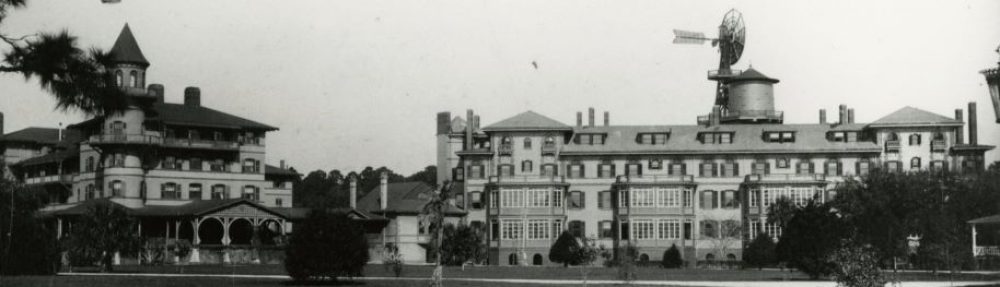

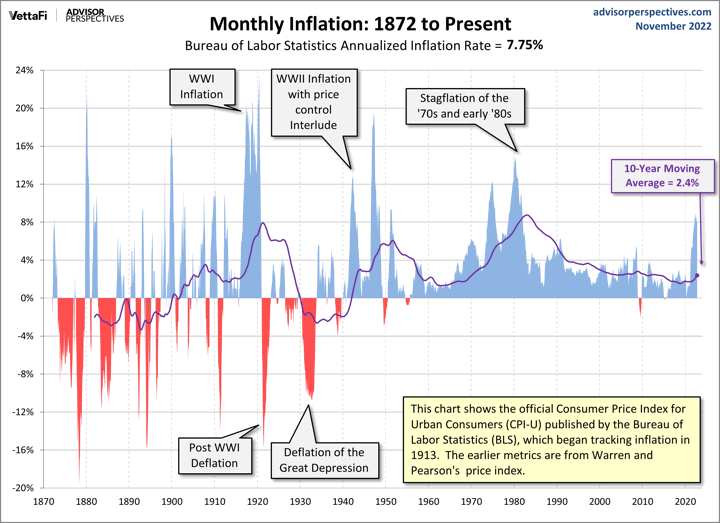
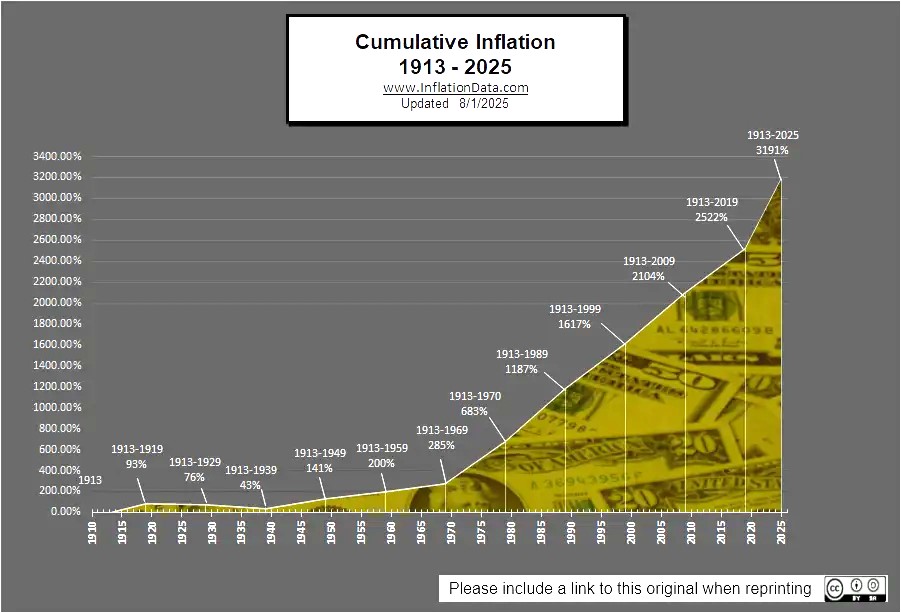
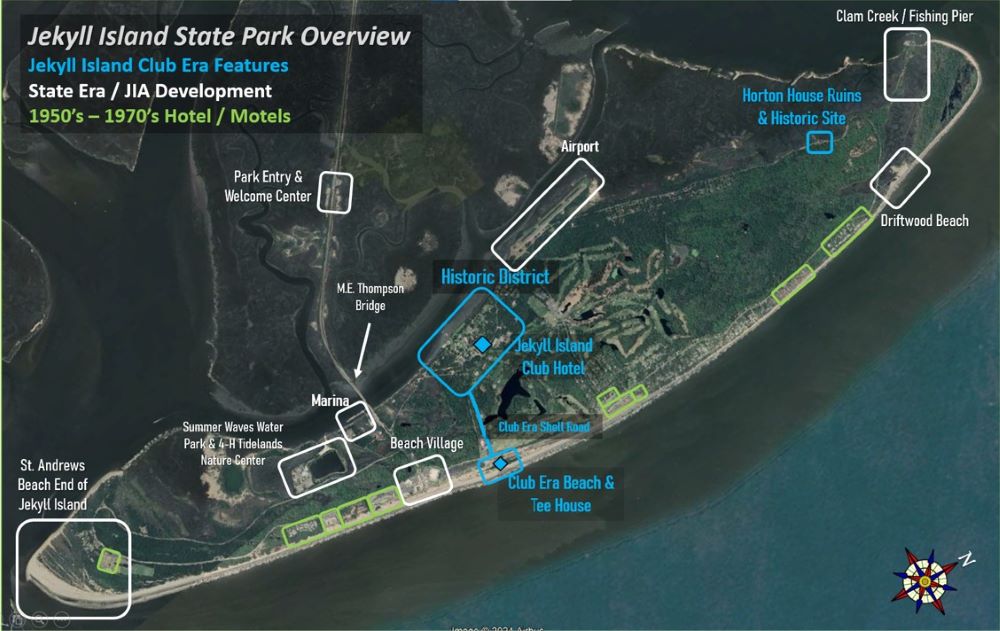
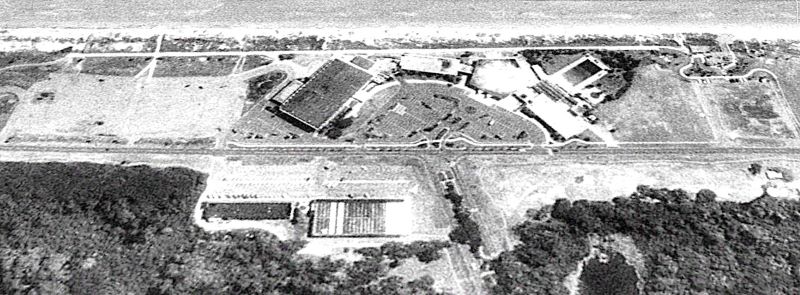
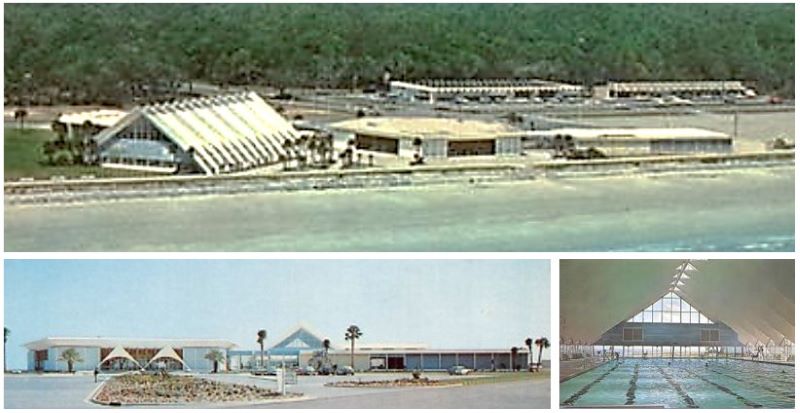
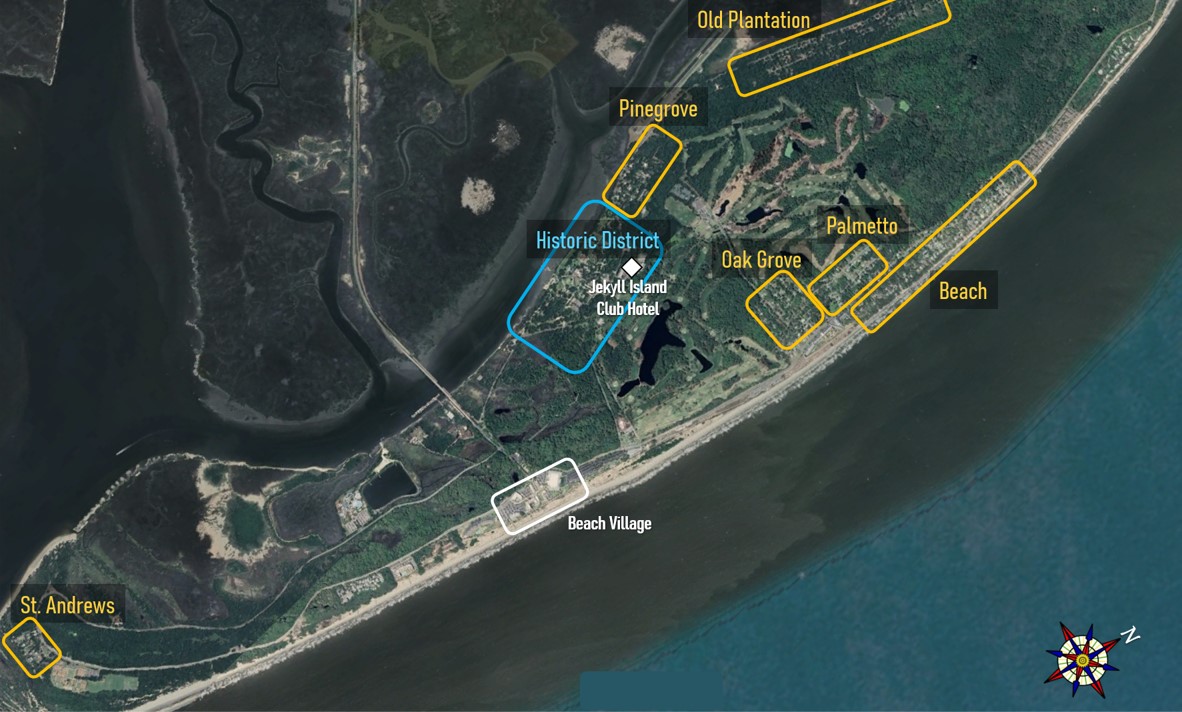
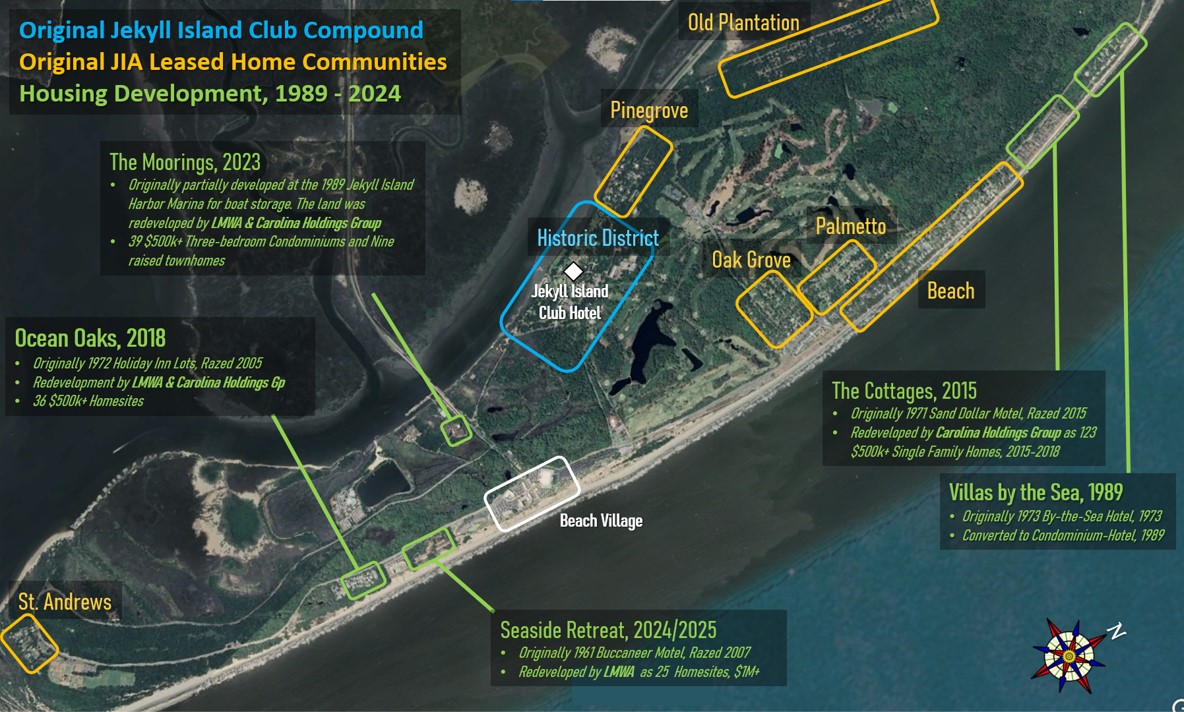
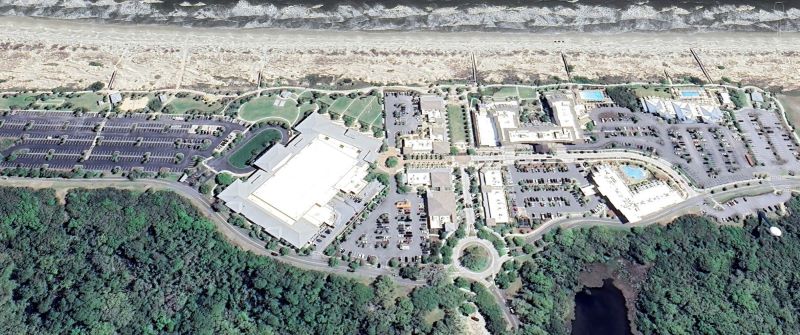
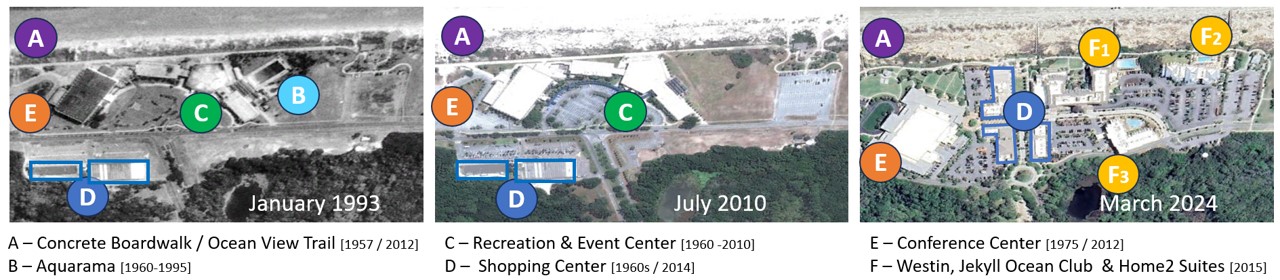
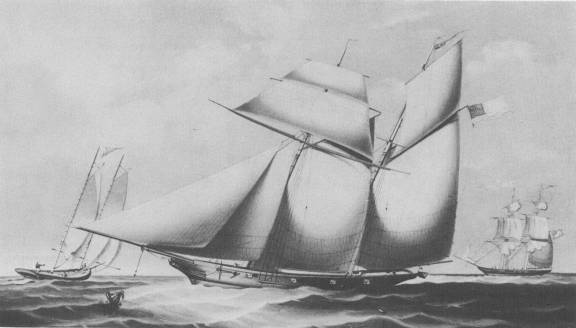
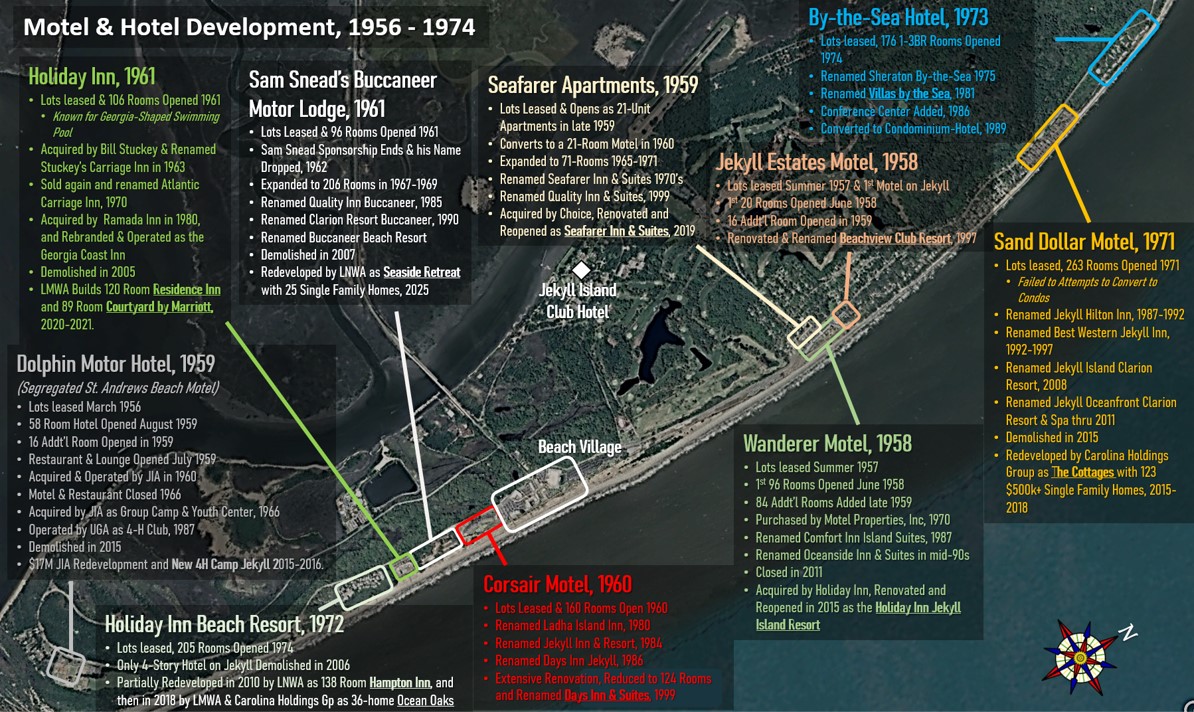

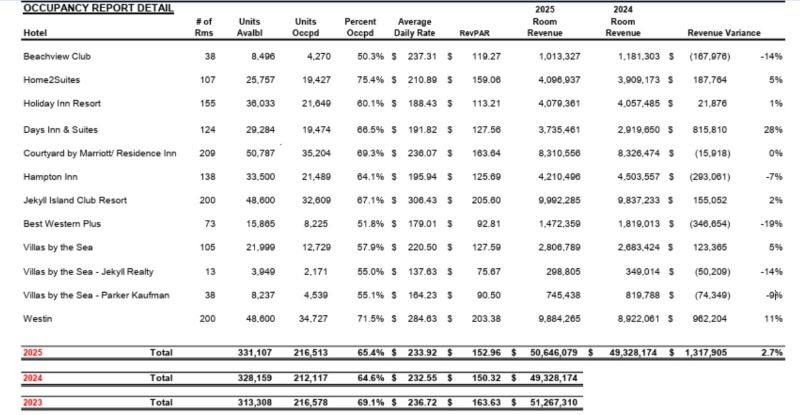
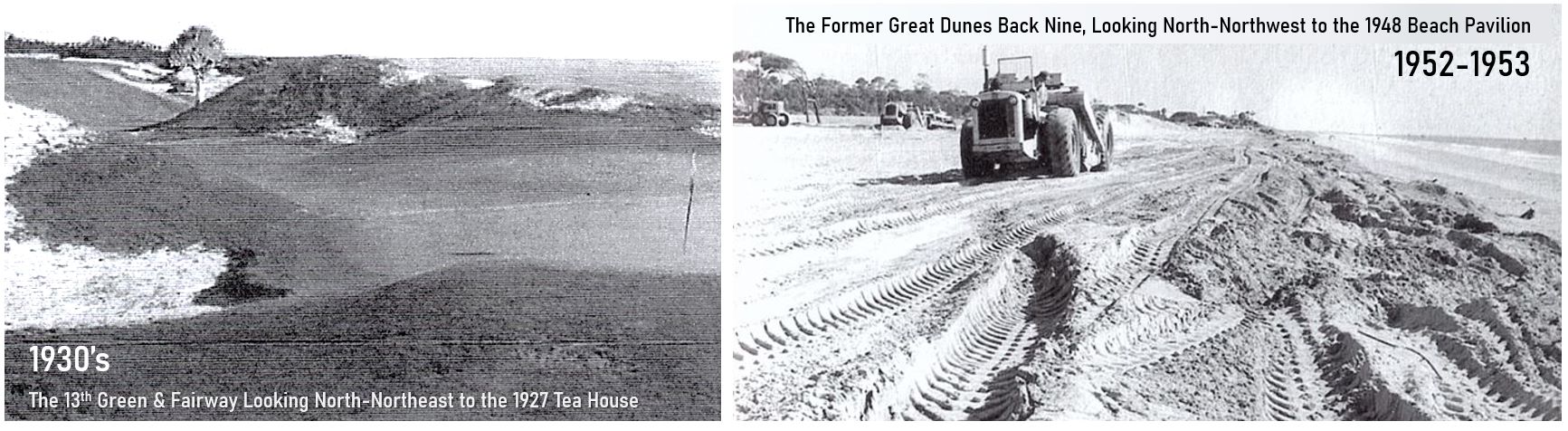

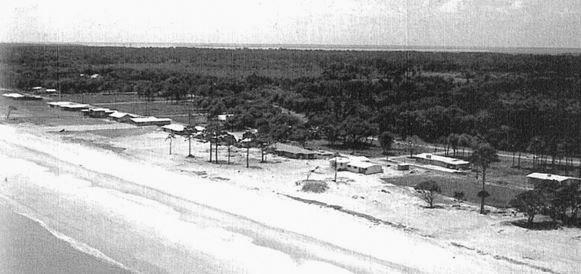
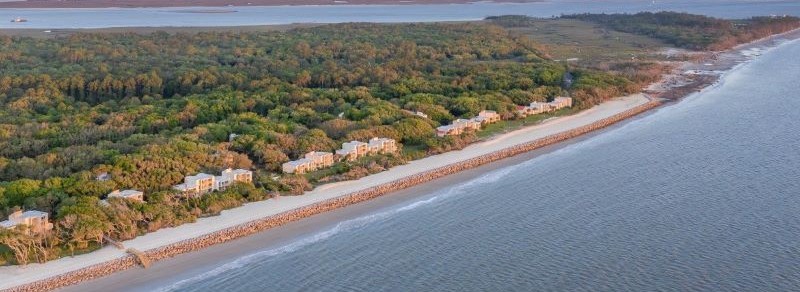
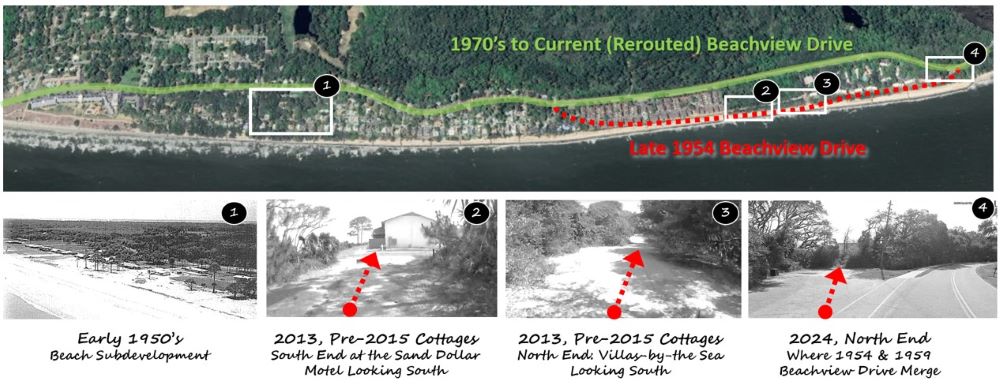
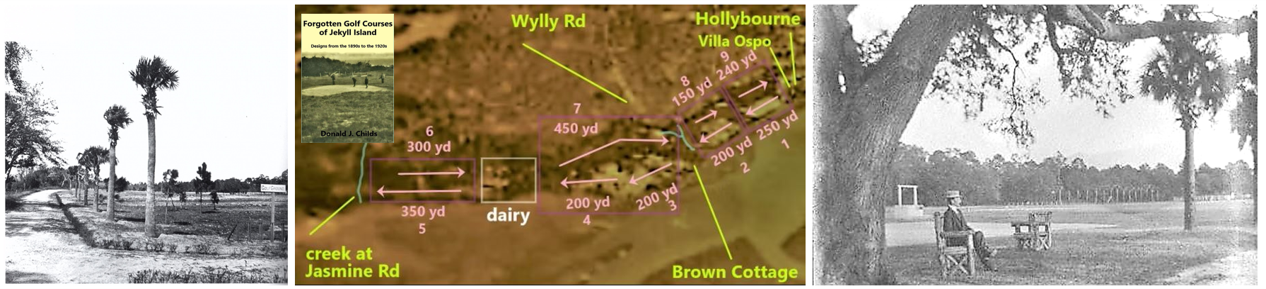

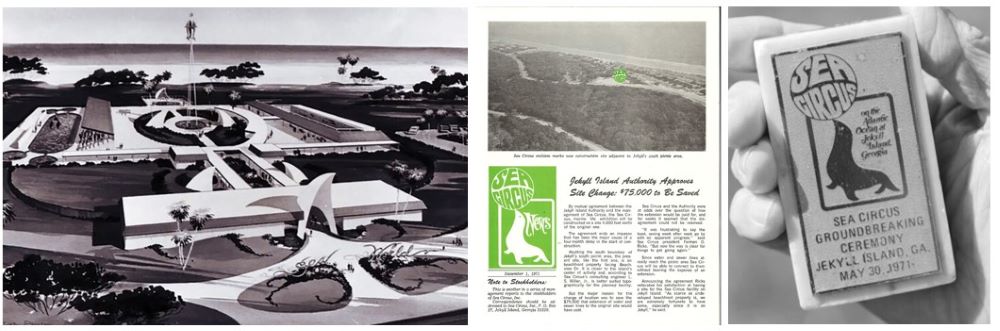
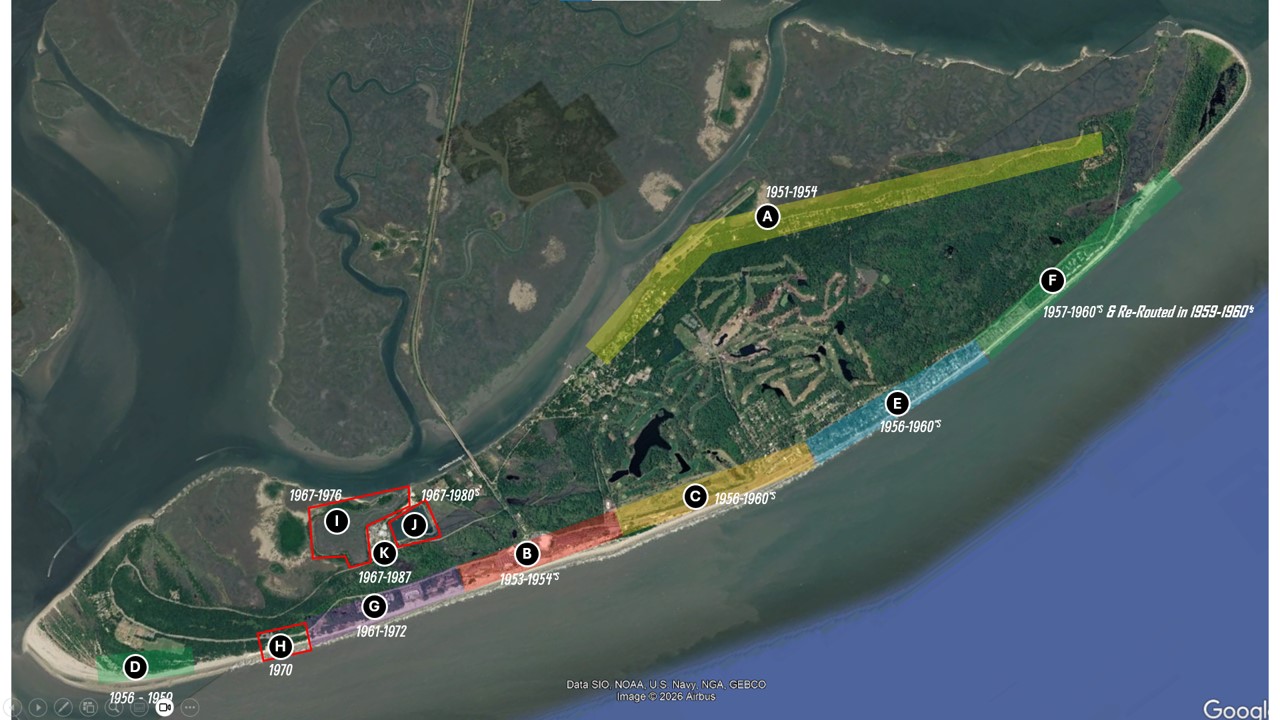
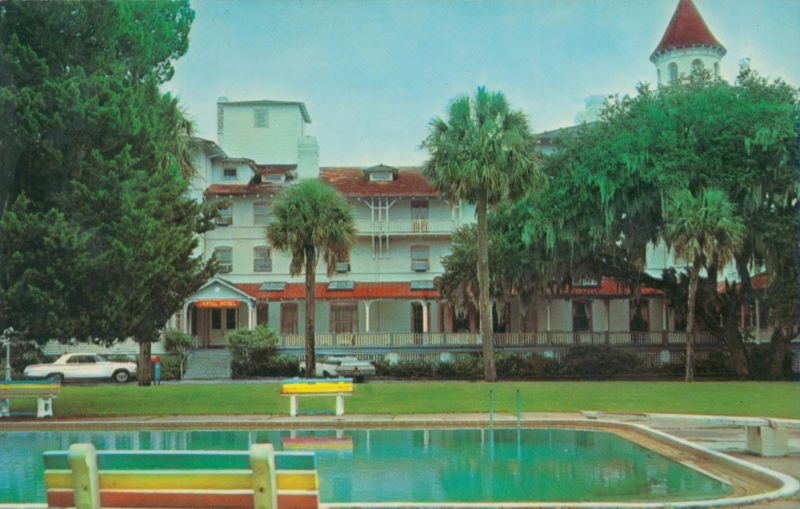
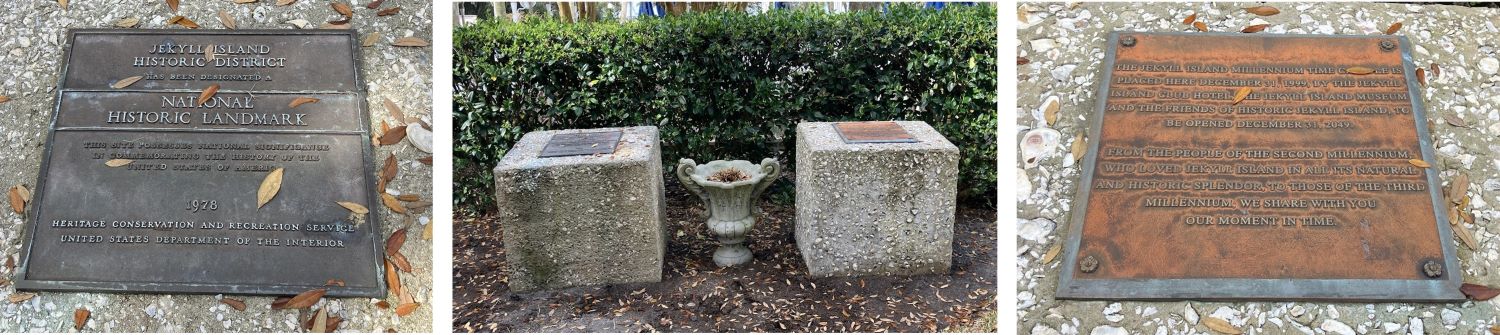
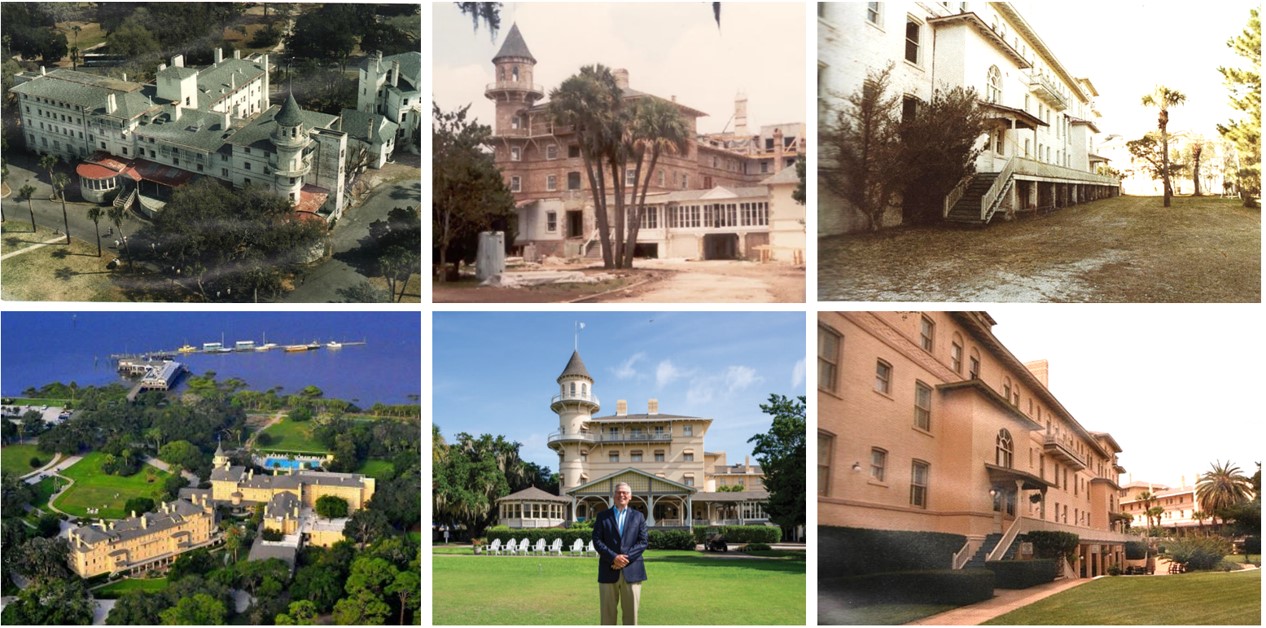

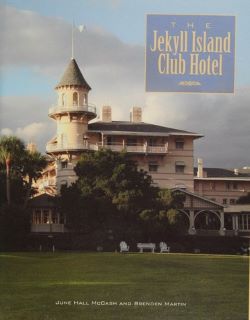
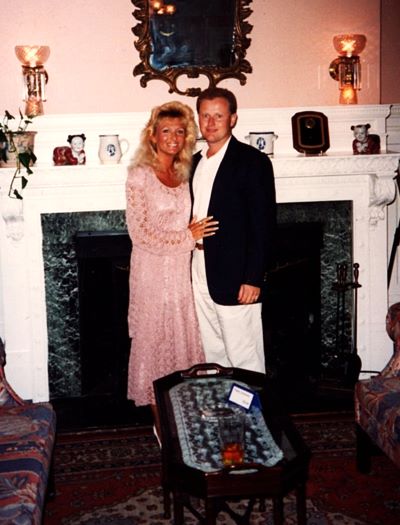
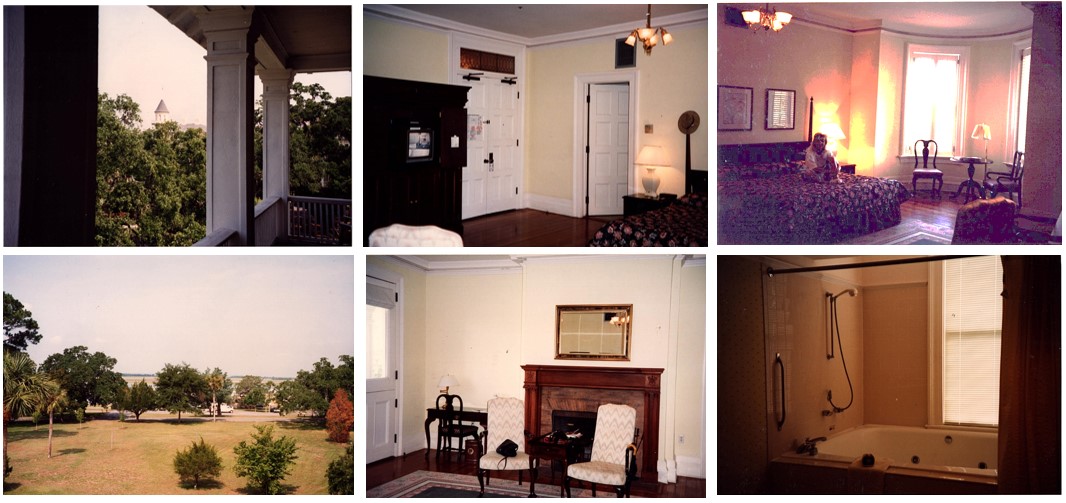
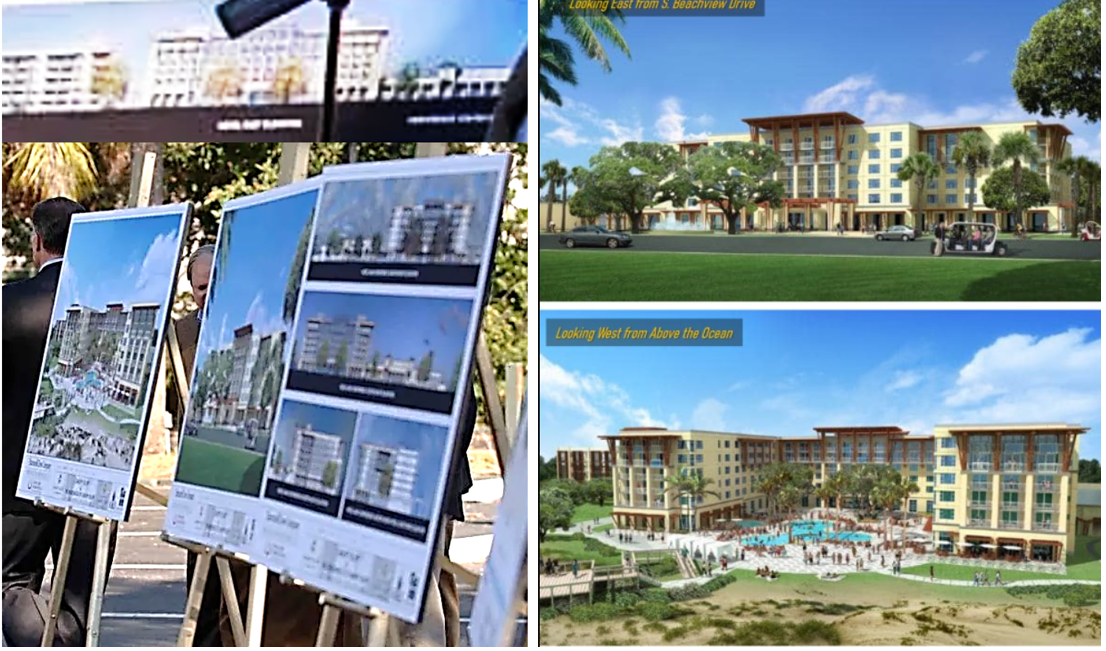
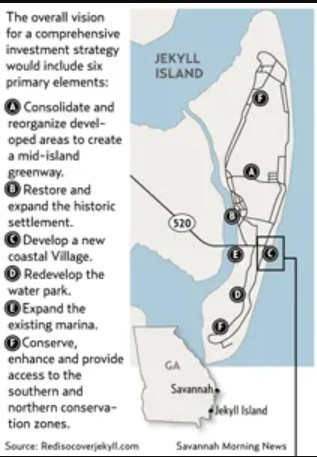
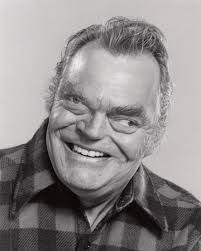

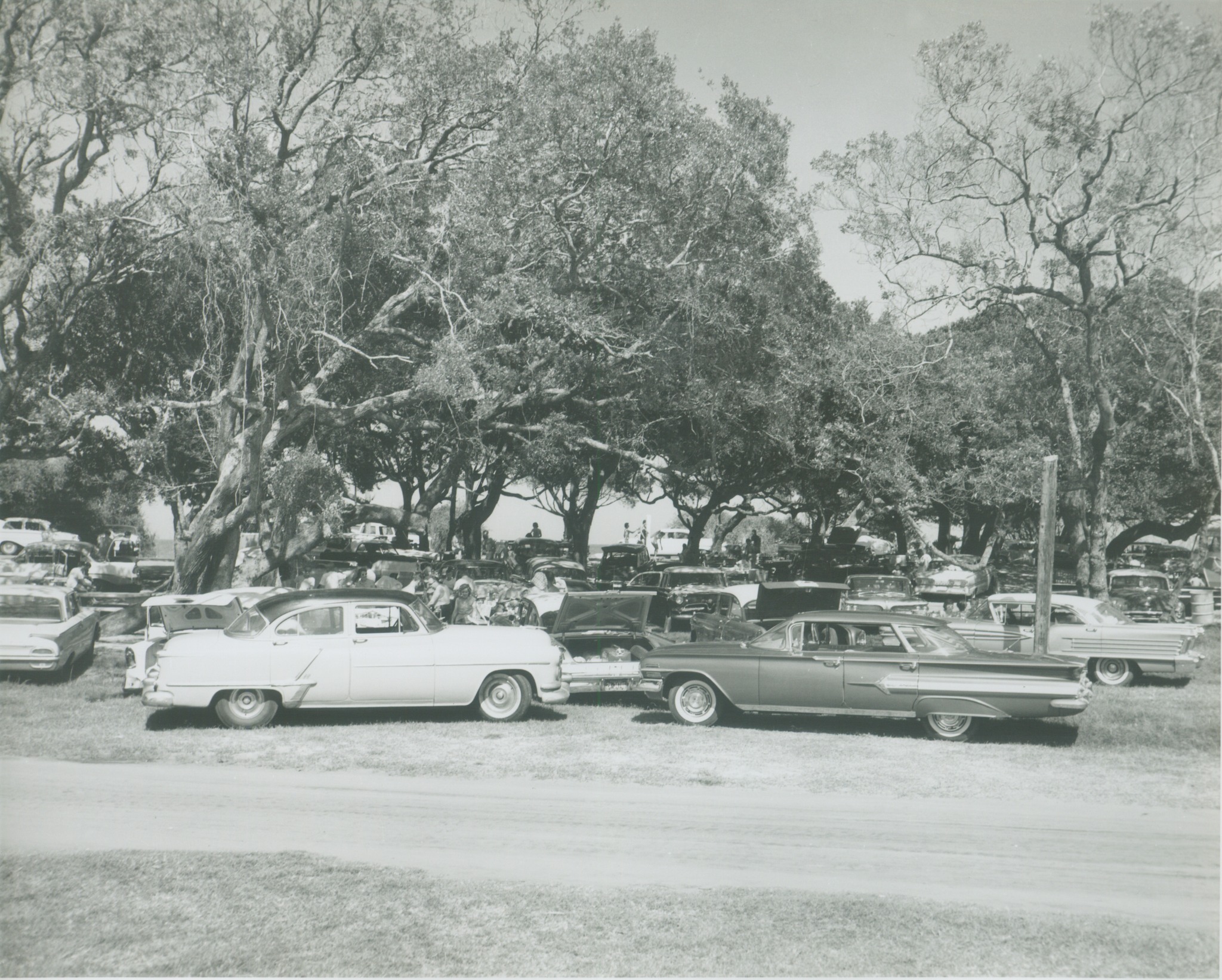
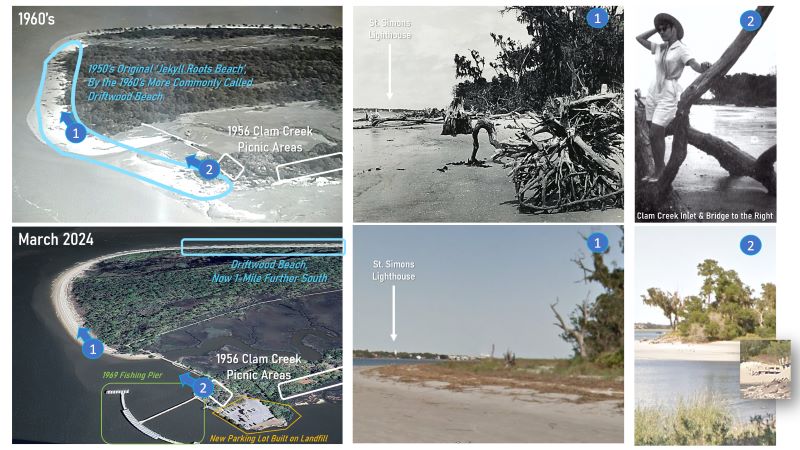
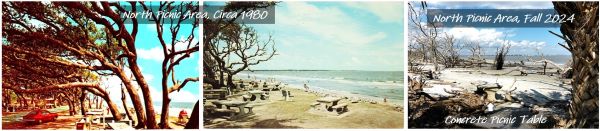
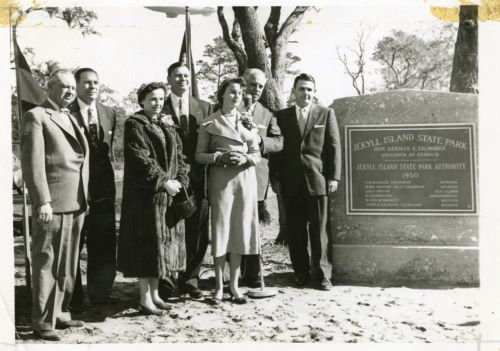
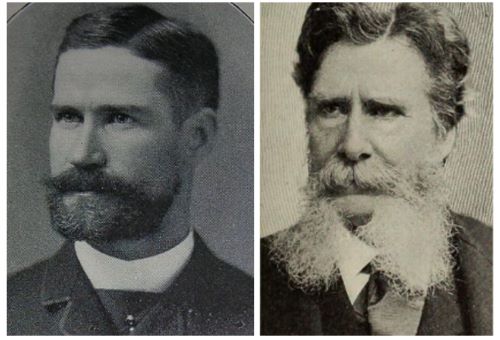
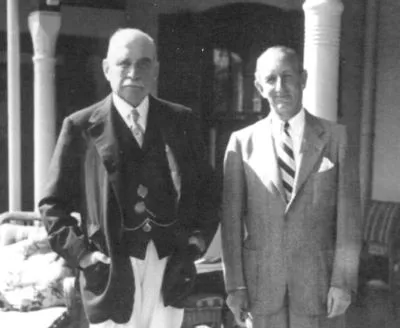
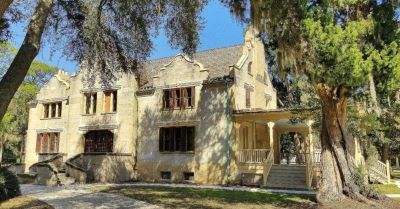

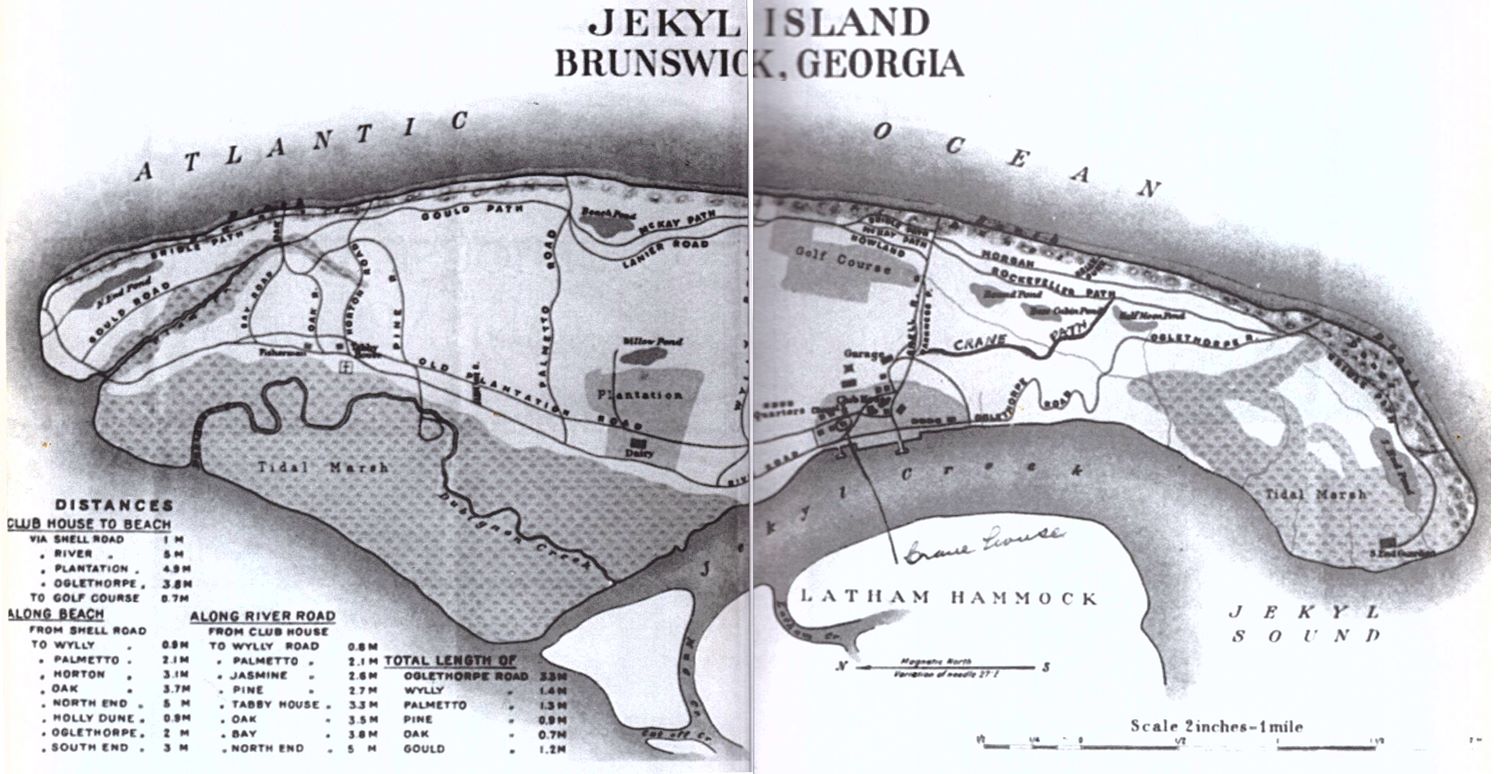
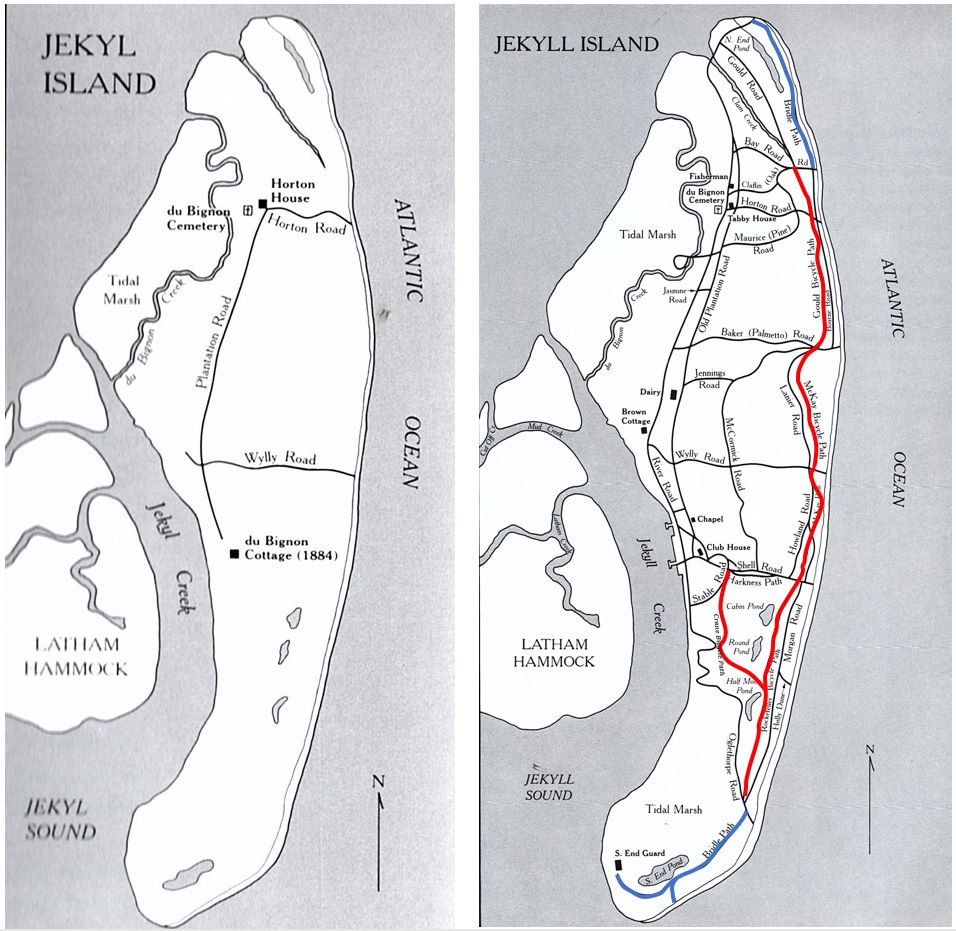
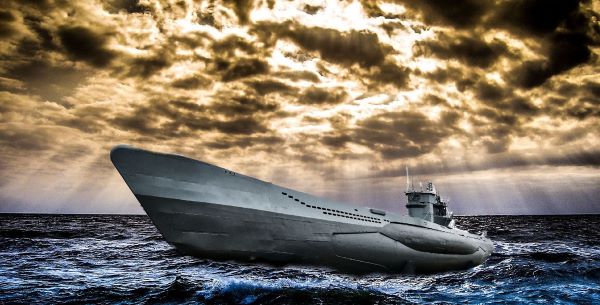
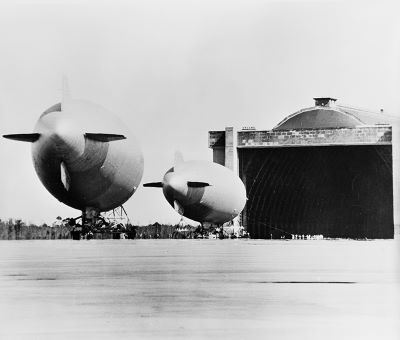
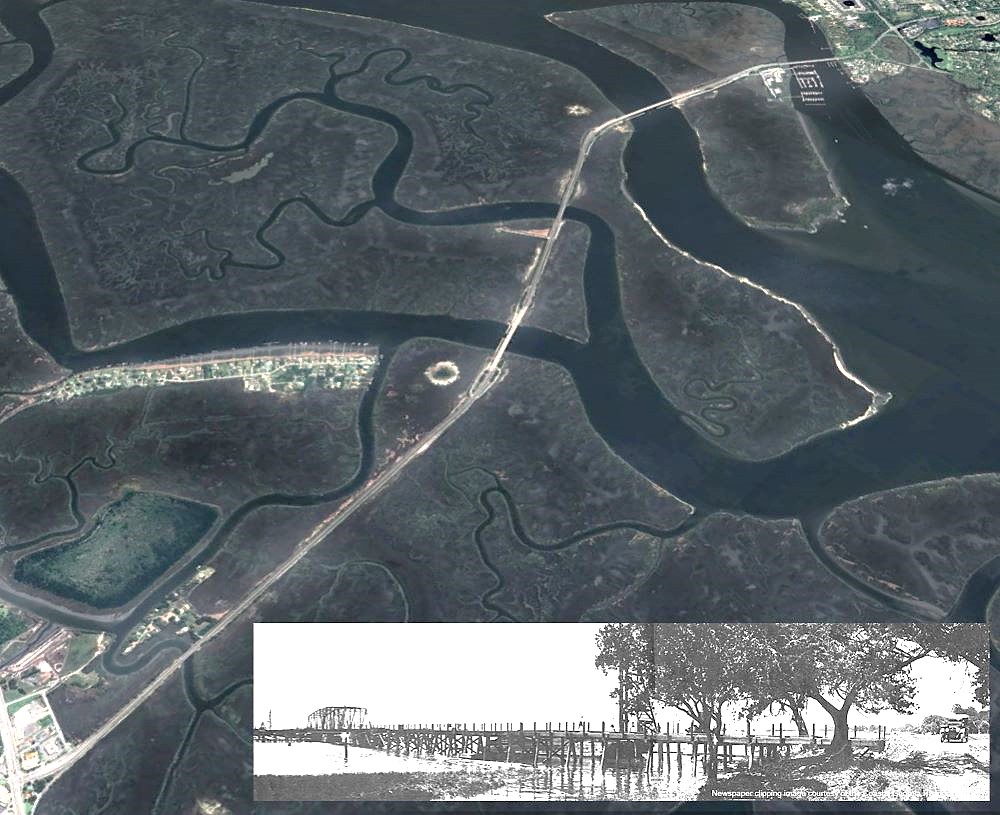
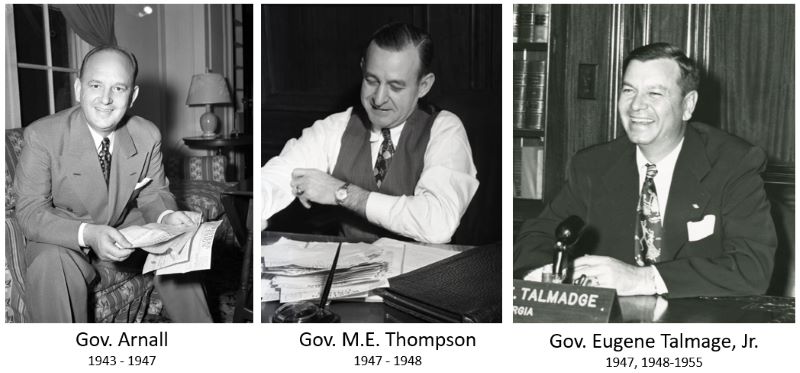
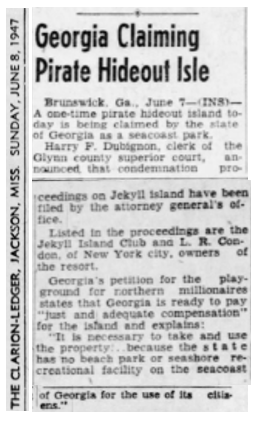
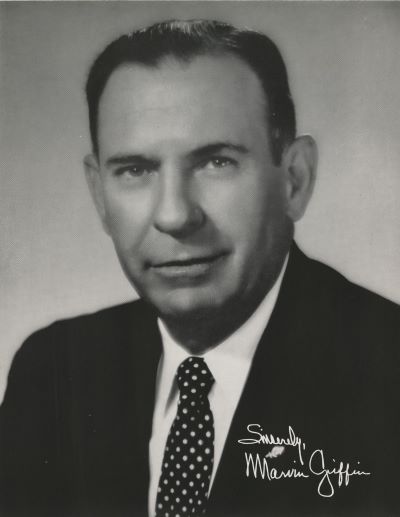
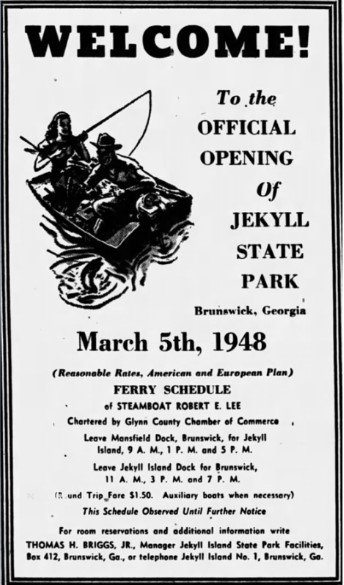

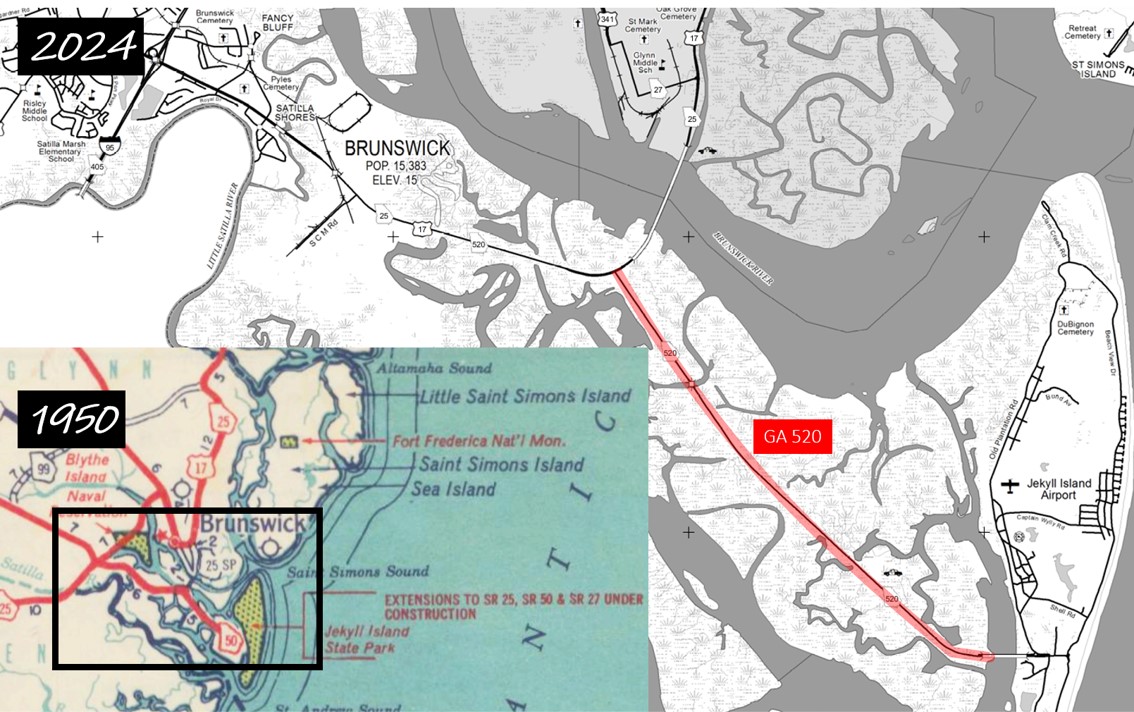
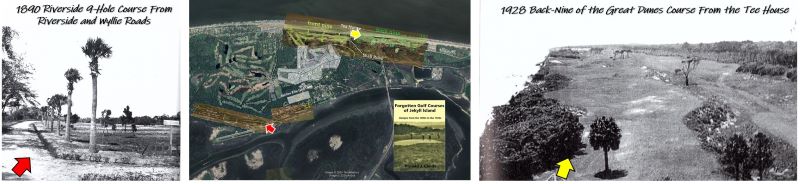
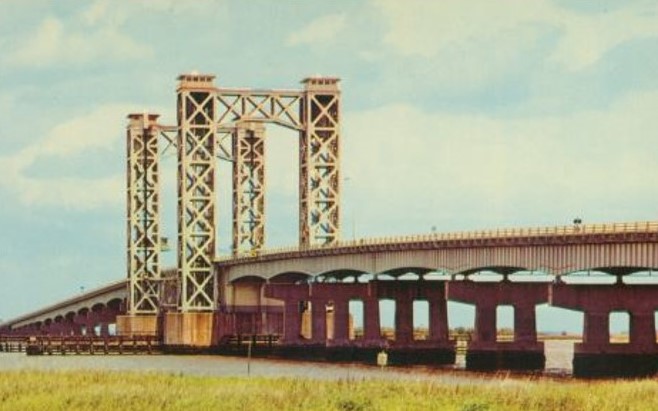
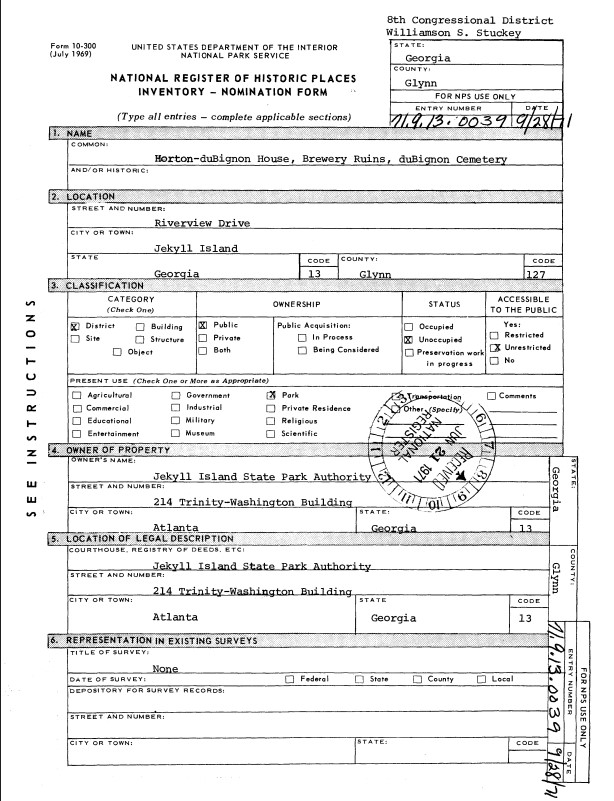
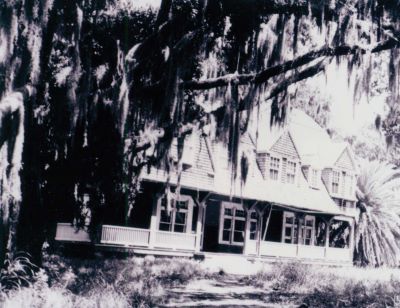
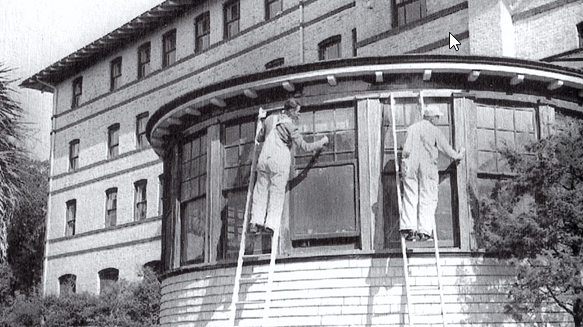
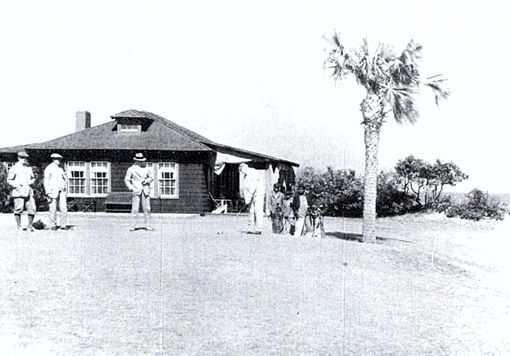
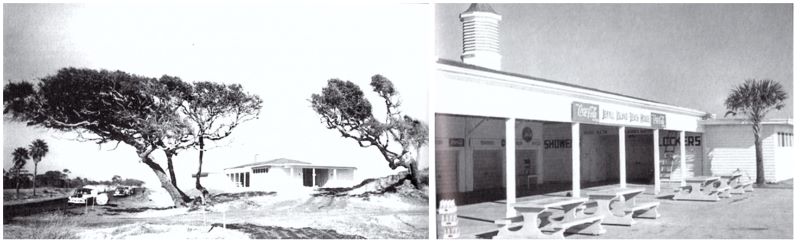
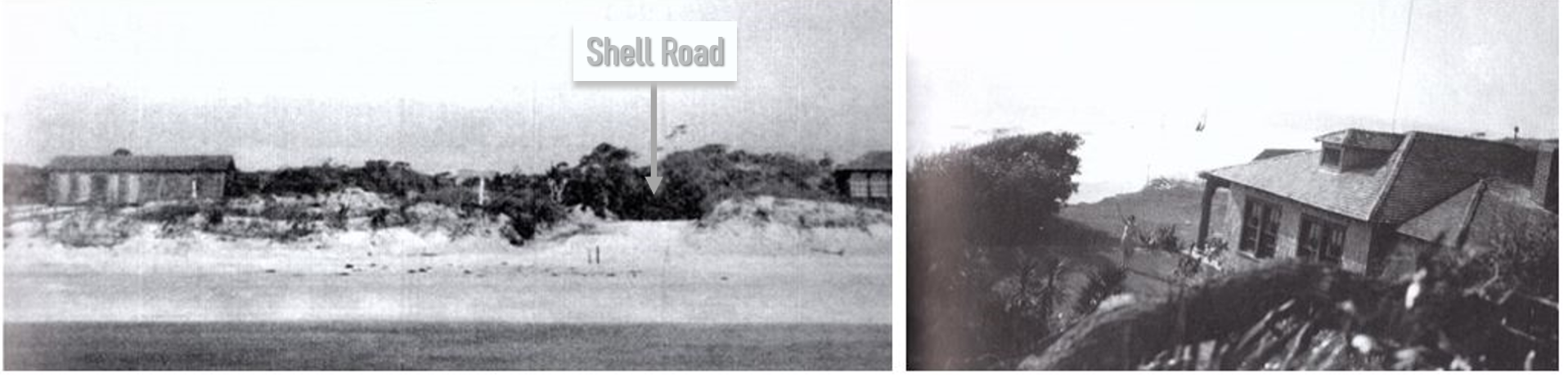
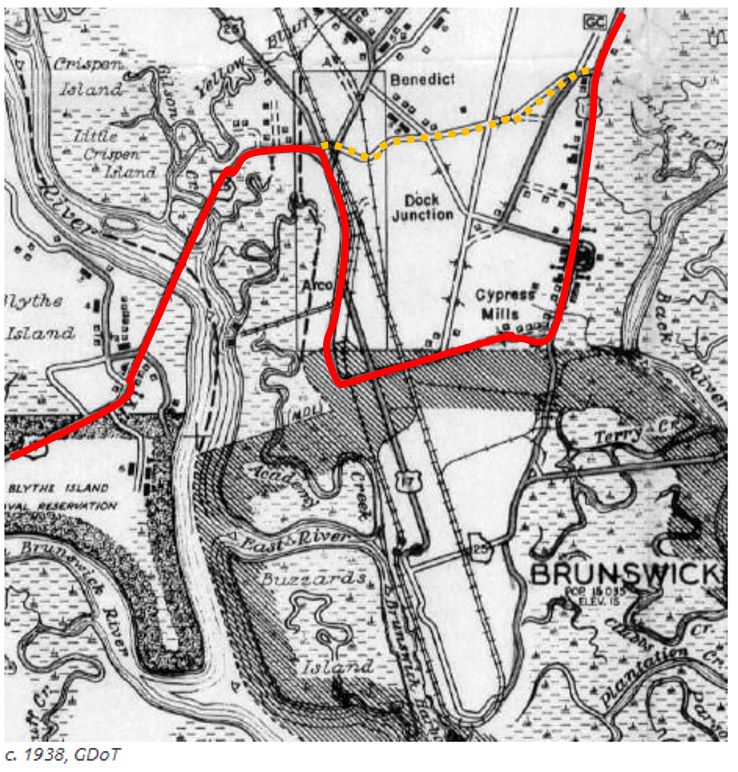
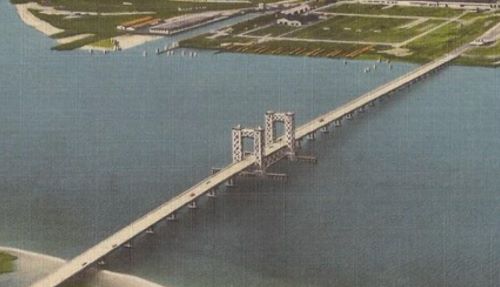
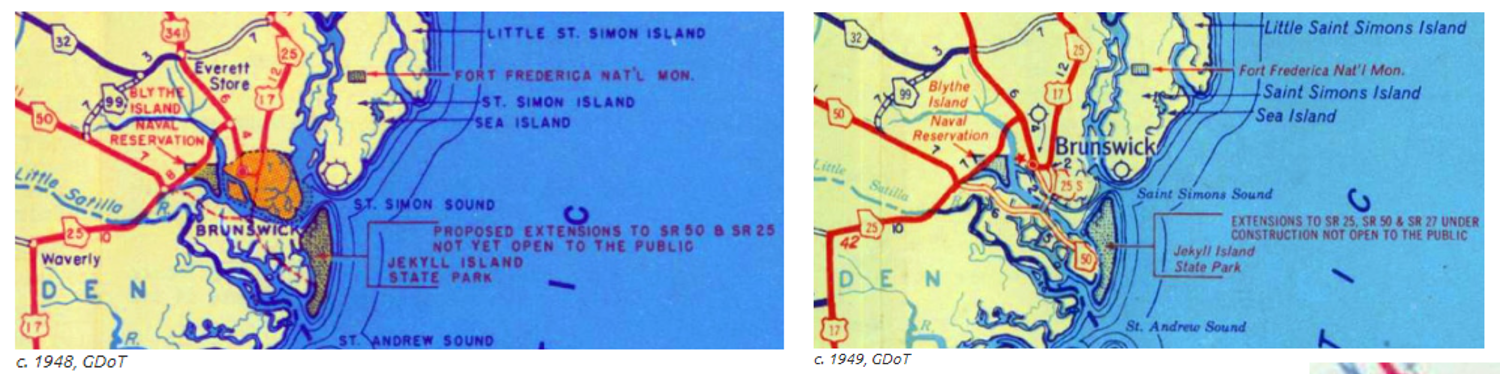
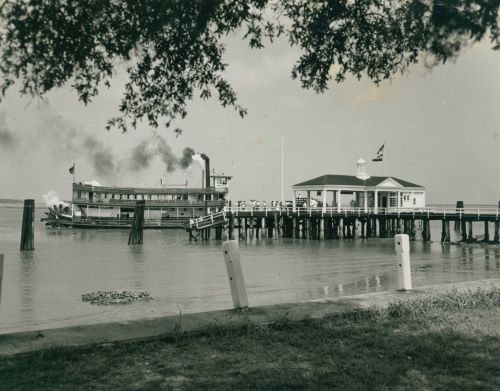
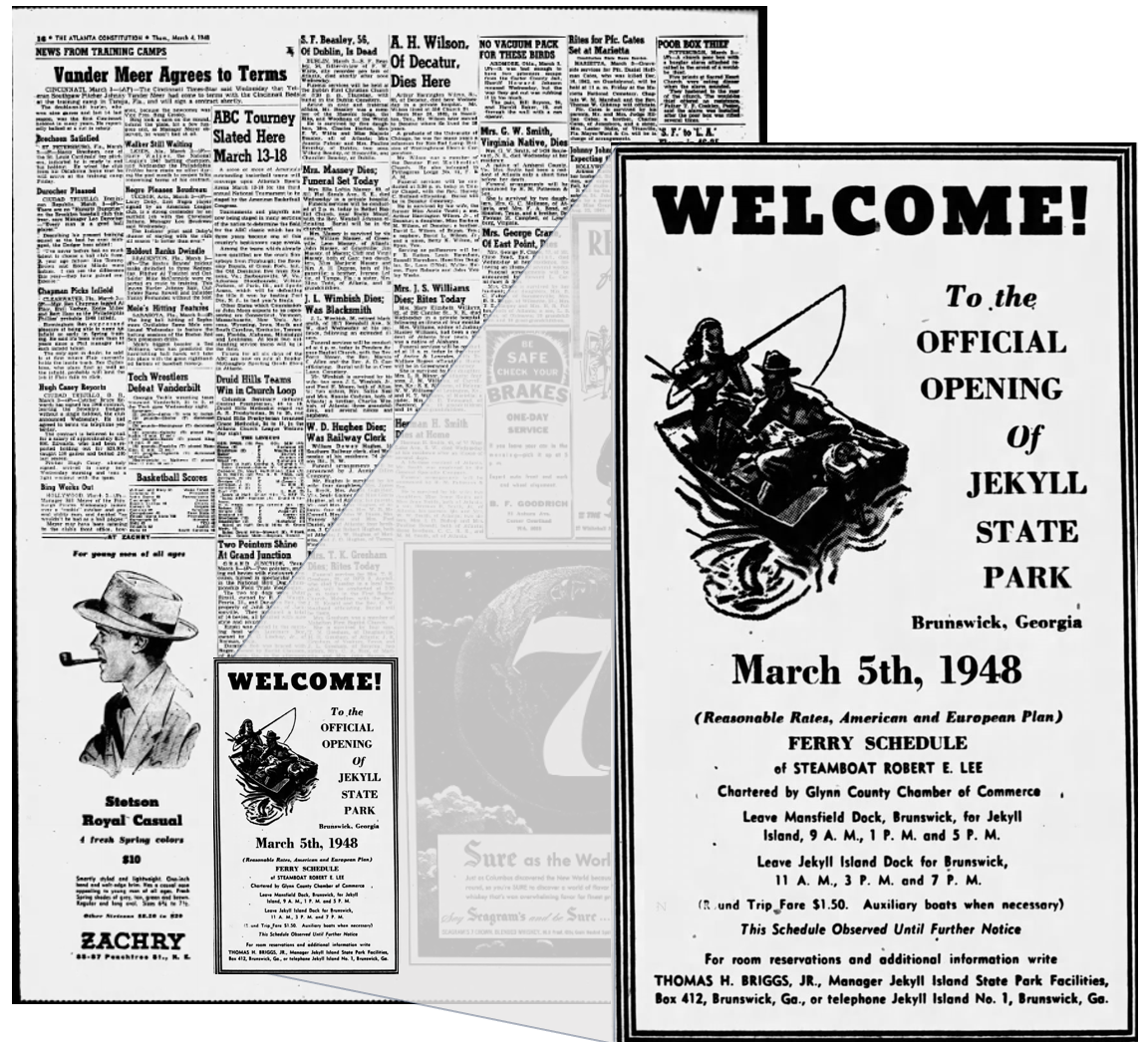
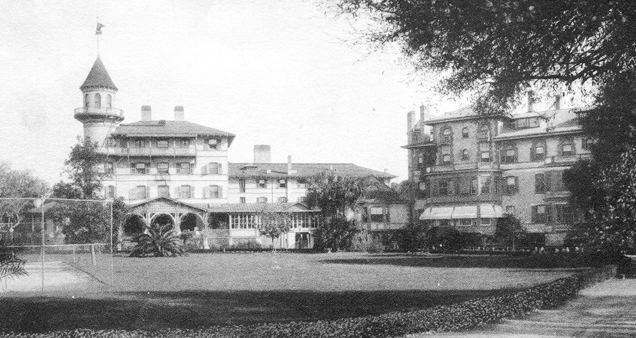
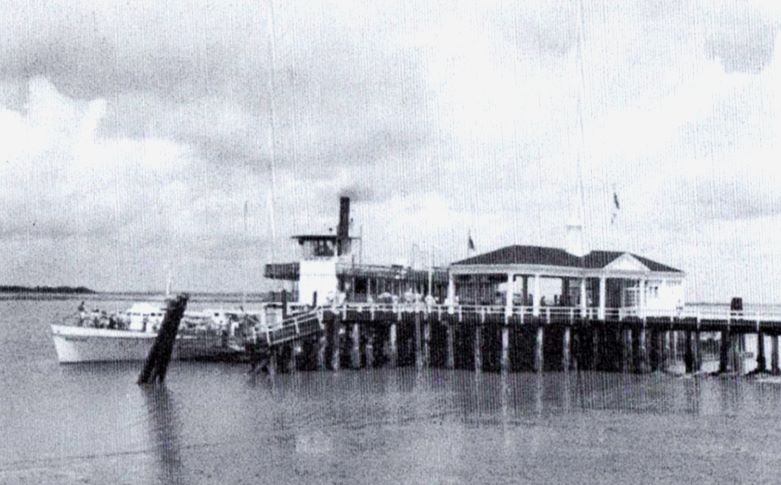
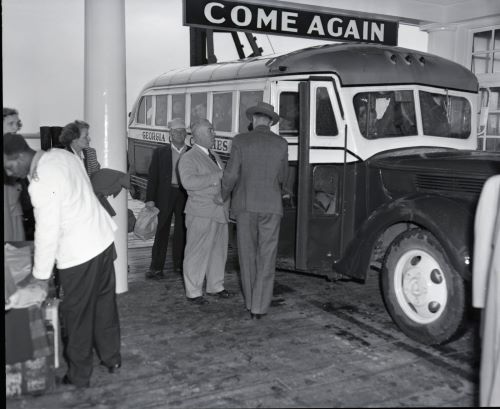
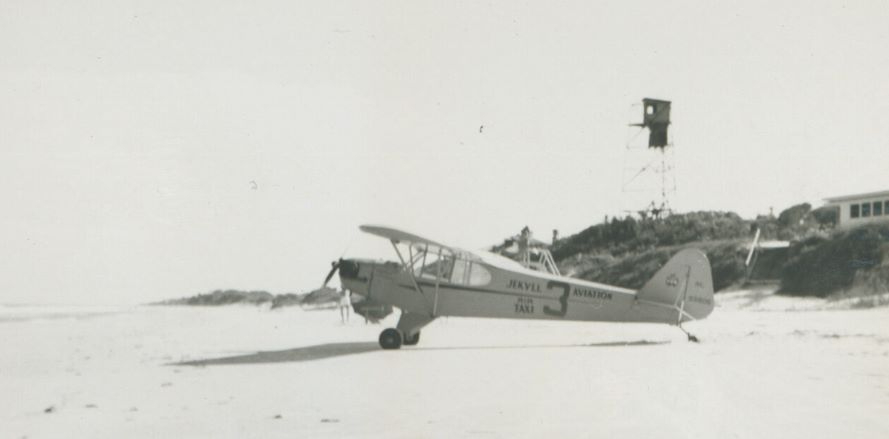
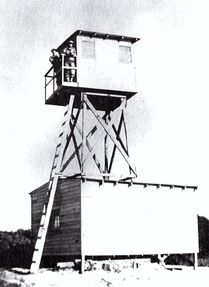
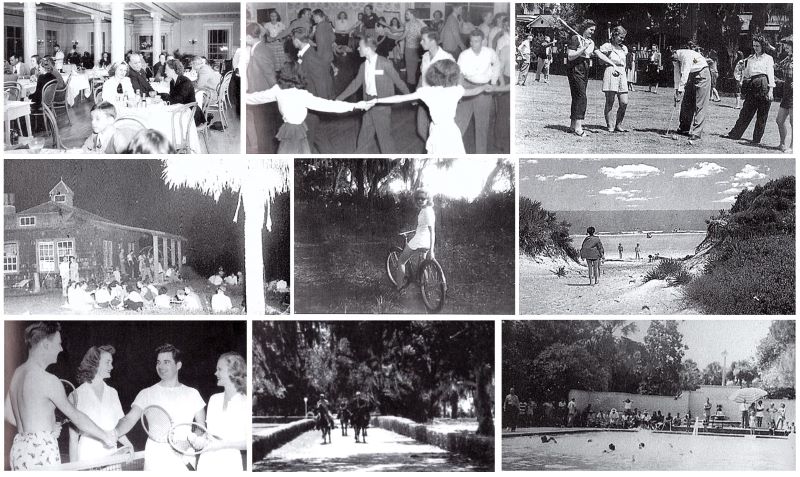
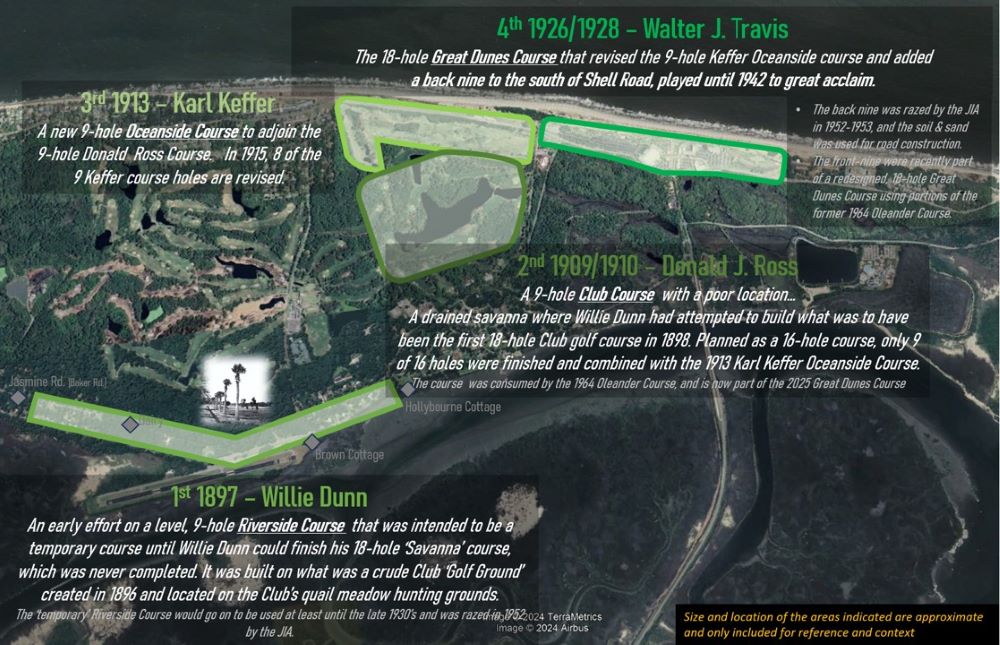
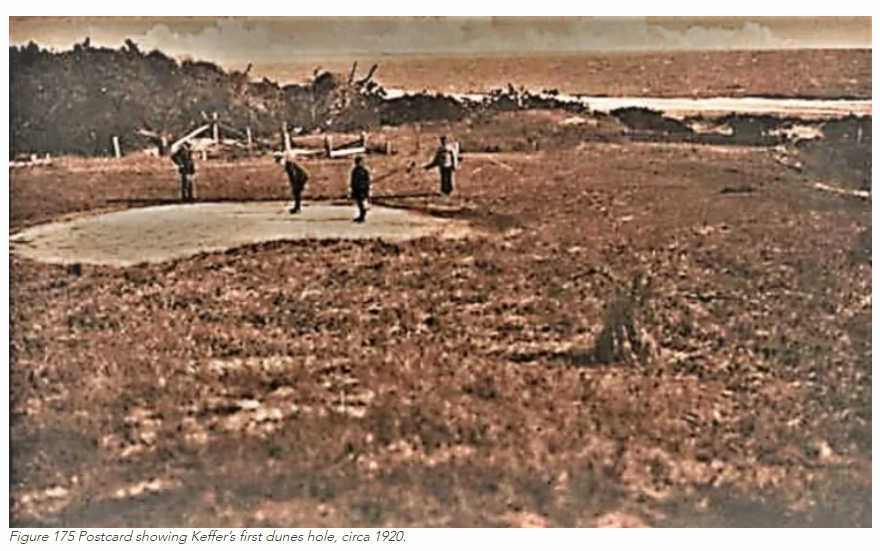
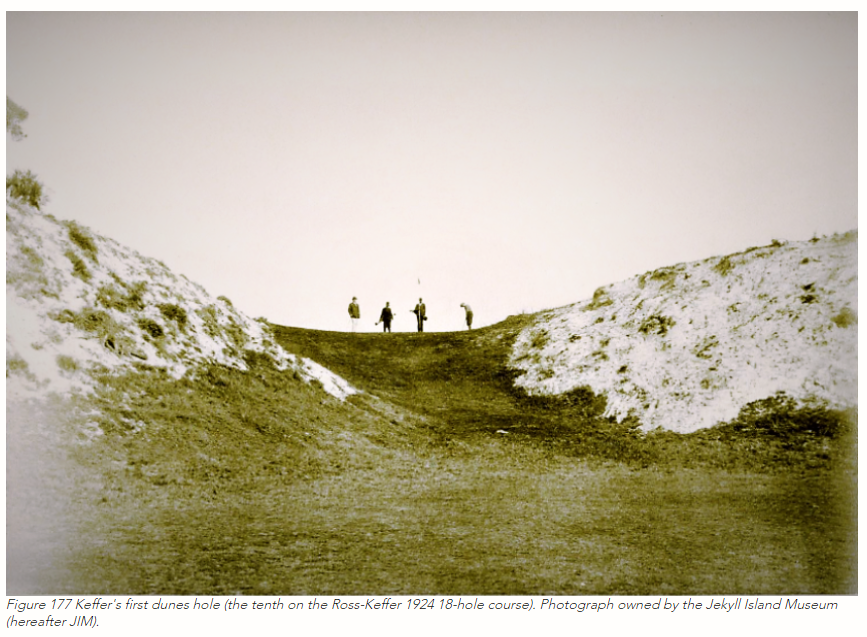
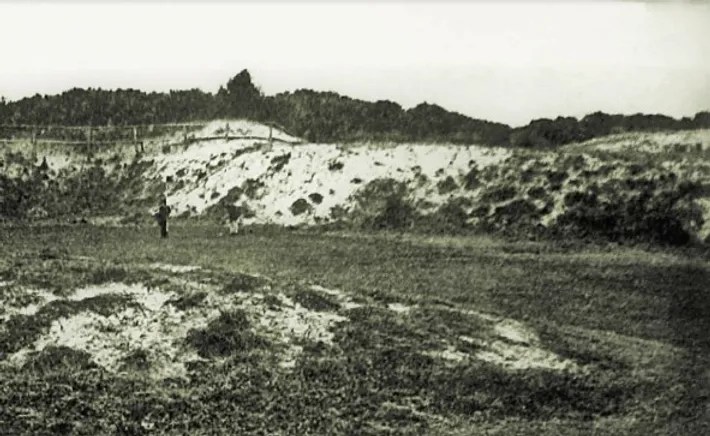
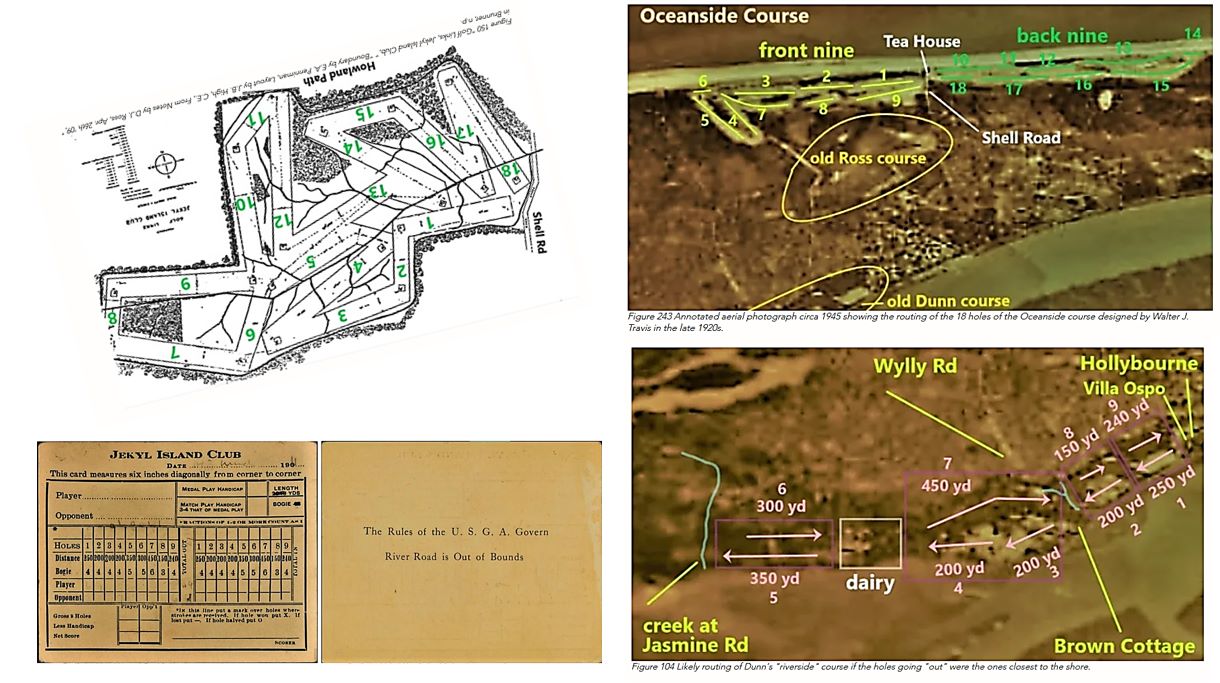
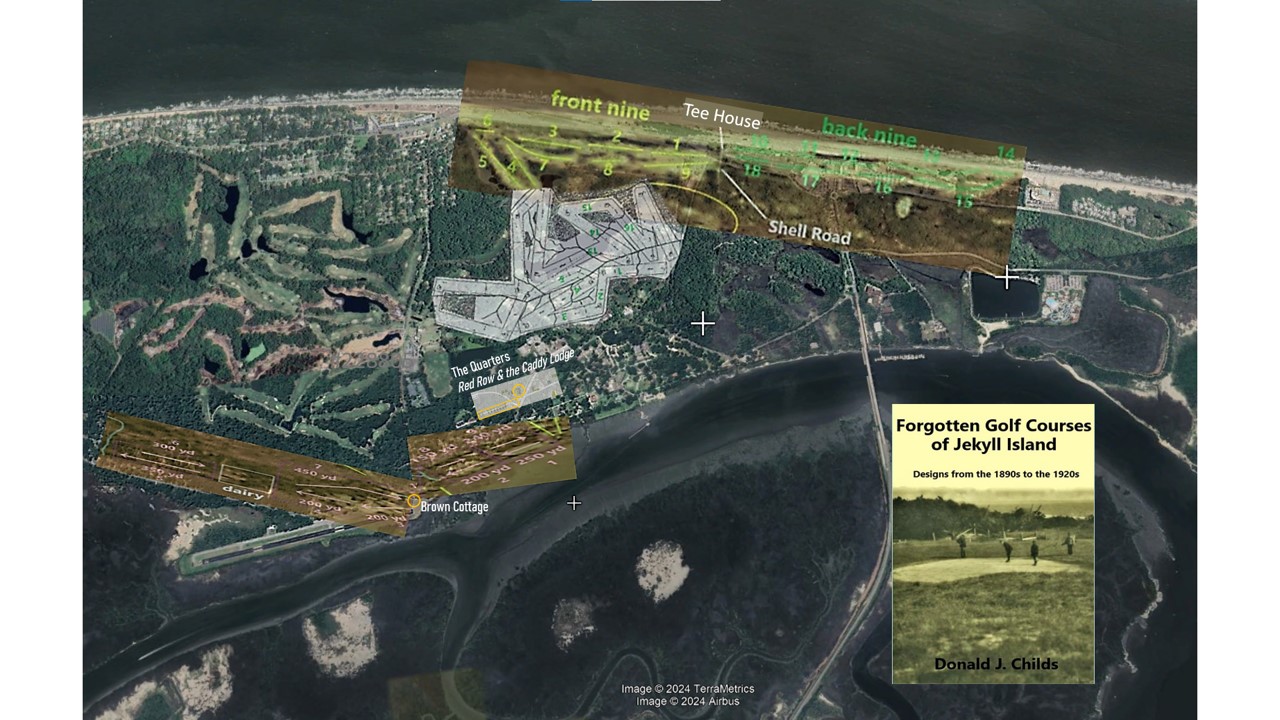
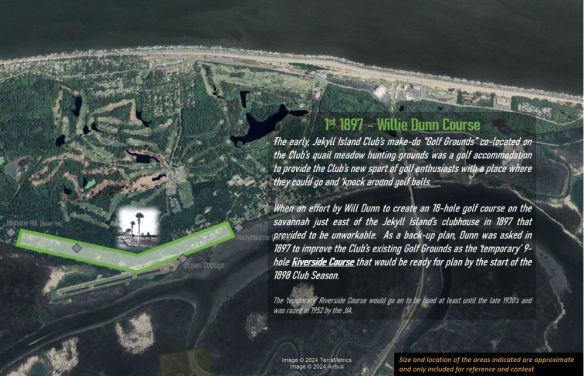
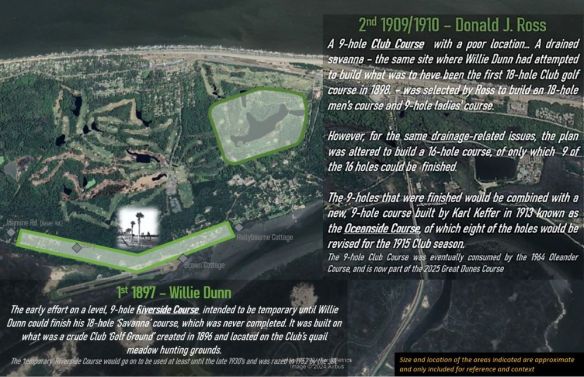
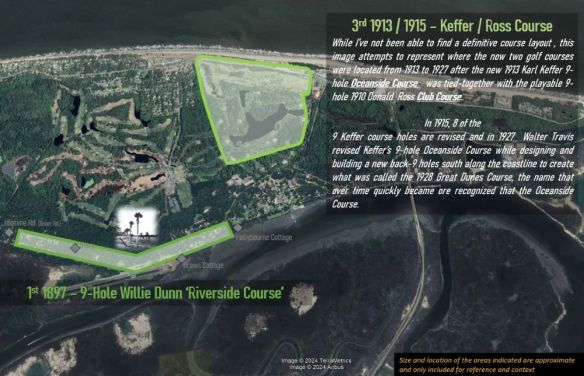
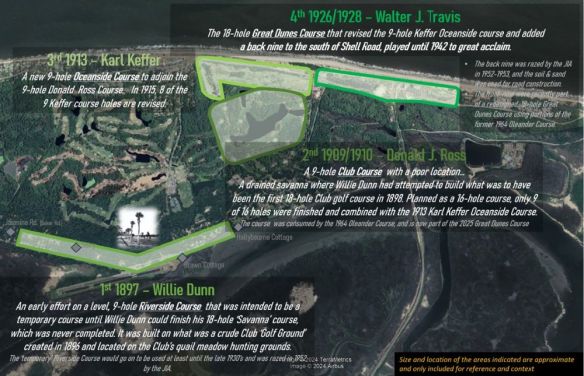
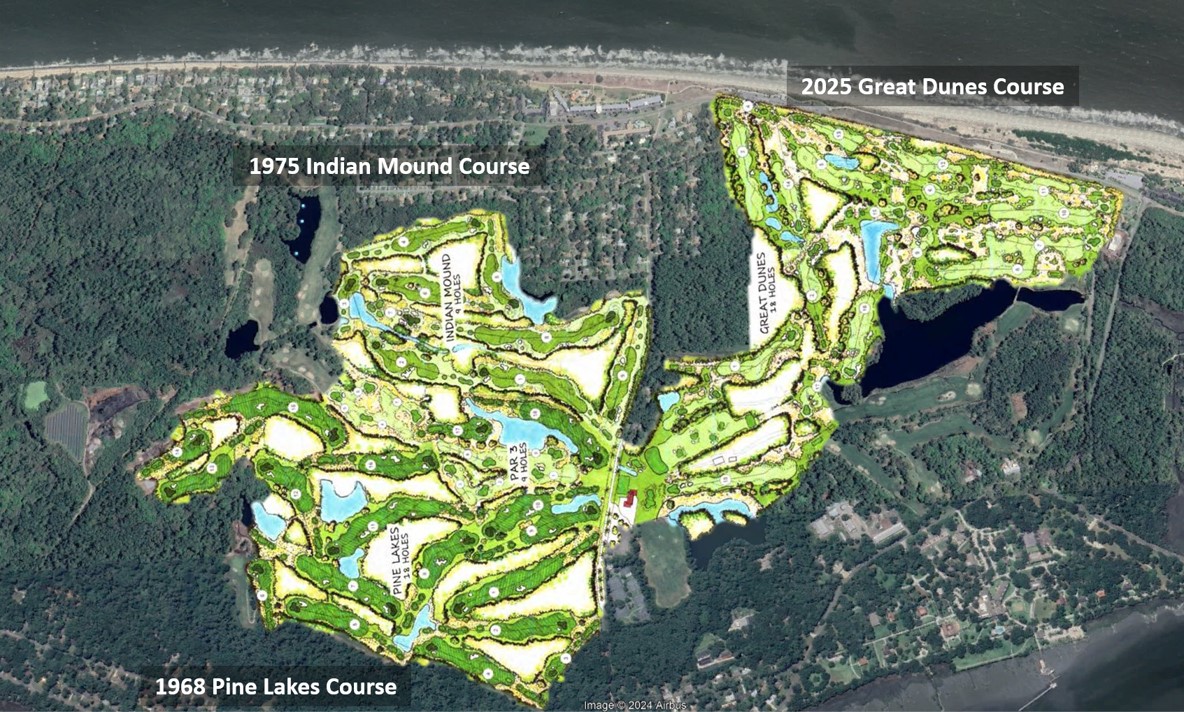
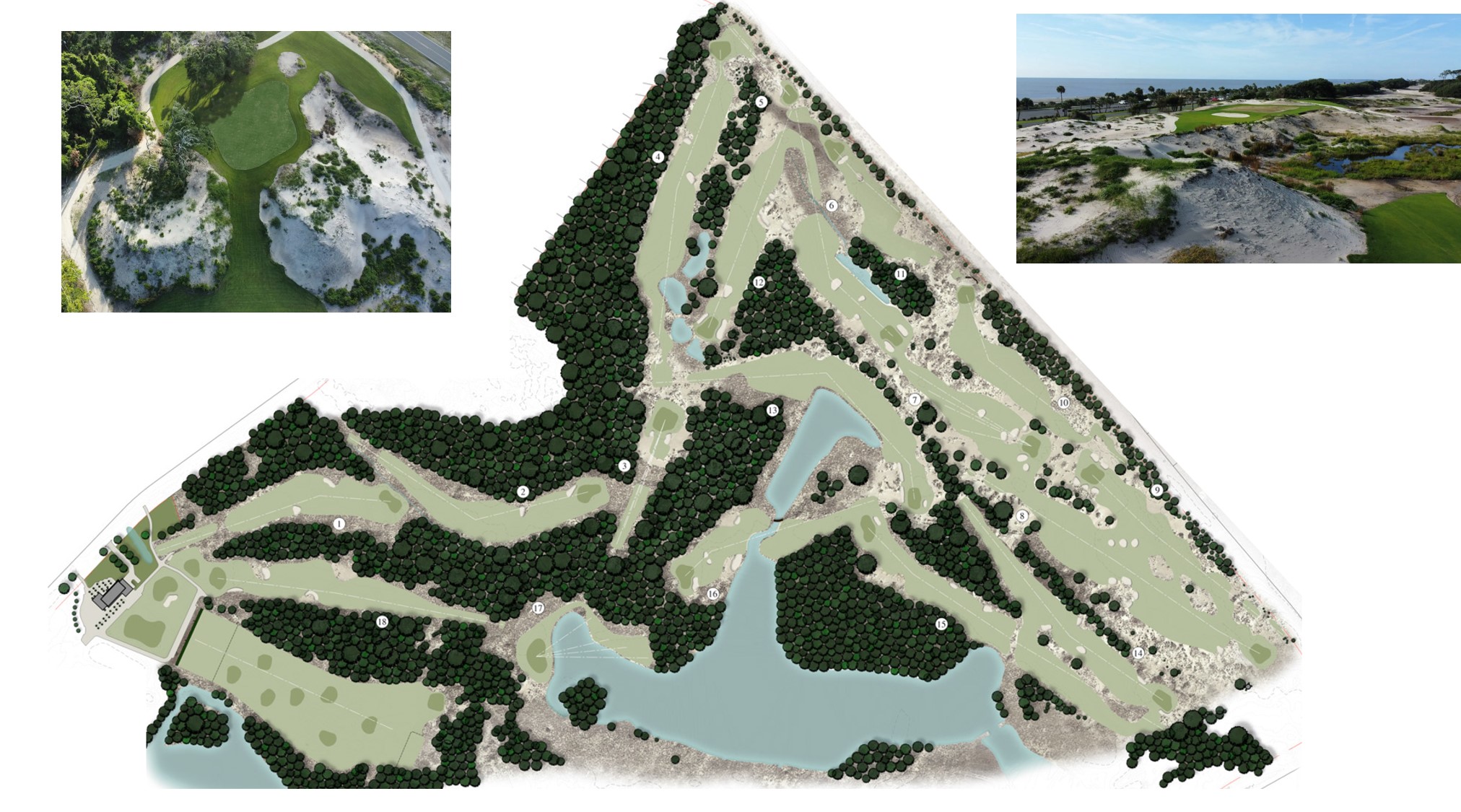
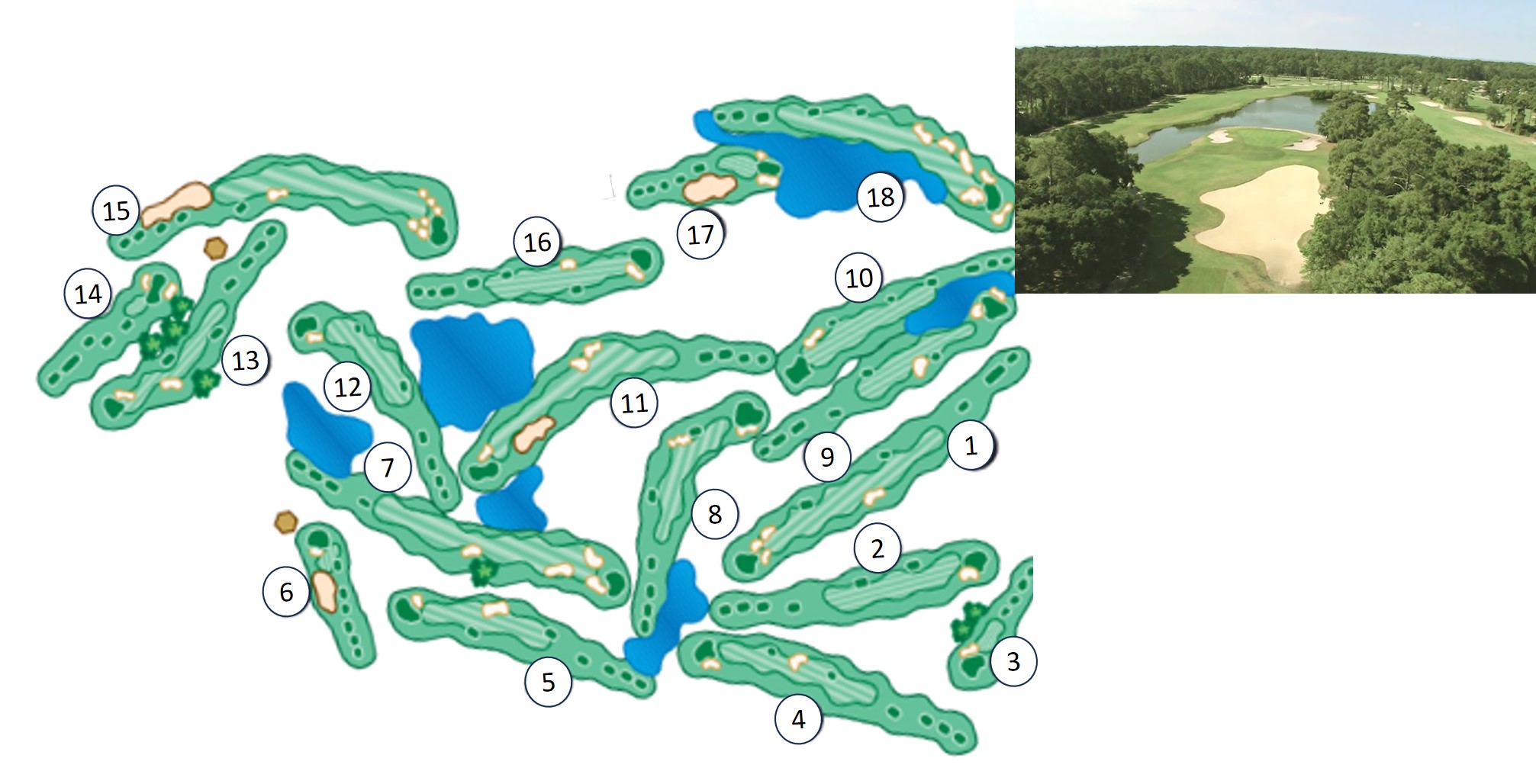
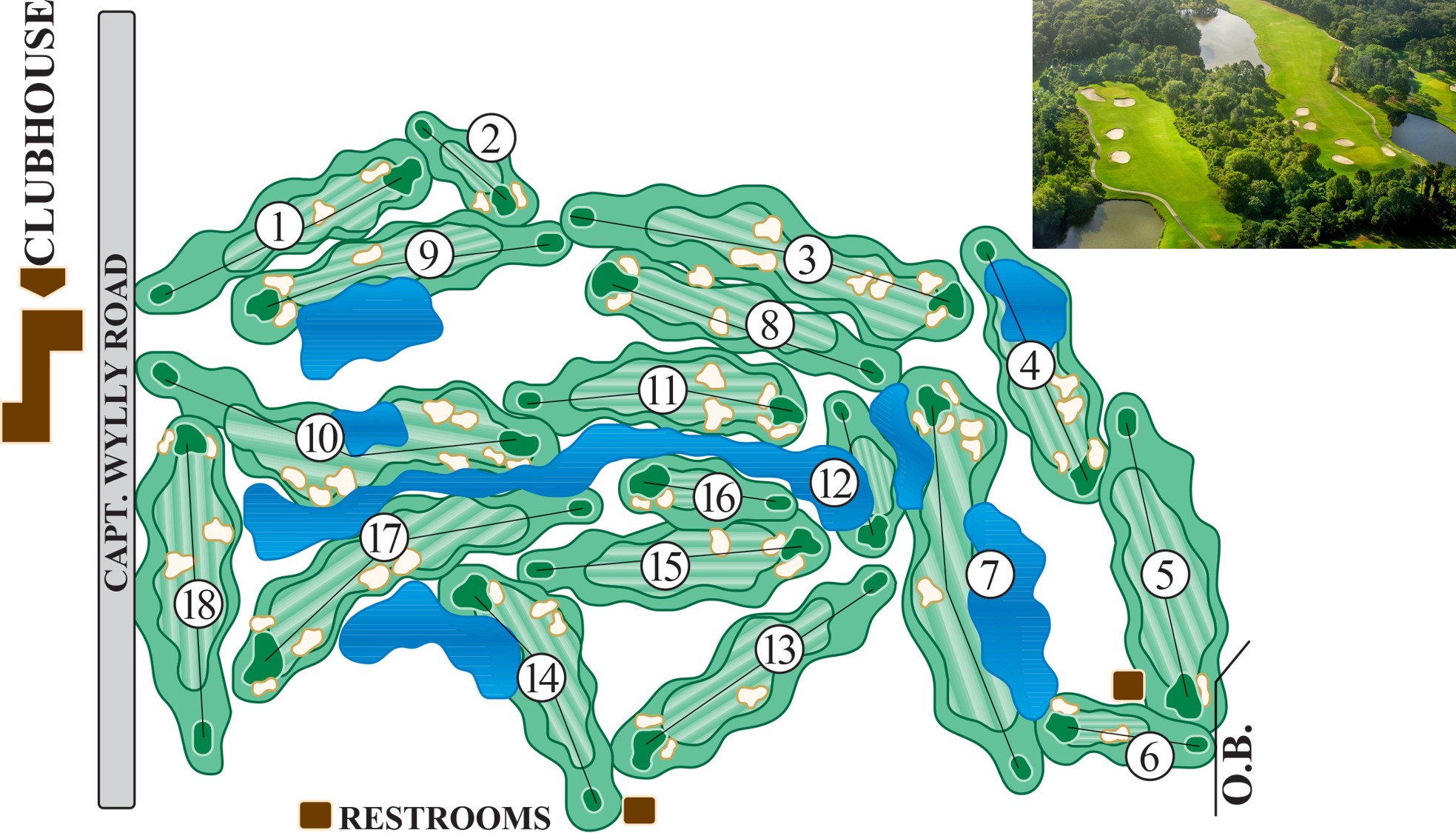
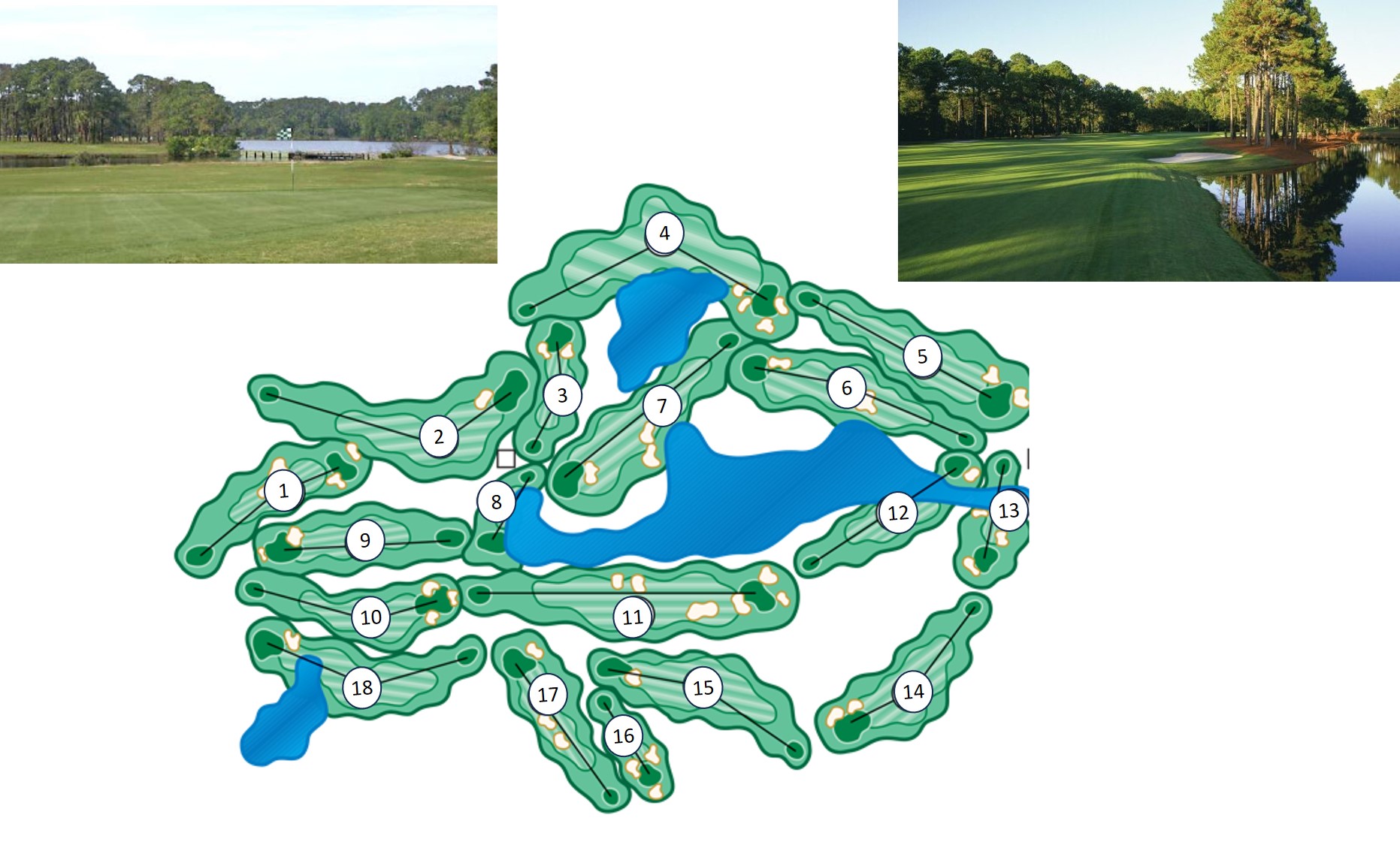
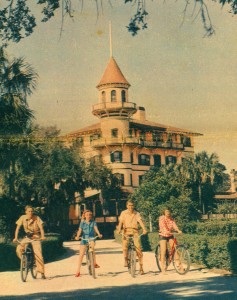
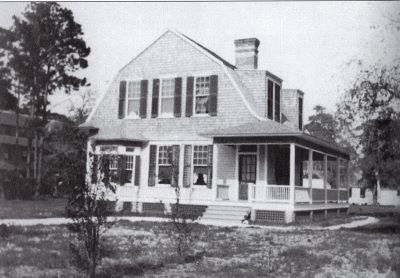
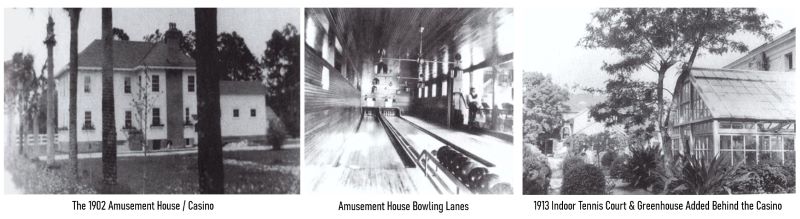
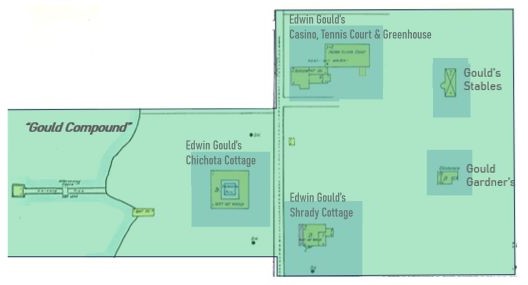
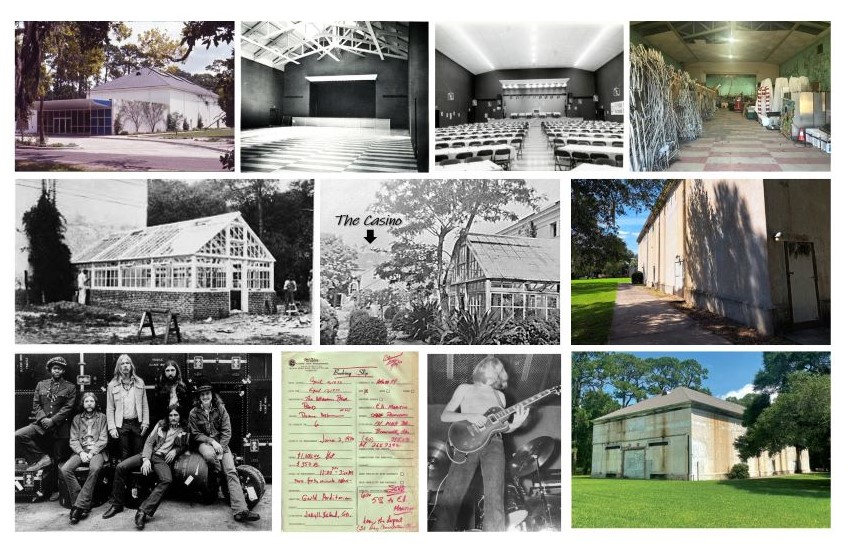
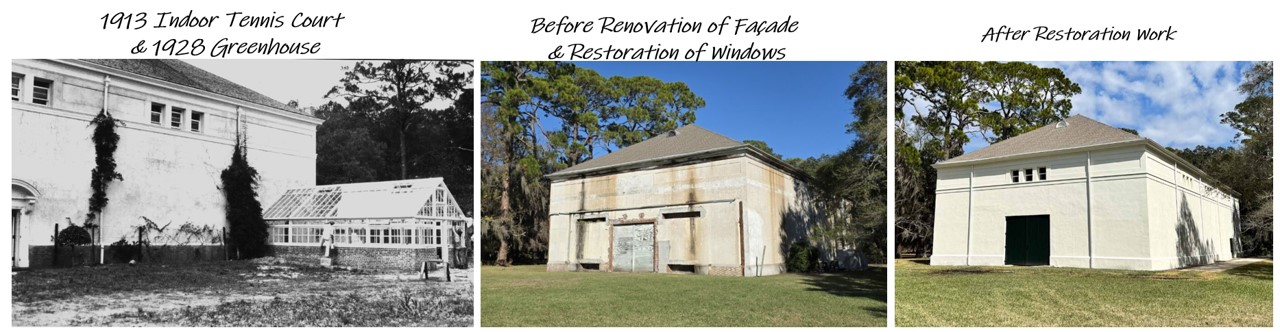
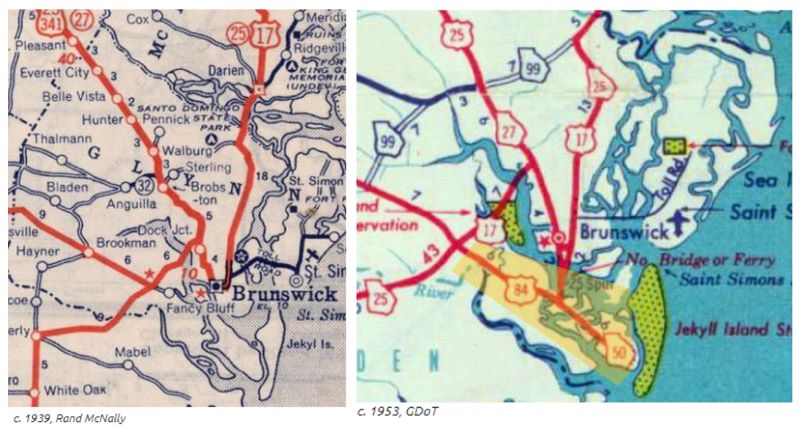
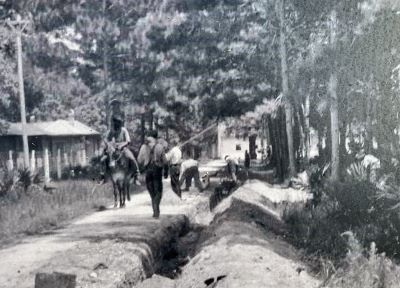
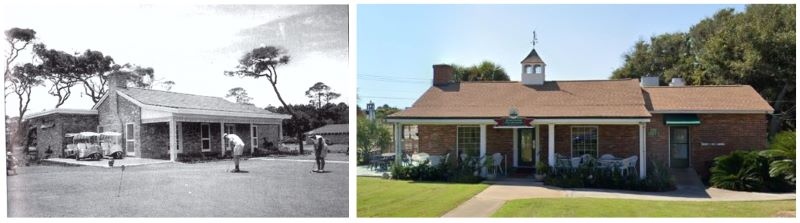
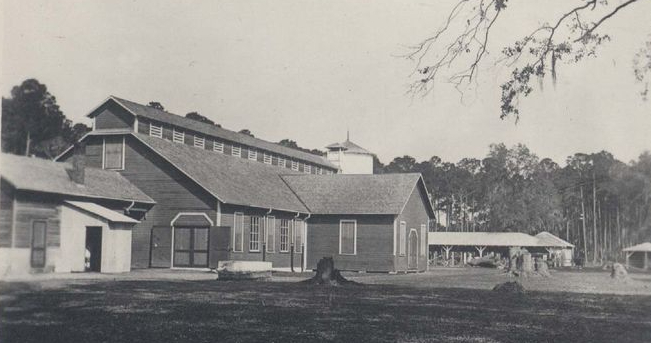
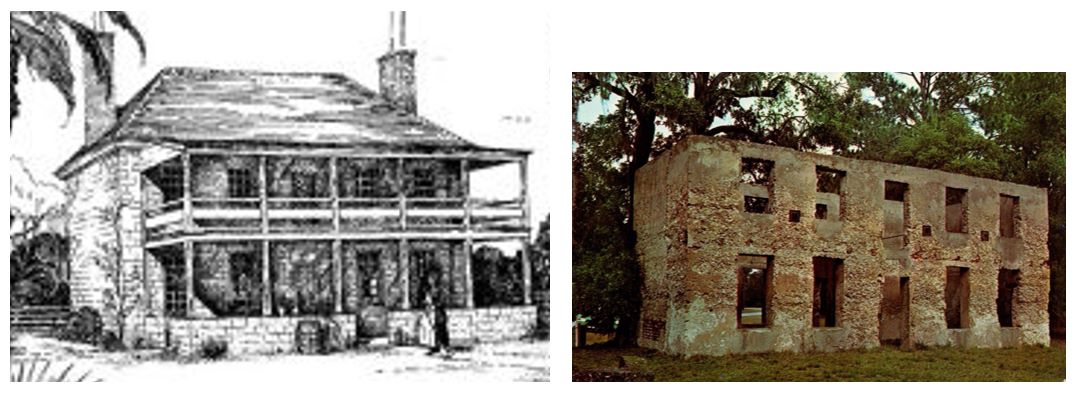
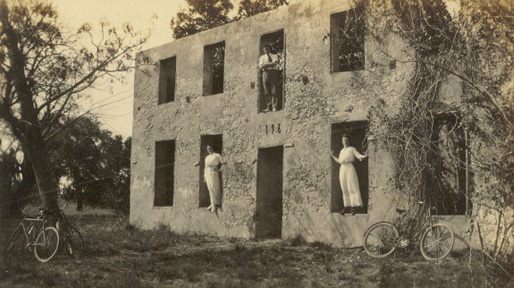
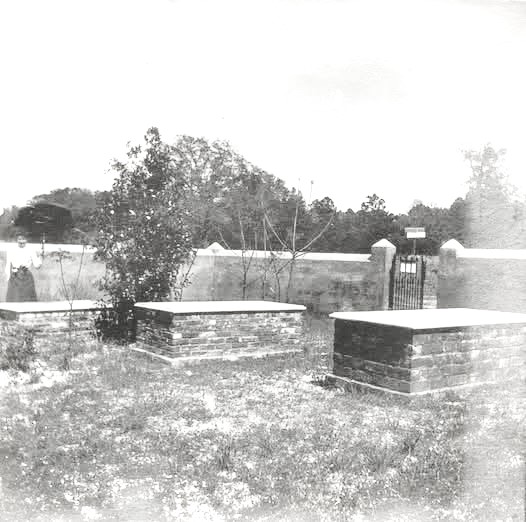
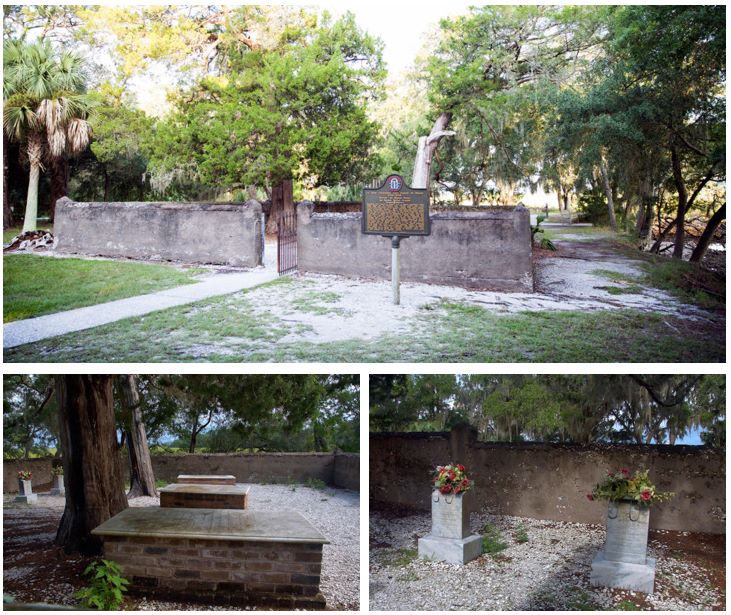
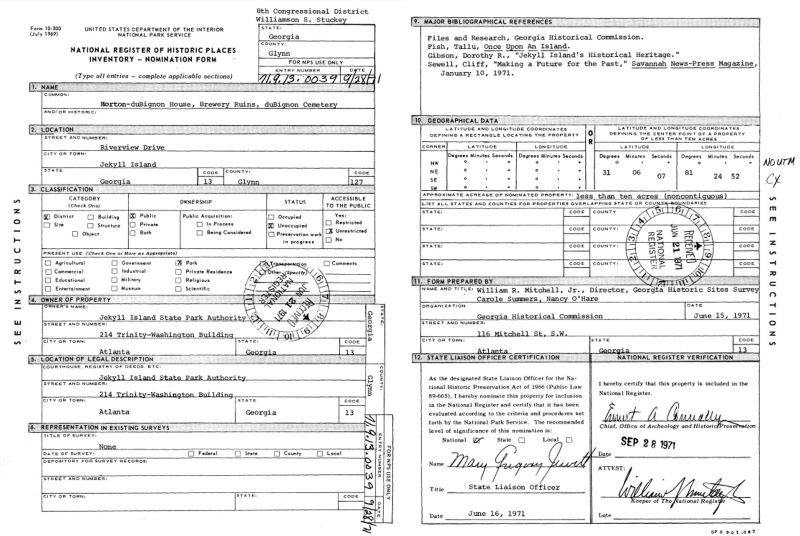
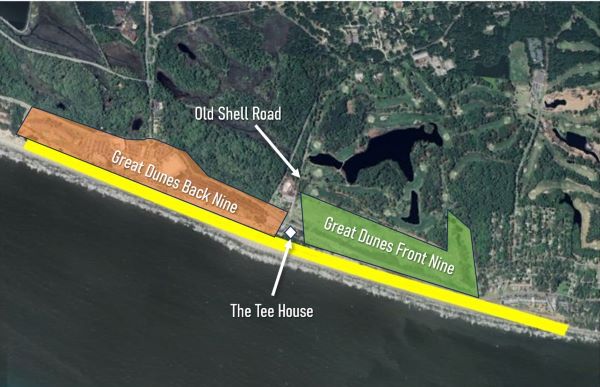
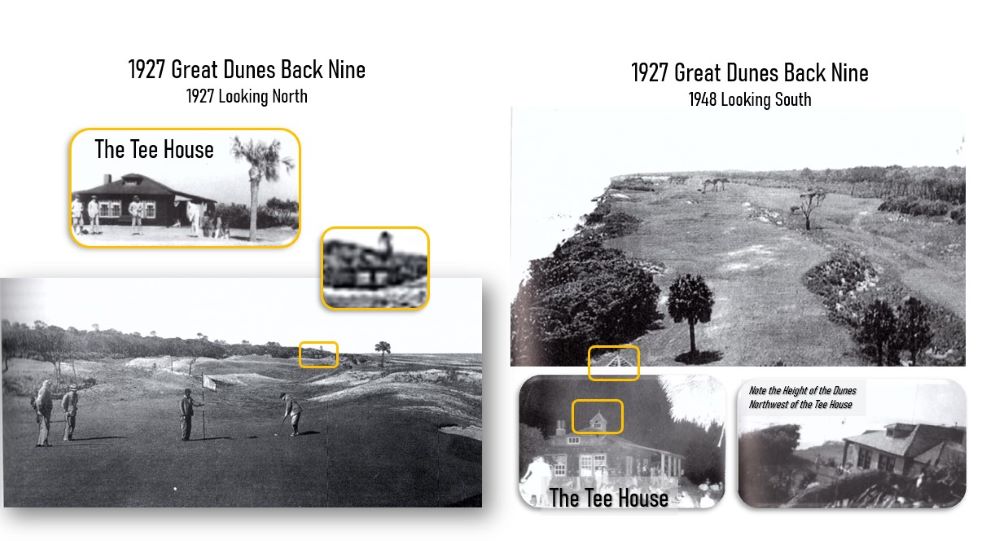
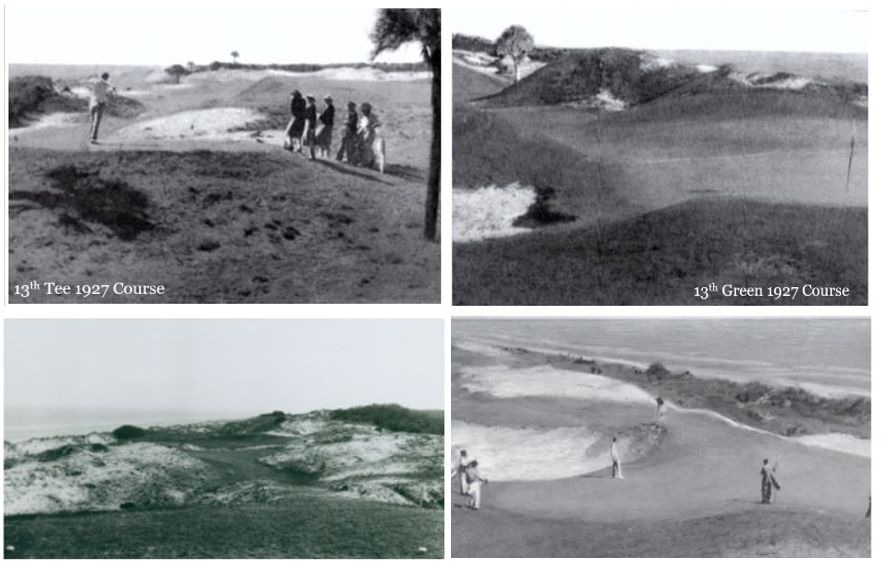
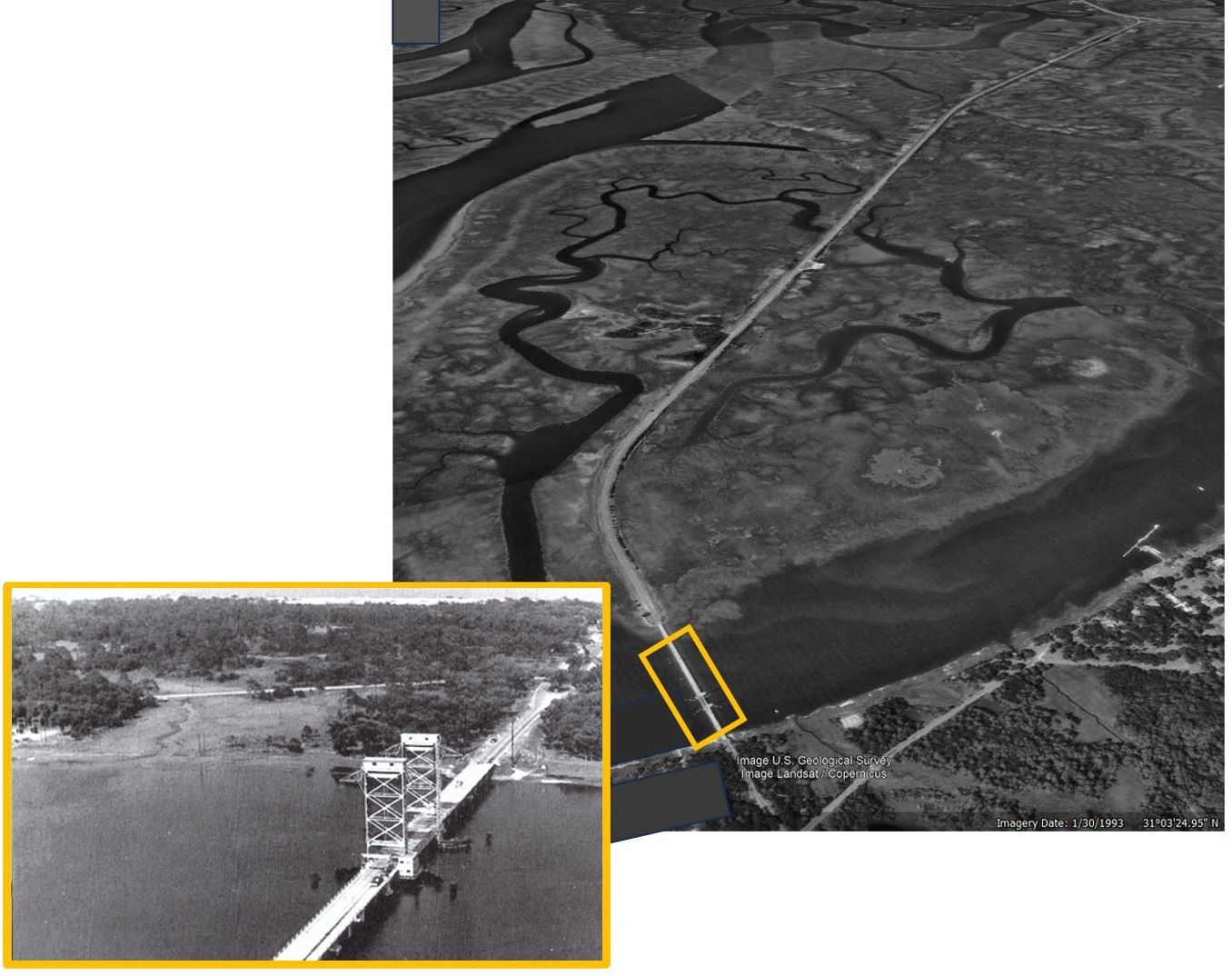
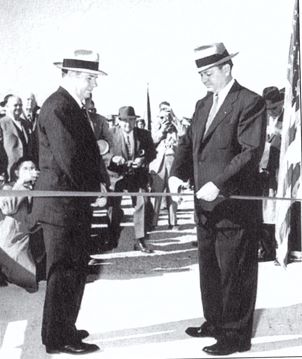
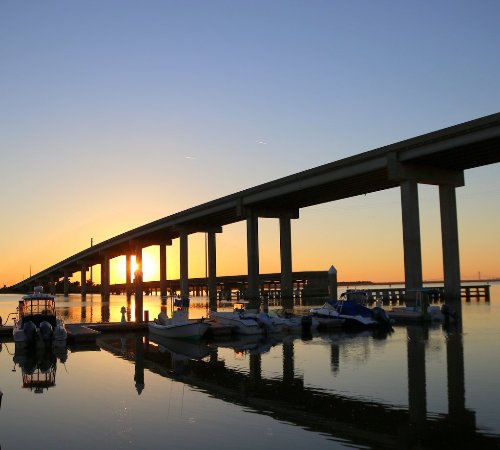
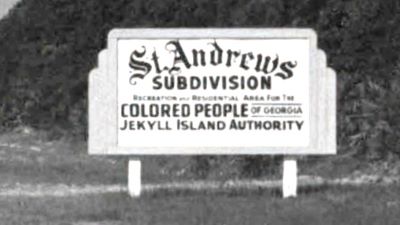
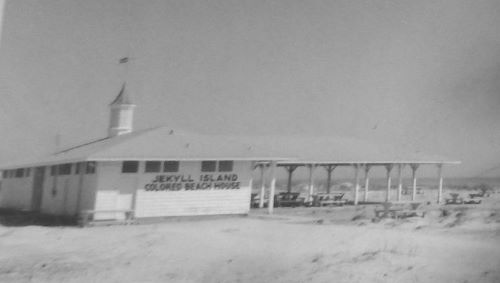
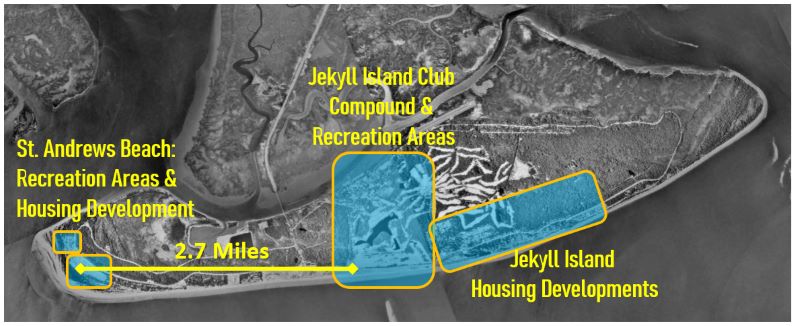
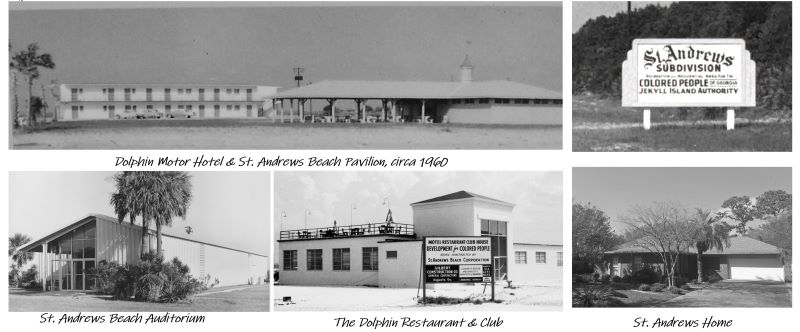
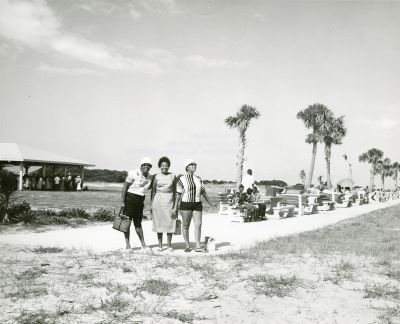
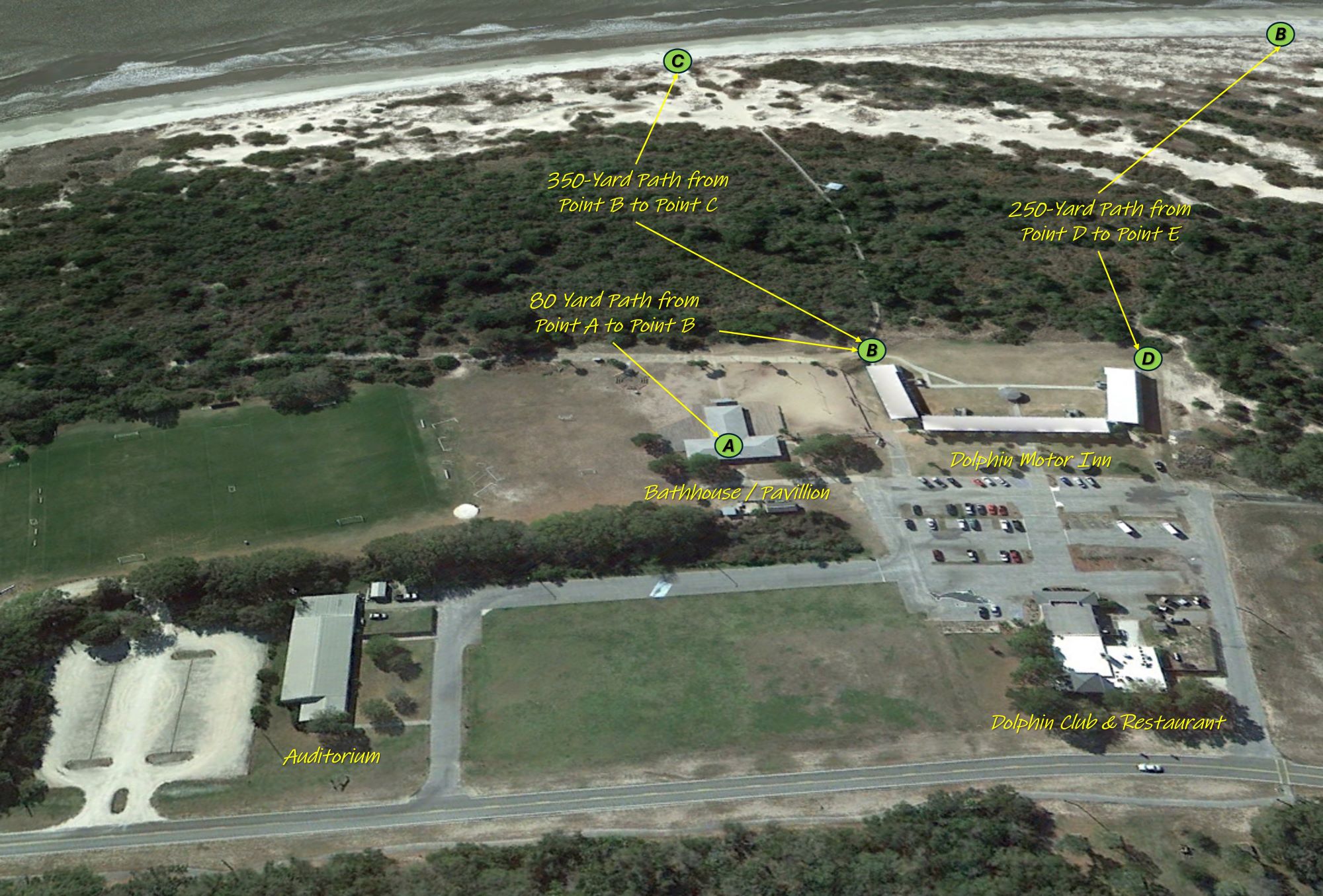
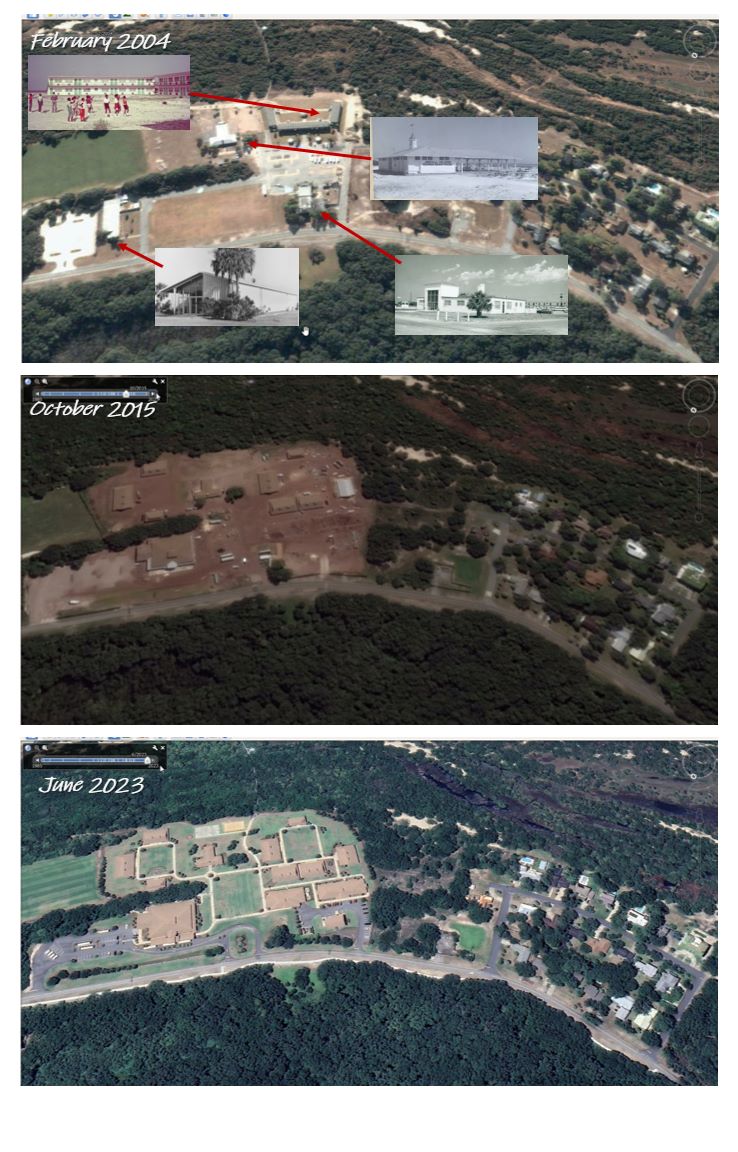
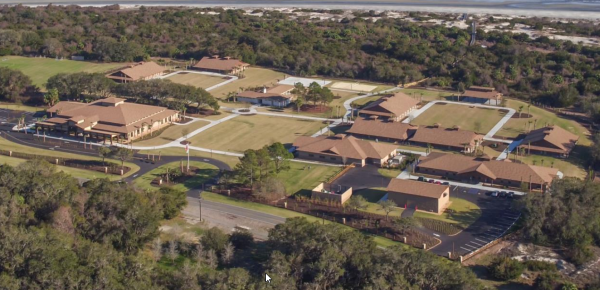
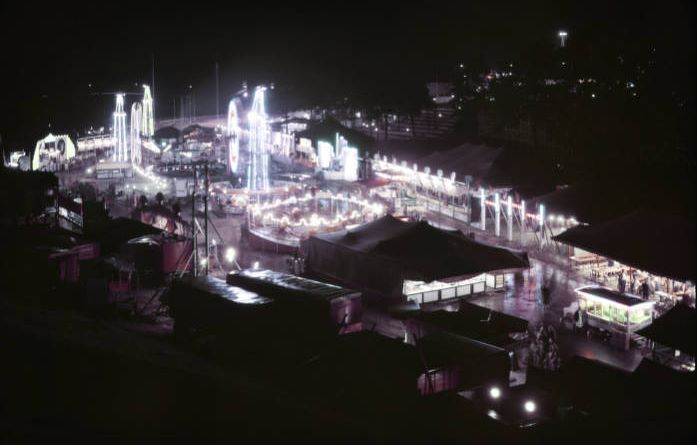
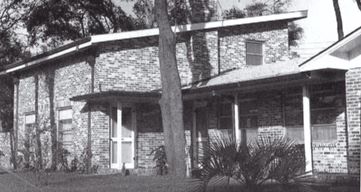
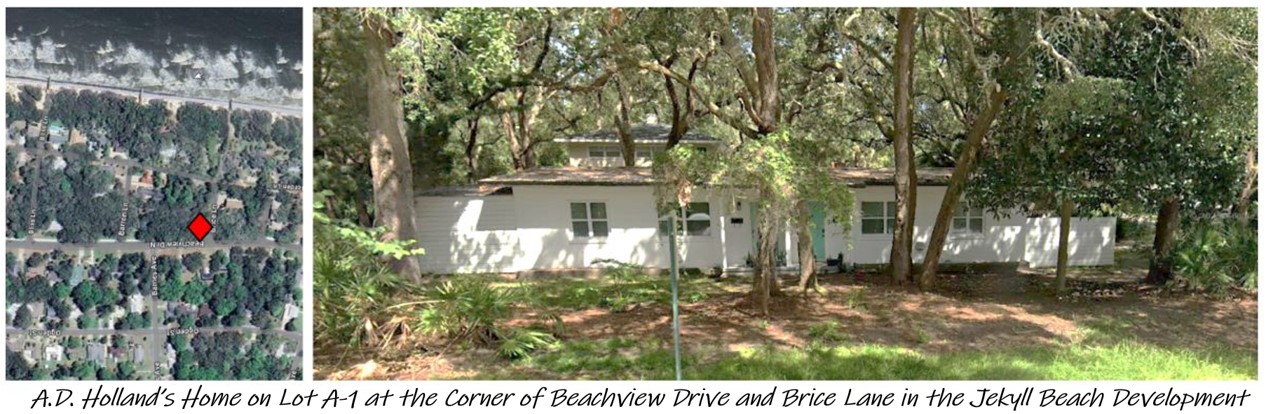
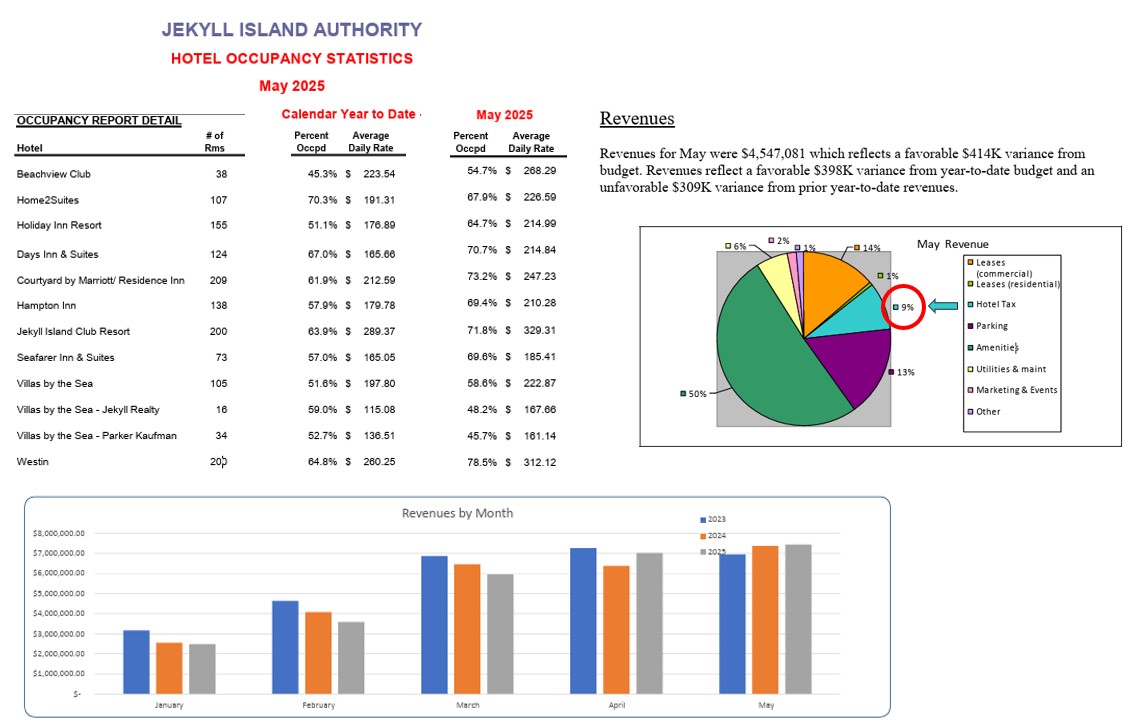
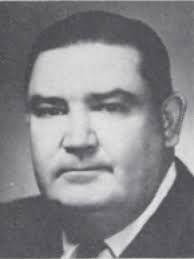
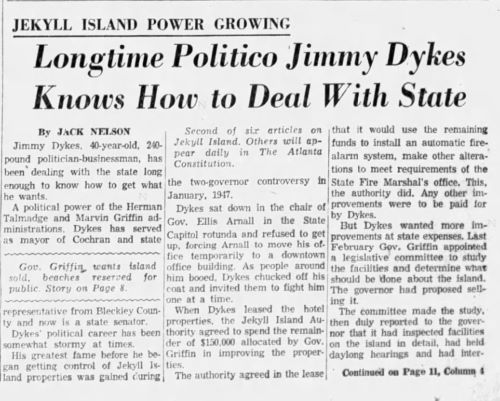


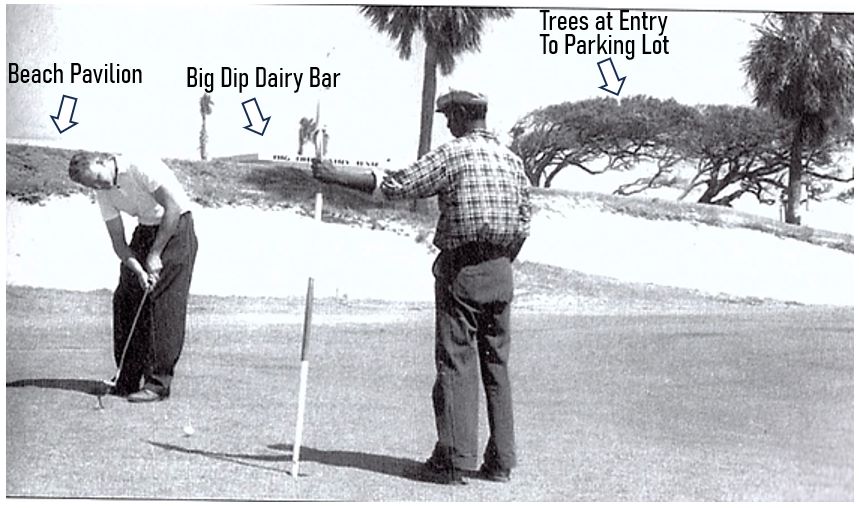
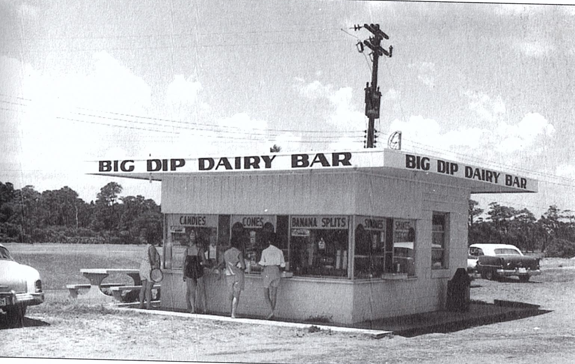
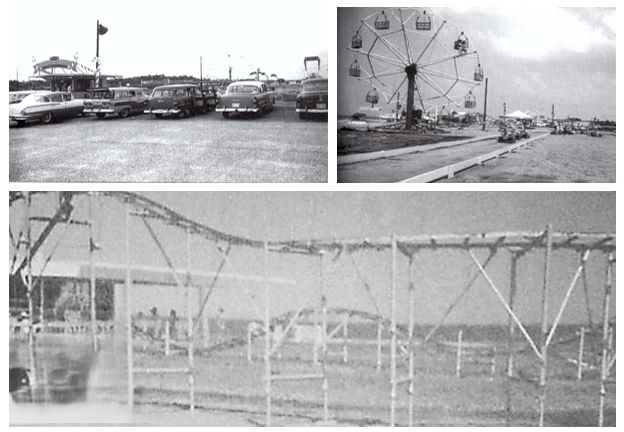
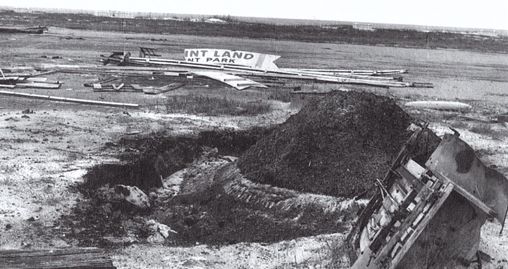
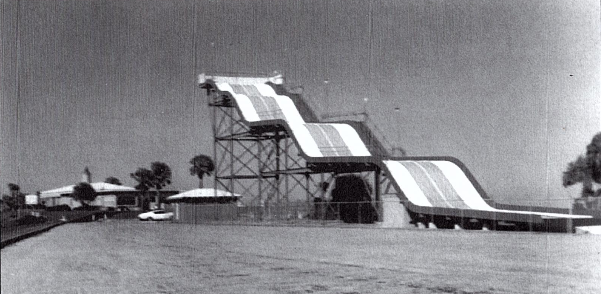
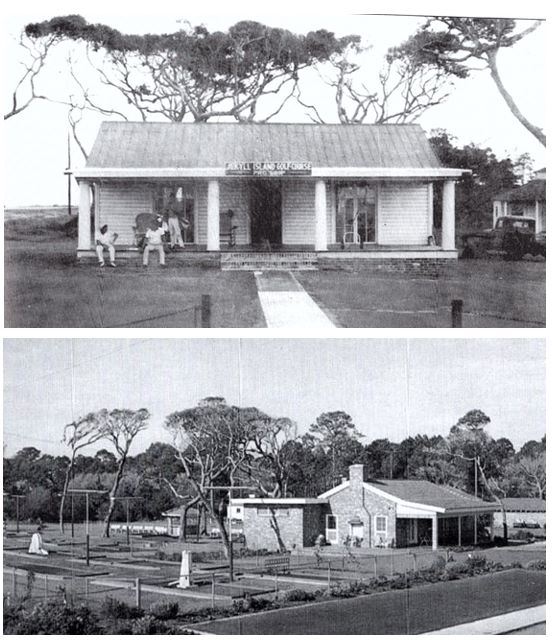
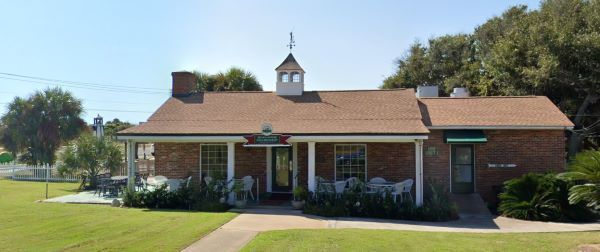

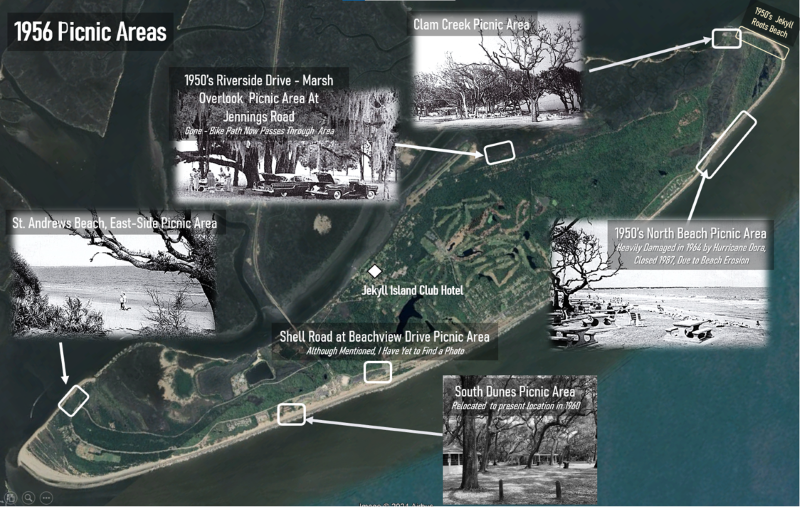
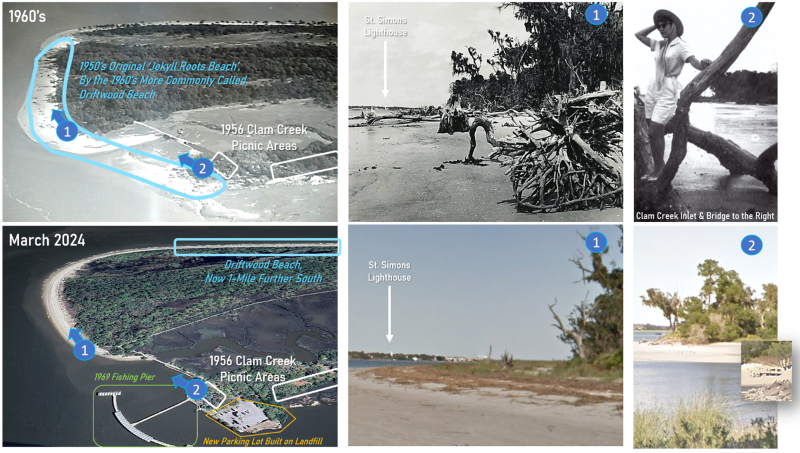
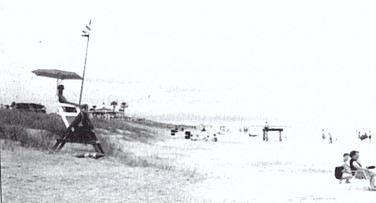
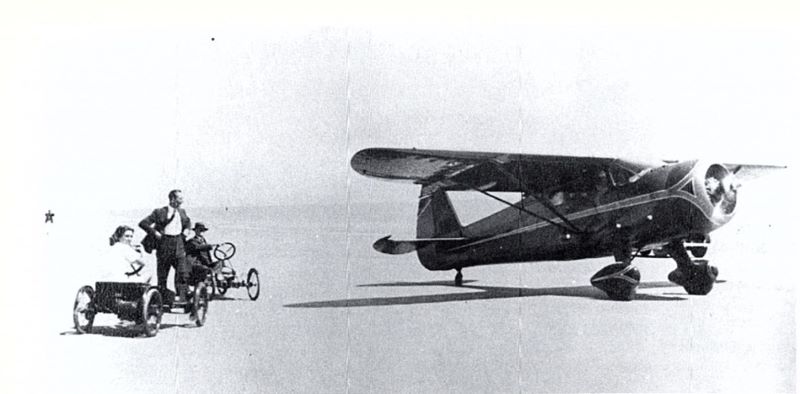
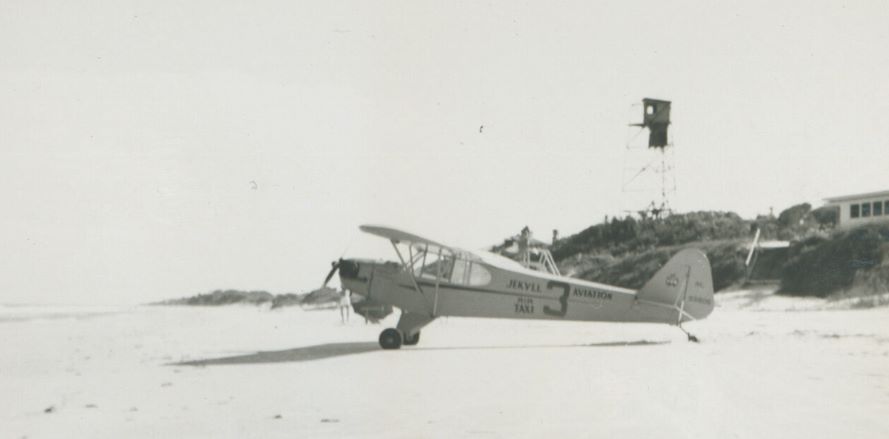
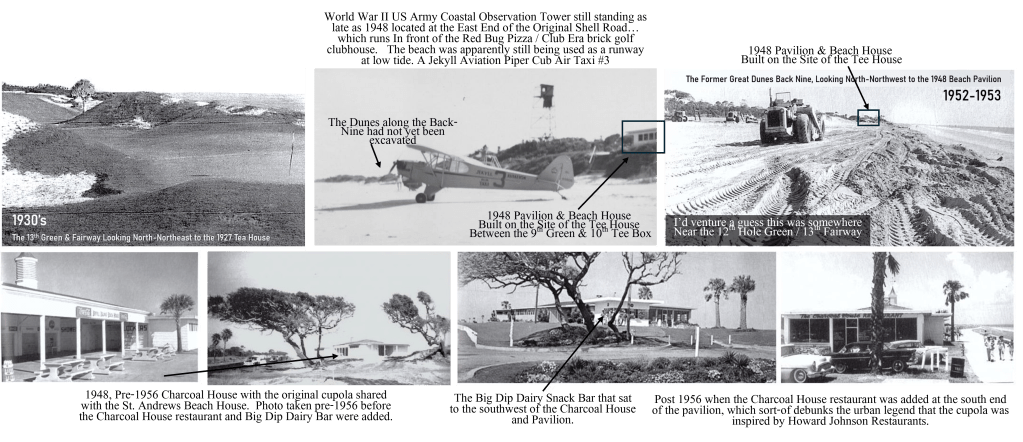
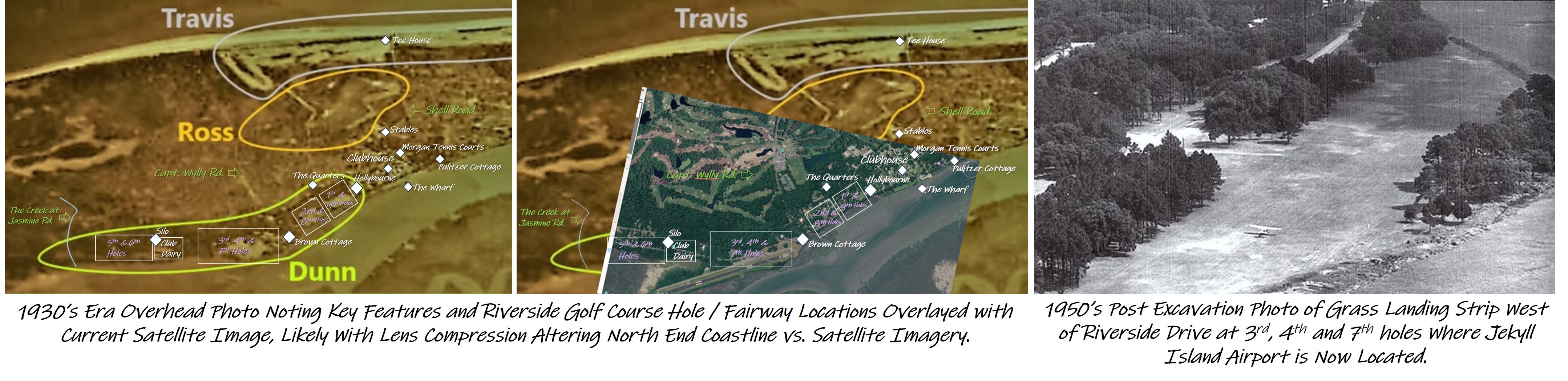
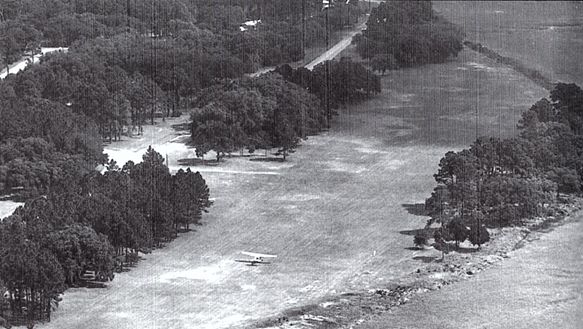
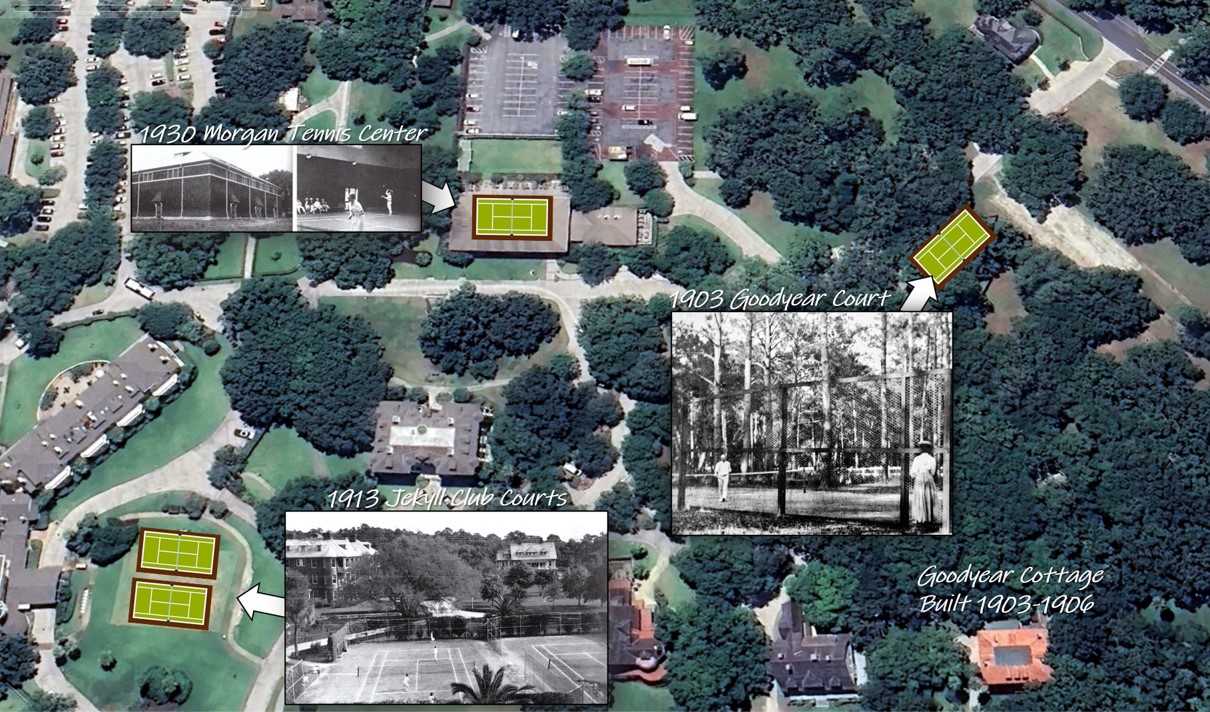
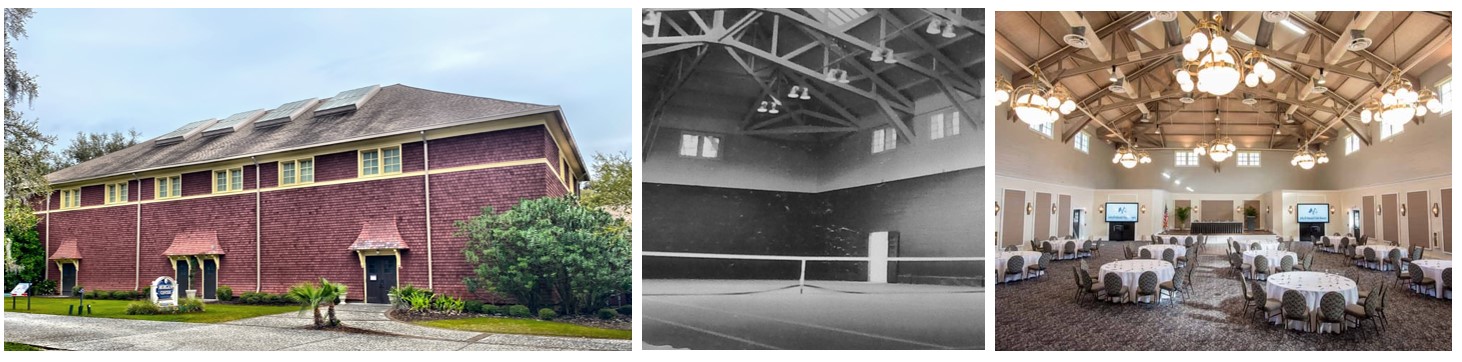
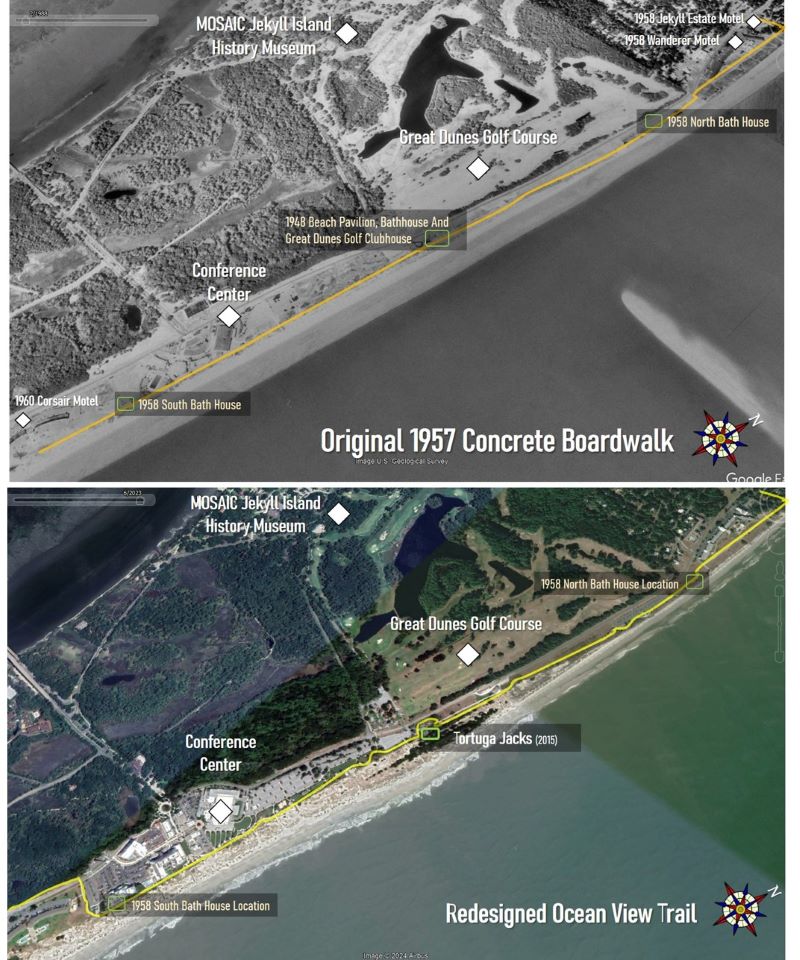
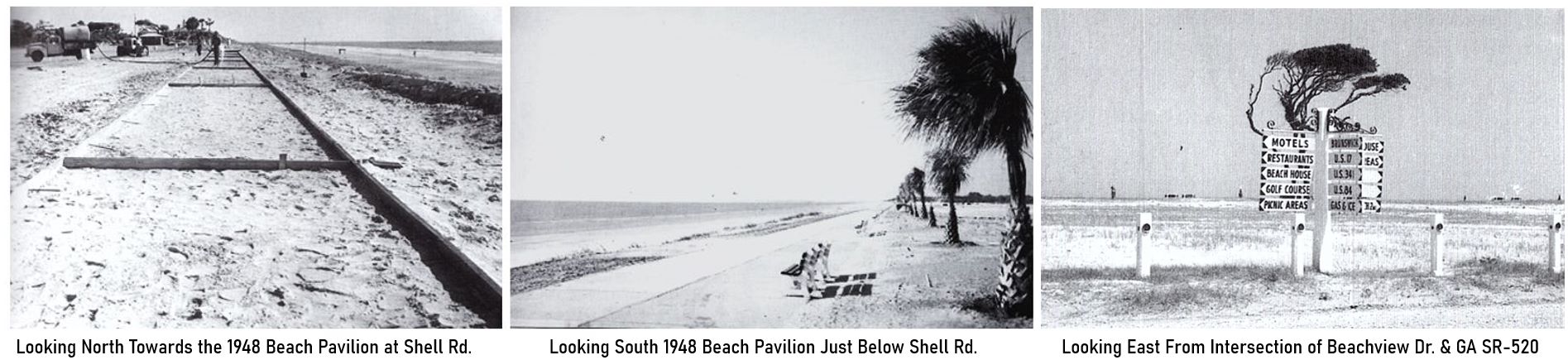
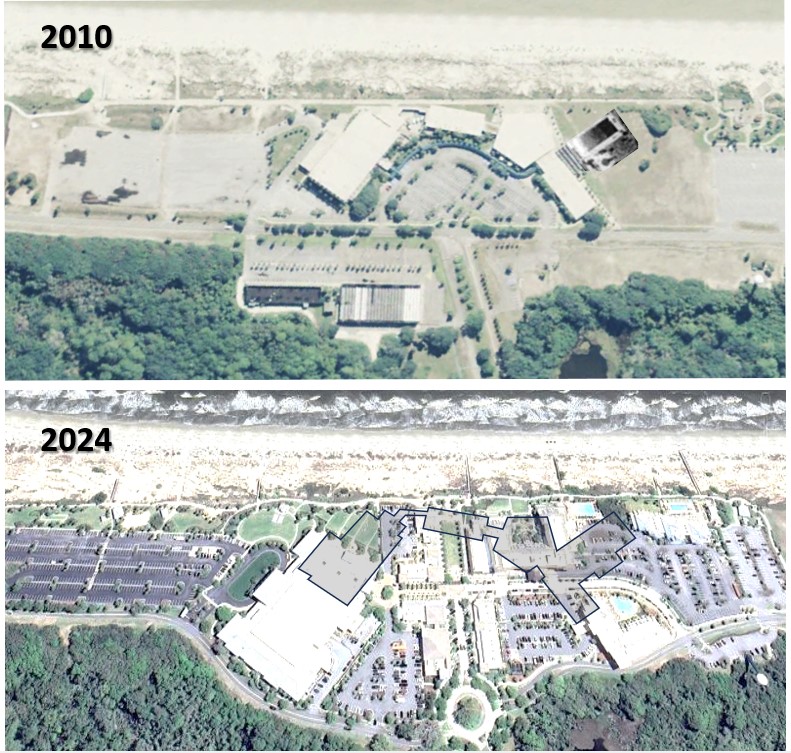
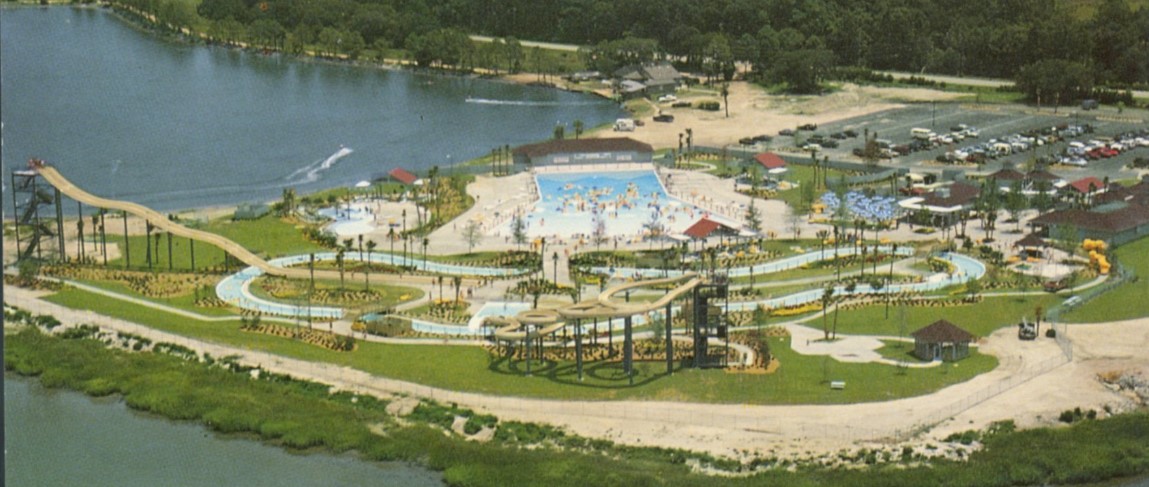
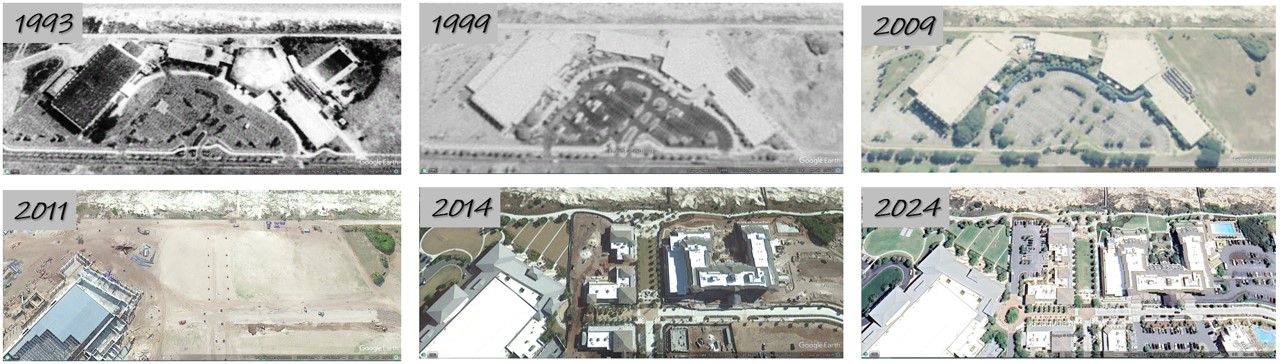


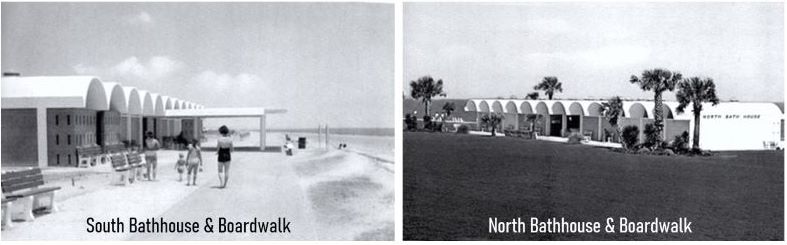
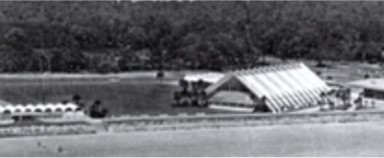

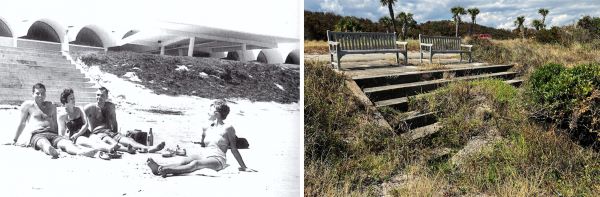
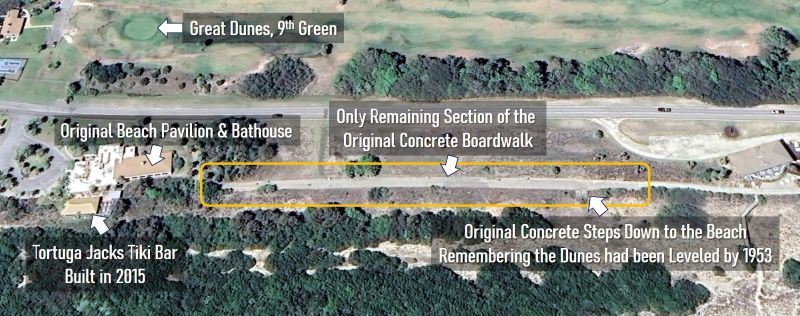
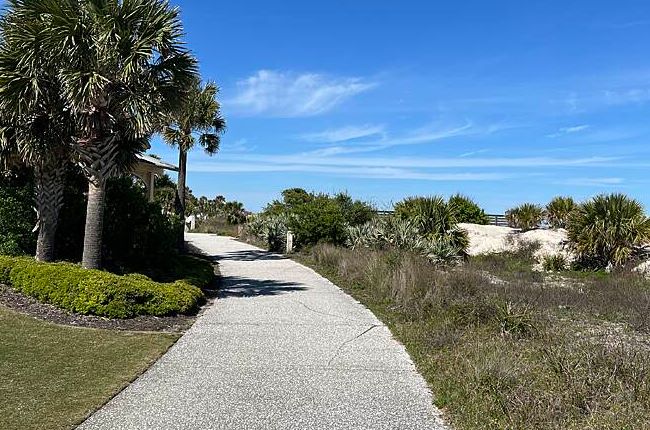
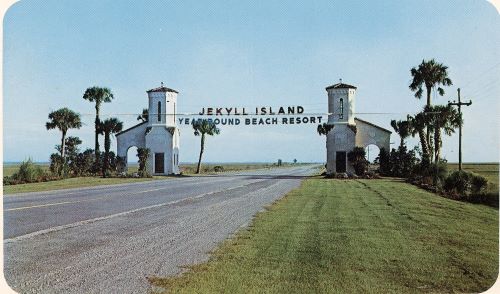
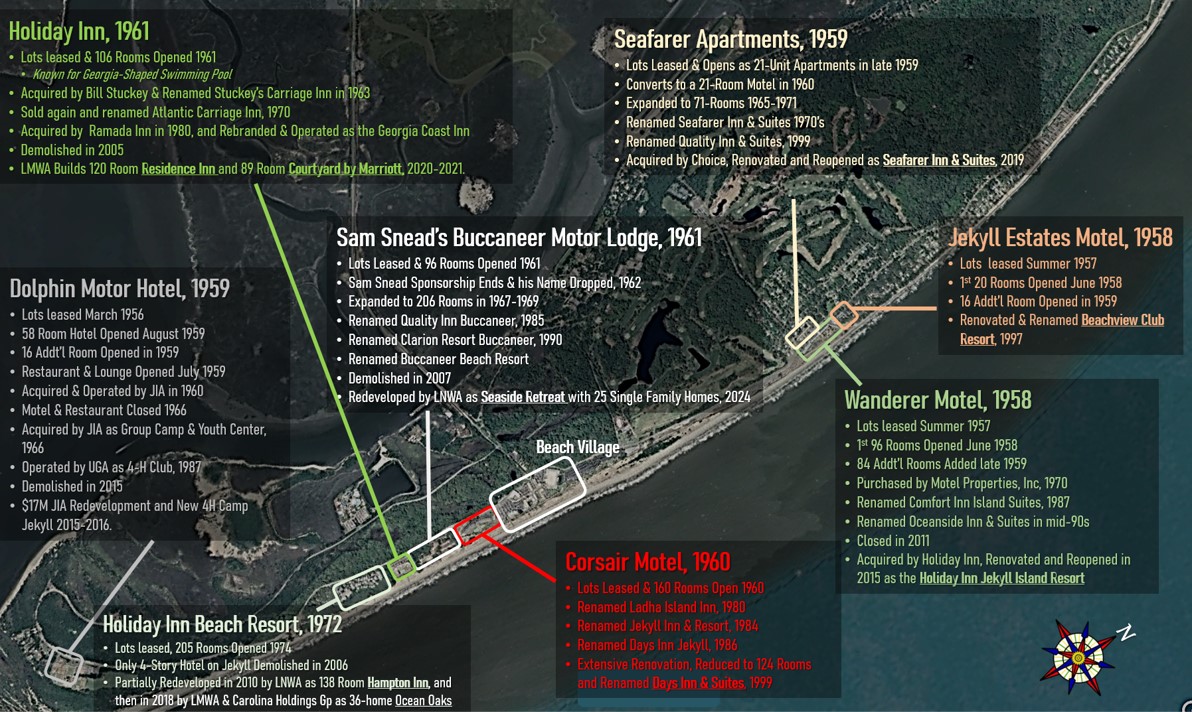
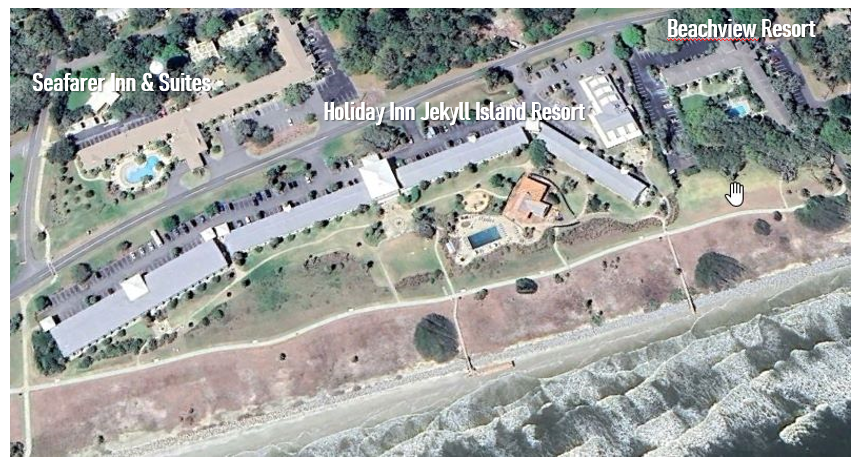
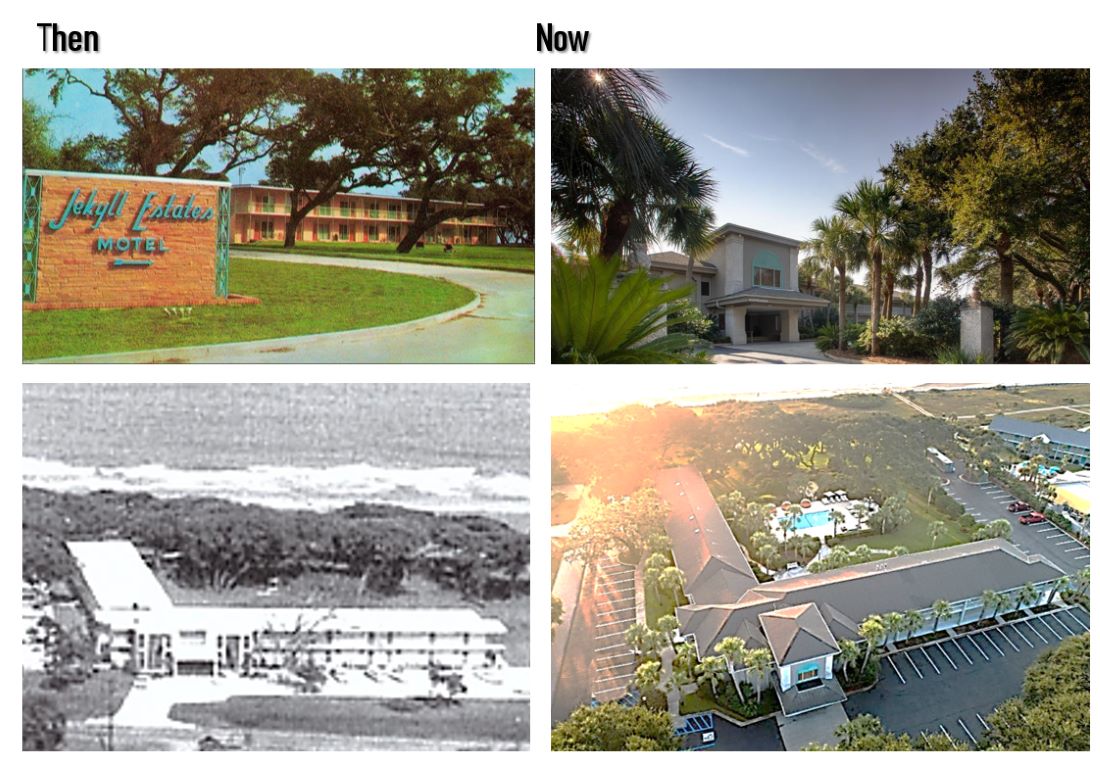
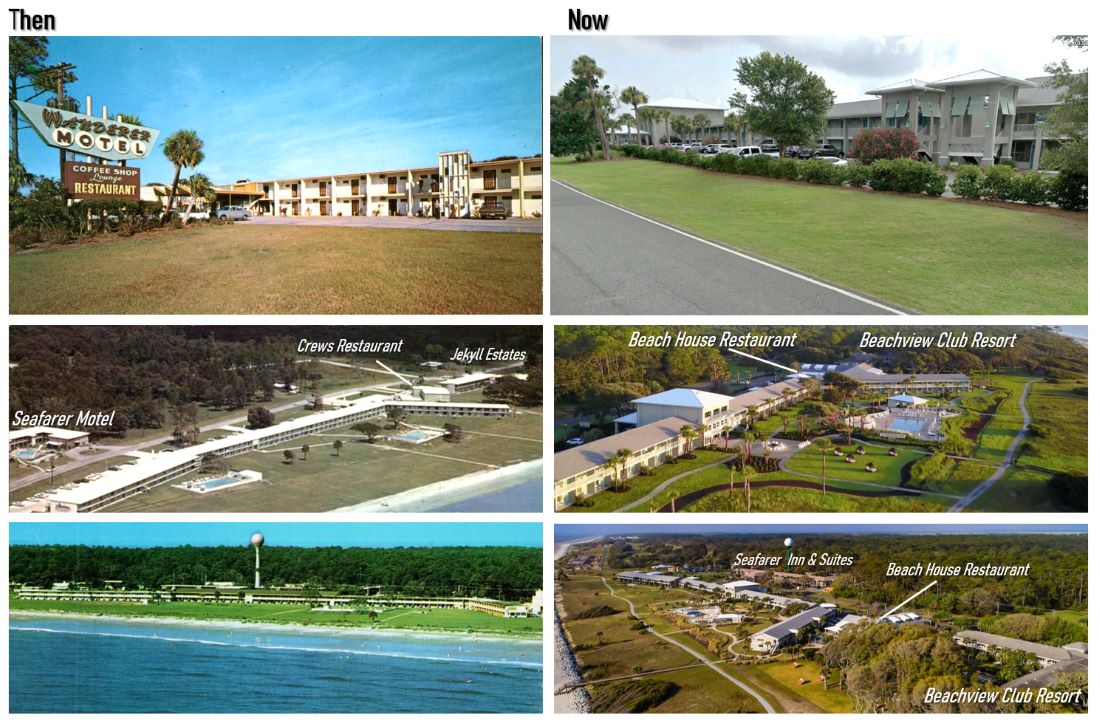
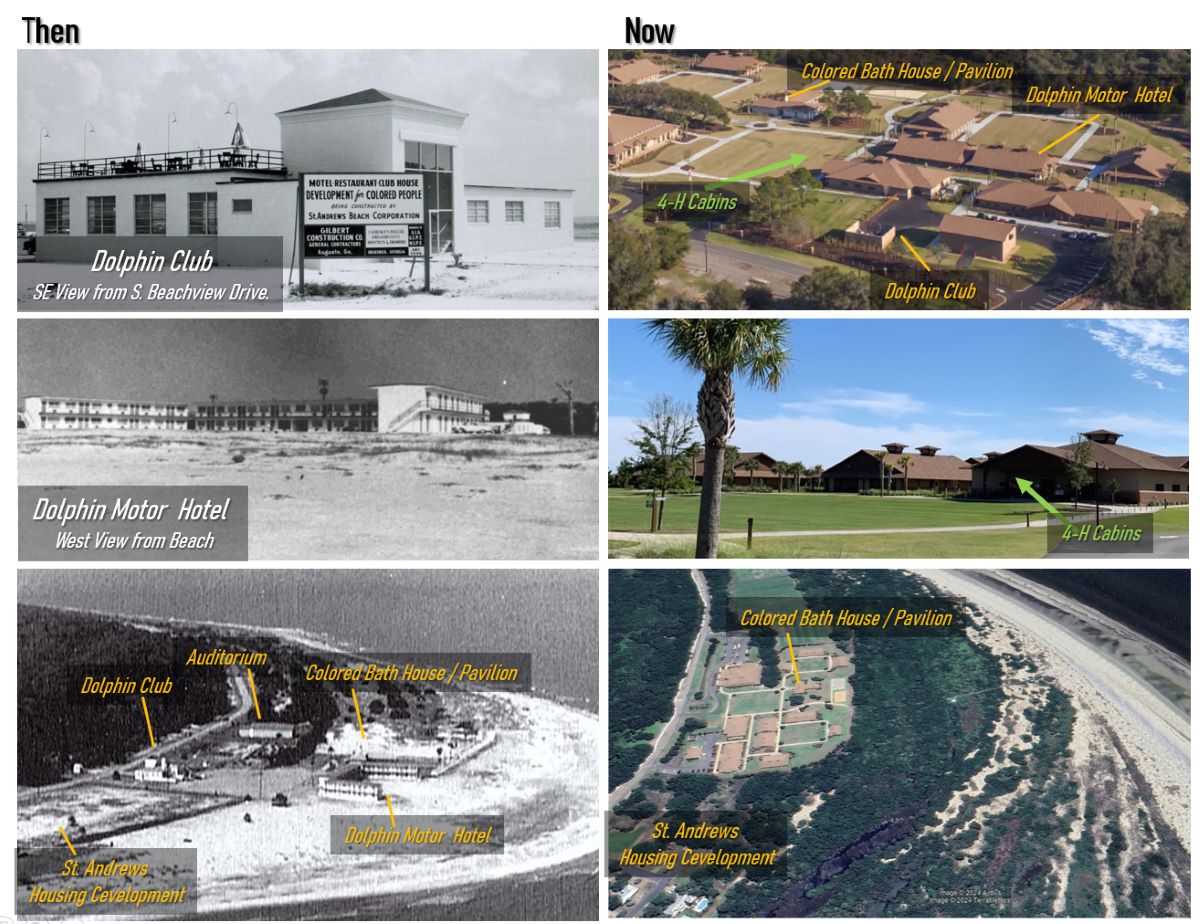
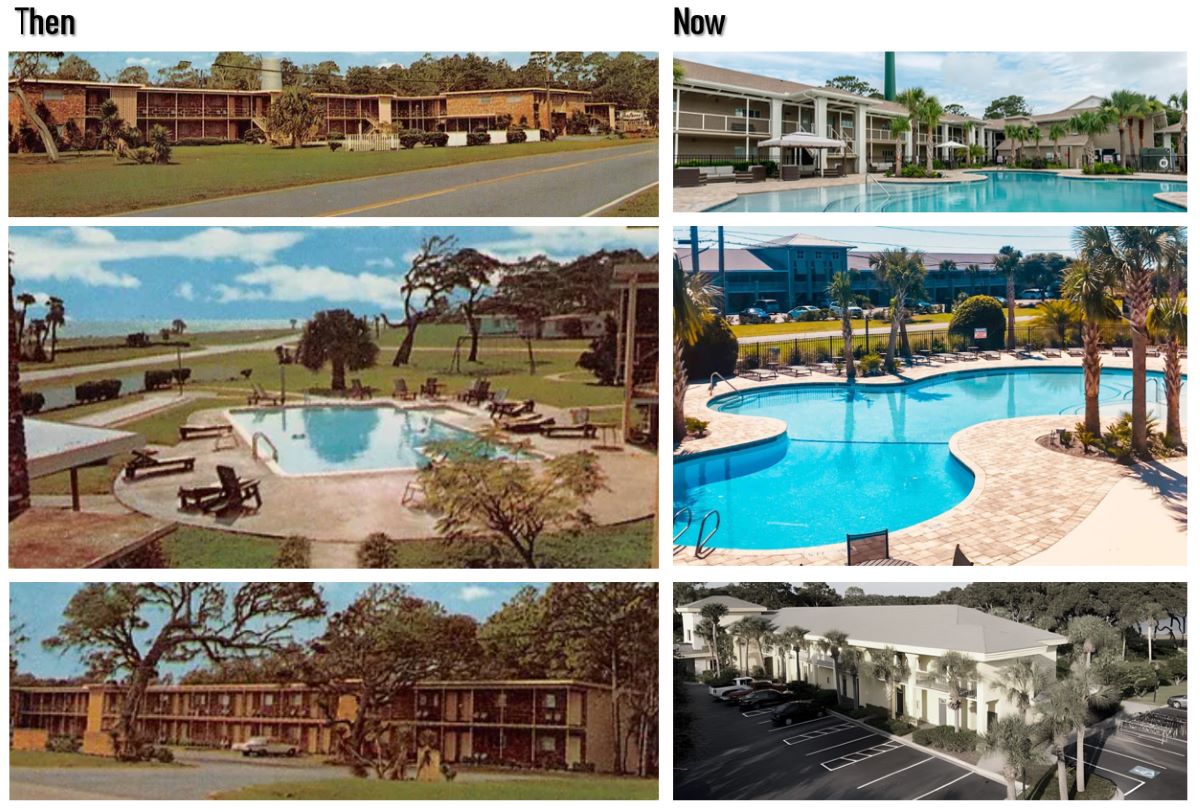
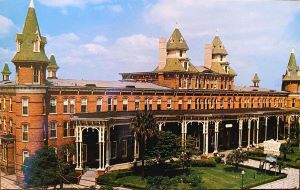
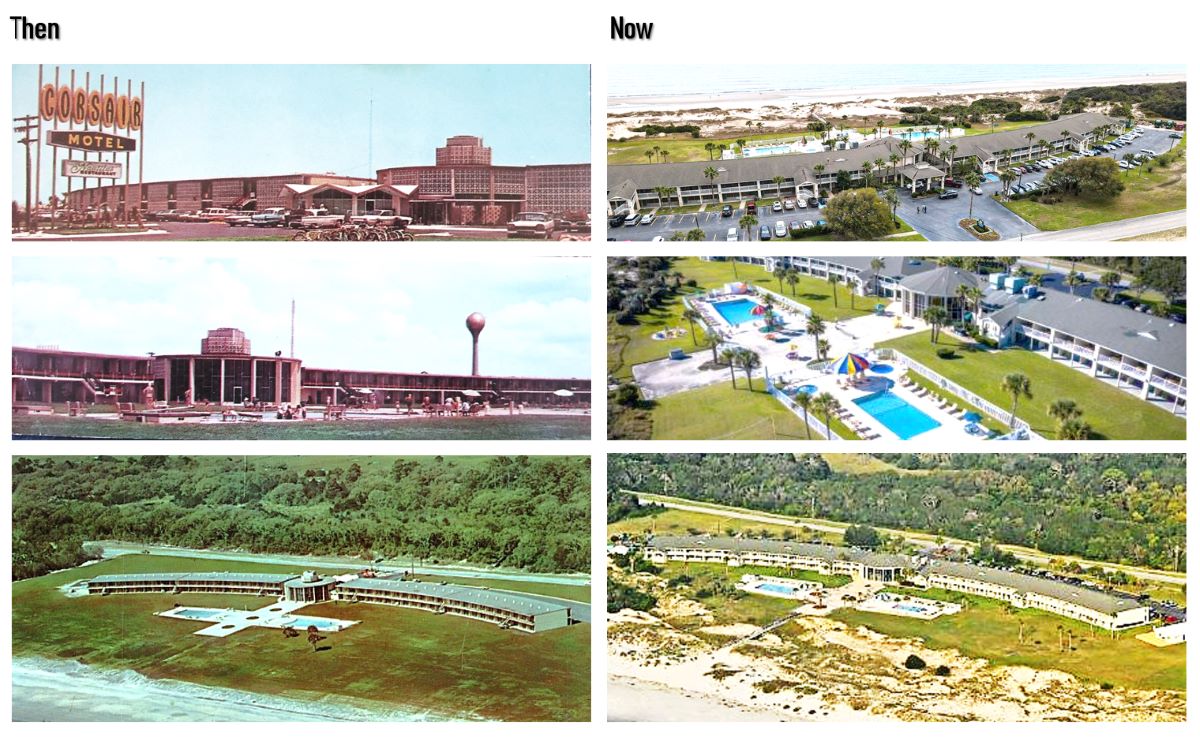
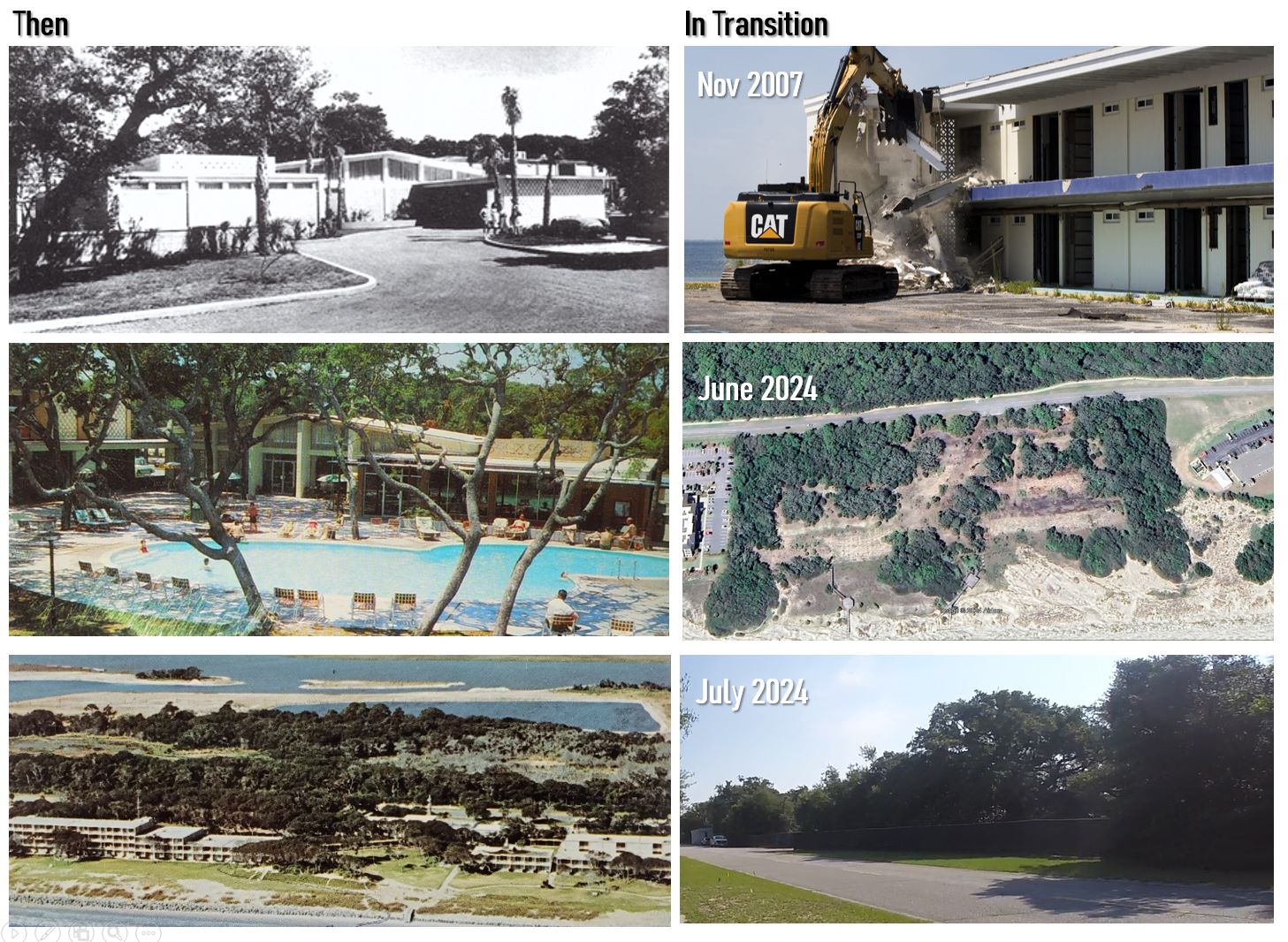
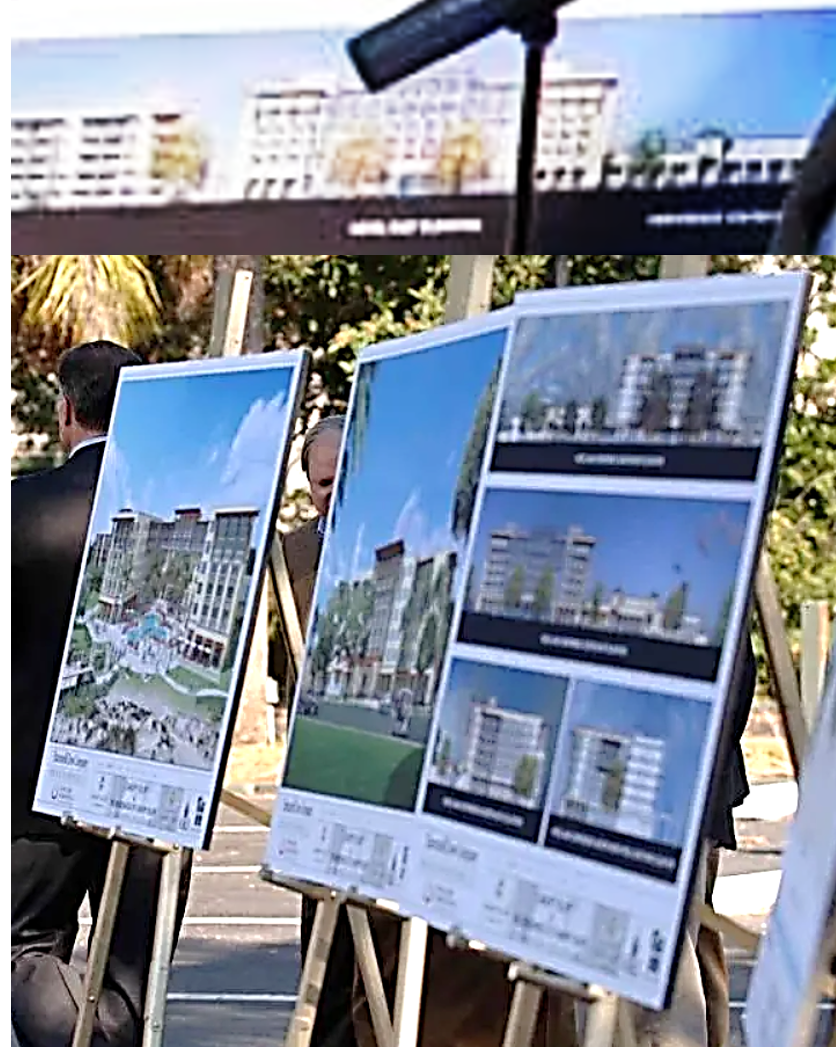
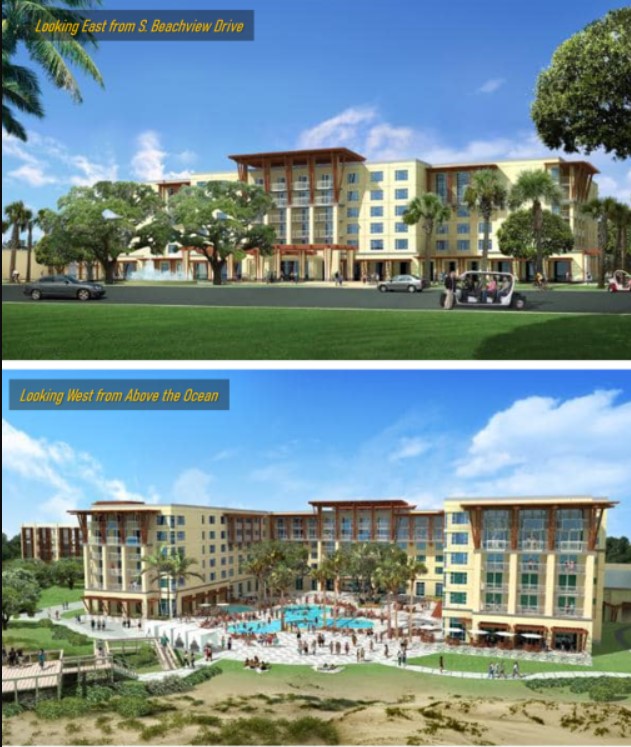
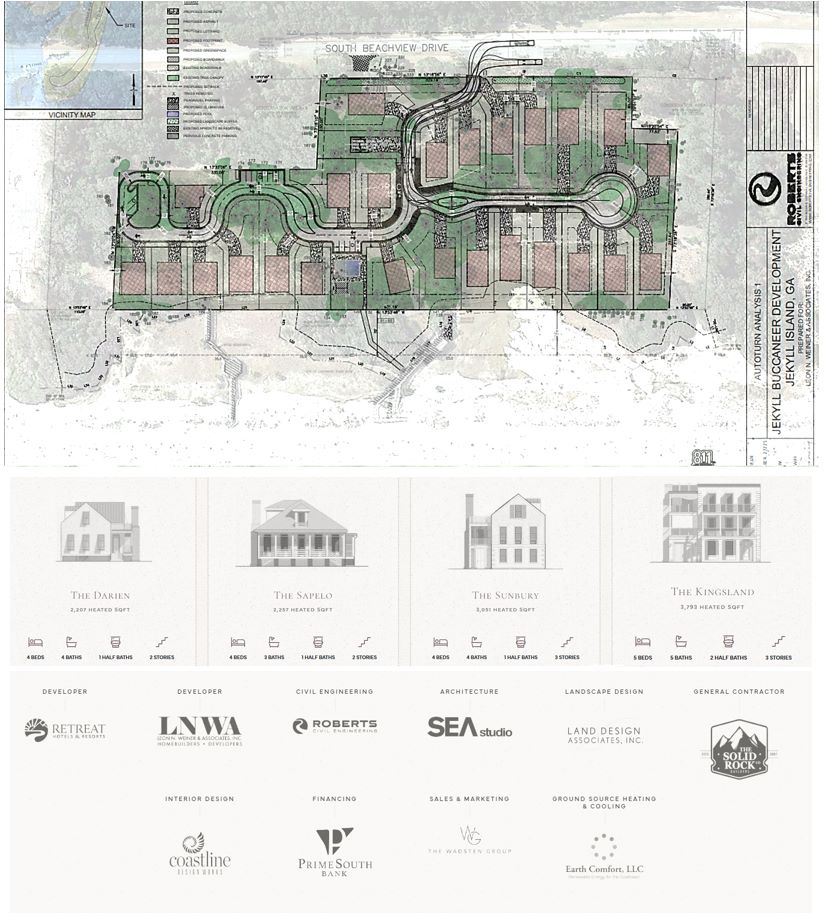
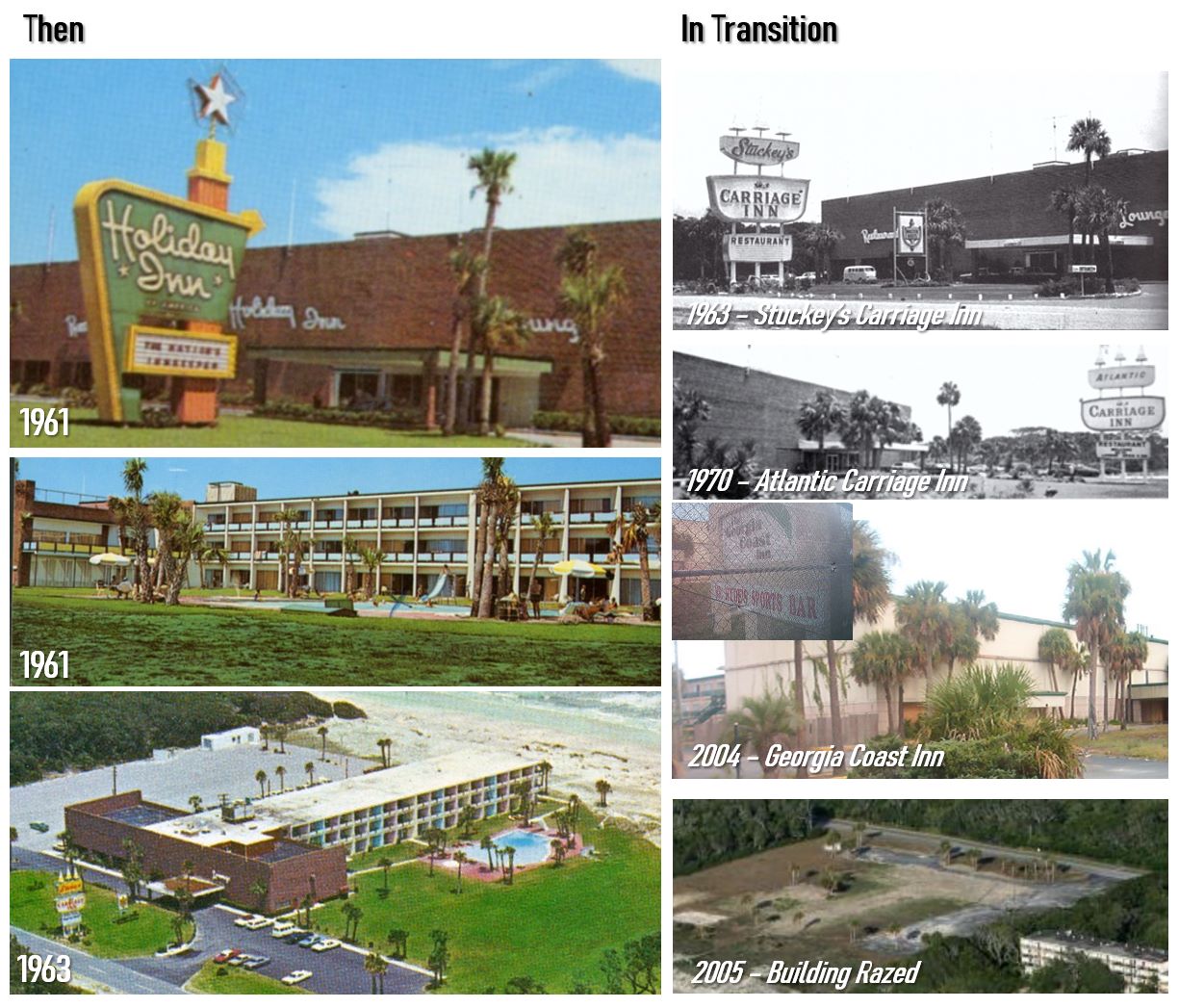
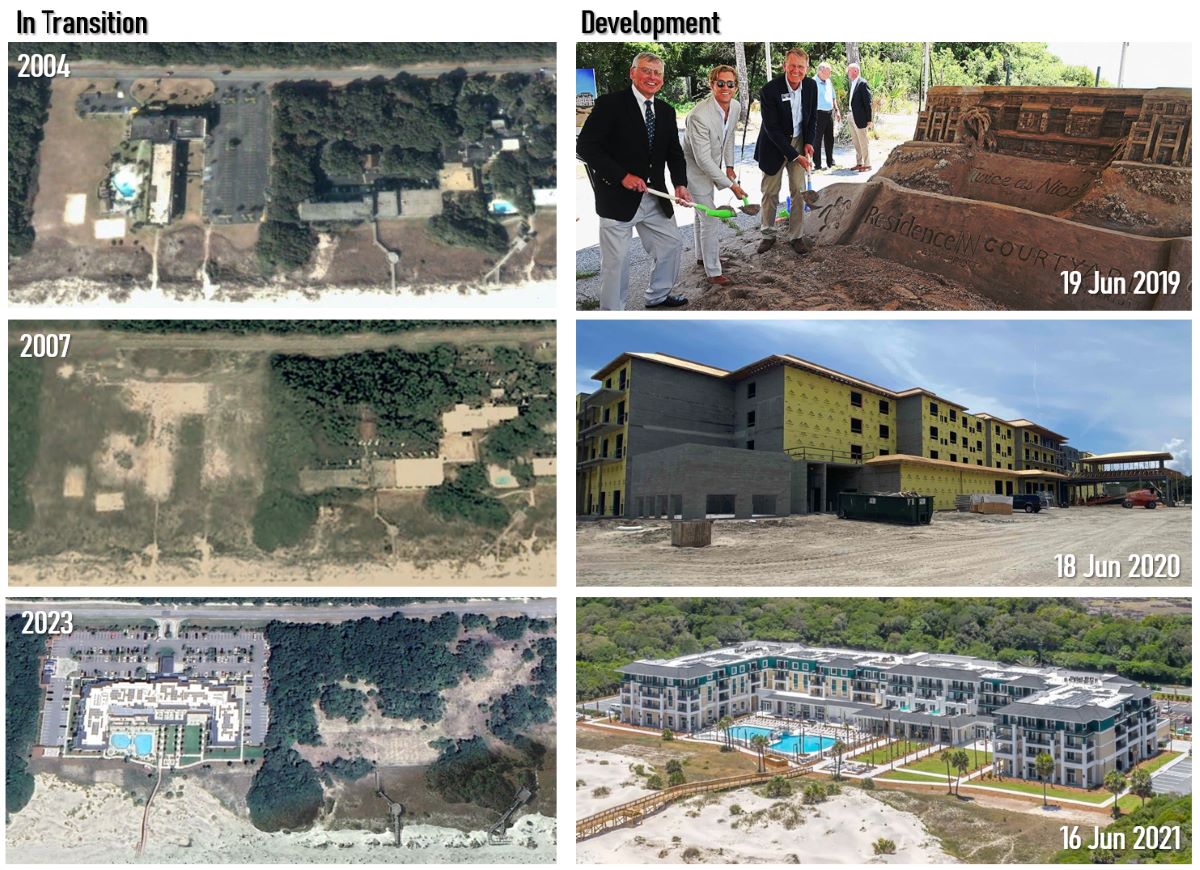
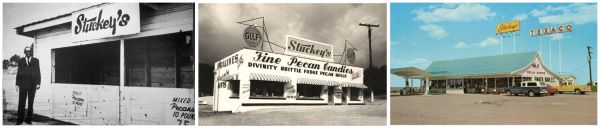
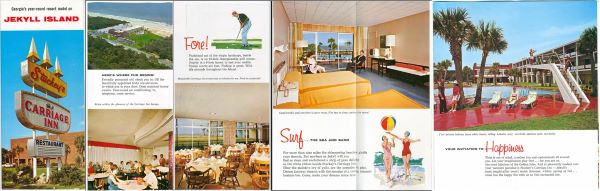
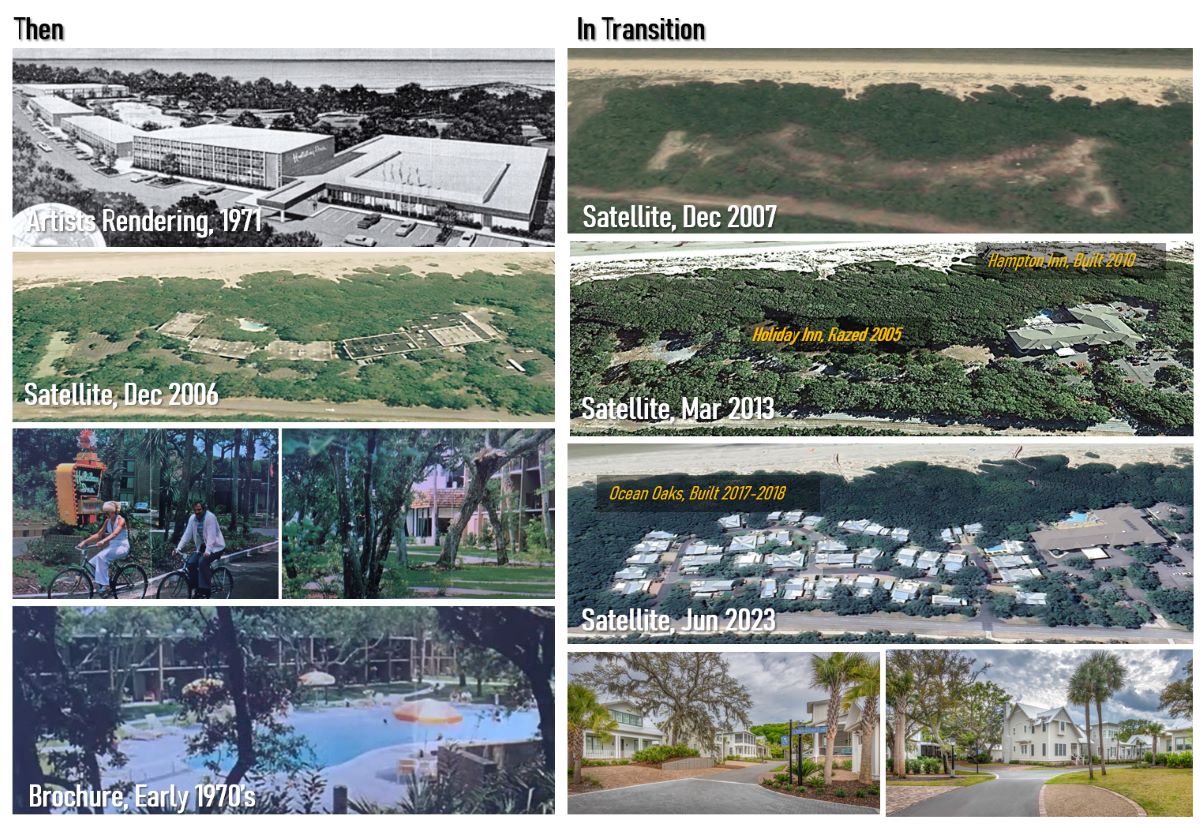
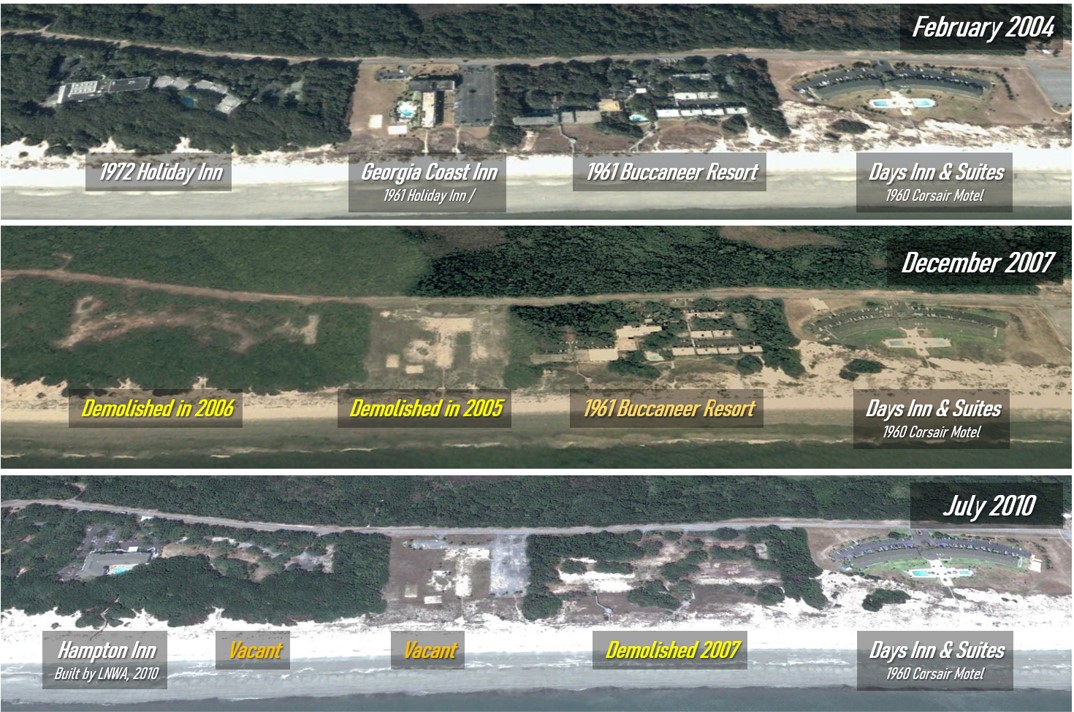
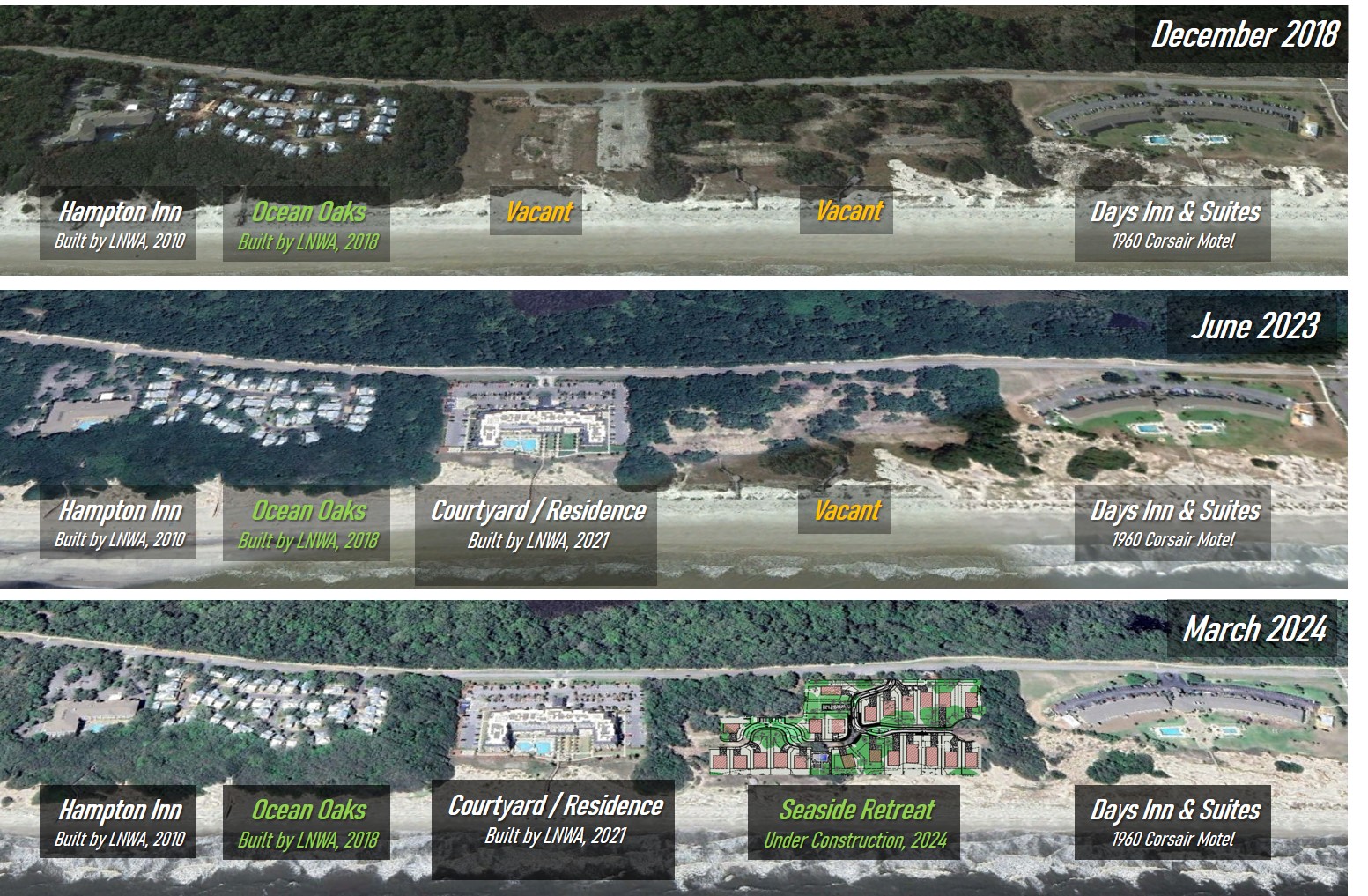
 Our Travels & Jekyll Island History